





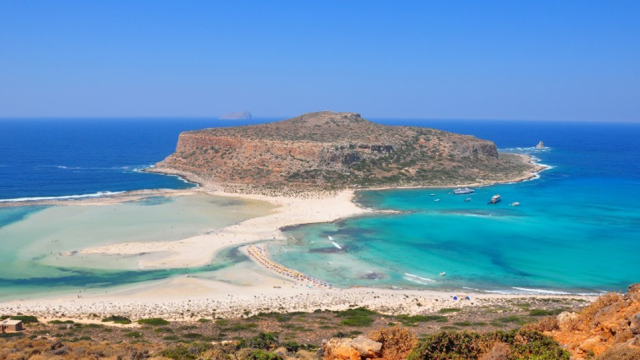
Elafonisi has received another international accolade, with the beach in Chania ranking second worldwide and first in Europe in Tripadvisor’s Travellers’ Choice Awards – Best of the Best Beaches 2026. In 2025, it had ranked first worldwide. Balos also performed exceptionally well this year, ranking third in the world.
According to a joint statement by Kissamos Mayor Giorgos Mylonakis and Kantanos-Selino Mayor Antonios Perrakis, “these distinctions go beyond the administrative boundaries of the Municipalities of Kantanos-Selino and Kissamos. Elafonisi and Balos are two destinations of global recognition that make a decisive contribution to the tourism profile of Crete and Greece. This success, however, also creates a very great responsibility: to protect what people from around the world come to experience.”
As they point out, in recent years the Municipalities of Kantanos-Selino and Kissamos have consciously chosen a difficult and demanding path. Prioritizing the protection of the natural environment and relying on scientific evidence, they have taken decisions that significantly restricted the exploitation of the area. They chose to bear the political, social and economic cost, putting the long-term protection of Elafonisi first.
These decisions concern beach umbrellas, vehicle access, round-the-clock, year-round protection of the beach, and the installation of fencing to protect the sand dunes and juniper trees. At the same time, the two municipalities have fought important institutional and legal battles. They defended the protection framework and the ban on vehicle access before the Council of State, defended the forest status of the area against objections by a private company, and, during the consultation on the Special Environmental Study, demanded and succeeded in doubling the area designated as a Nature Protection Zone.
There is, however, one point that must be fully understood, they stress, and that concerns responsibility for managing a protected area such as Elafonisi, which does not belong solely to the two municipalities. Under Law 4685/2020, the Greek state established the Natural Environment and Climate Change Agency (NECCA) as the central body responsible for coordinating the governance and management of the country’s natural environment and protected areas.
For Elafonisi, NECCA commissioned a special project for the “Preparation of management plans to regulate recreational activities in areas of Western Crete.” The project specifically concerns Elafonisi, Falassarna and Balos–Gramvousa and addresses precisely the major question at hand today: how, and to what extent, recreational activities can be developed in these exceptionally sensitive ecosystems.
According to the mayors, although the Municipalities of Kantanos-Selino and Kissamos officially requested on May 26 that they receive all of the project’s deliverables, they have still received no response from NECCA.
“At the same time, the Visitor Carrying Capacity Study remains pending, which NECCA, as the competent management authority, is obliged to carry out. The study is crucial for scientifically determining the maximum permitted number of visitors, as well as the facilities that Elafonisi beach and the opposite coast of Voulismeni can accommodate.
“Likewise, at the institutional level, the Ministry of Environment and Energy still needs to complete the process for issuing the required Presidential Decree, so that the zones, permitted uses and protection measures for Elafonisi acquire permanent and binding legal force,” Mylonakis and Perrakis point out.
Elafonisi, they emphasize, does not have unlimited capacity.
“The experience of other world-famous destinations has shown that when development exceeds what a place can withstand, the very natural environment that created its value gradually deteriorates. At Elafonisi, we still have the opportunity to prevent this from happening.
“Completing this effort now requires the activation of all the competent authorities and the exercise of the responsibilities assigned to each of them. Elafonisi’s global recognition is a major achievement for Crete and Greece. Protecting it is an even greater responsibility,” they stress.
At the same time, they make clear: “The above applies equally to Balos, Gramvousa and Falassarna, areas within the Natura 2000 network that fall administratively under the Municipality of Kissamos and face similar pressures. The need is shared. The international recognition of these unique destinations must be accompanied by the protection demanded by their natural value.”
Ask me anything
Explore related questions




