





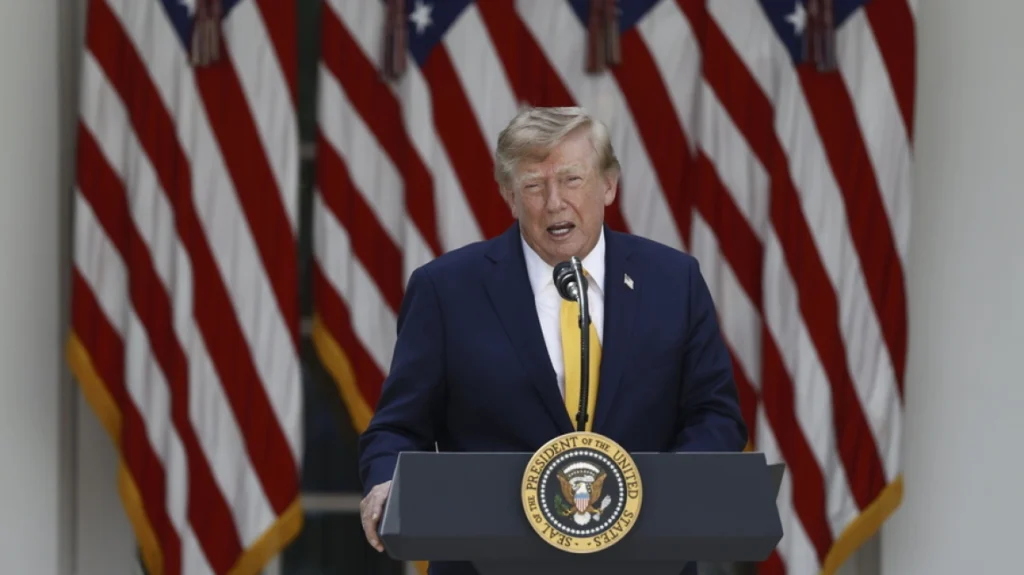
The administration of U.S. President Donald Trump confirmed yesterday, Monday, its intention to cut off “all economic resources” to Iran, warning every country that continues to “support” Tehran — which, for its part, promised Washington a “new defeat.”
During a press conference in the U.S. capital, Treasury Secretary Scott Bessent referred to a new barrage of so-called “secondary” sanctions currently being prepared, which would target not only Iran directly but also its trading partners, and would cover gold, technology, digital resources, aviation, maritime transport…
However, he did not specify when the new U.S. sanctions would take effect, nor which countries risk coming under Washington’s sights. China, the world’s second-largest economy, for example, consumes large quantities of Iranian oil.
“Iran faces a very clear choice, between only two possible paths: complete isolation (…) or a return toward normality and the possibility of reintegration into the global economy,” Mr. Bessent said.
The warning was also directed at the rest of the world: countries that do not participate in the U.S. measures will either contribute “to the isolation of Iran” or themselves face sanctions, including even expulsion from “the dollar system.”
“We will hold everyone accountable” if they dare challenge the effort aimed at “the economic strangulation of the regime”: “no one should test our resolve” on this matter, Scott Bessent warned.
“New defeat”
The previous day, he had promised Iran an “economic D-Day,” using a term referring to the Allied landing in Normandy, in France, which was still under Nazi occupation at the time, in order to cut off Tehran’s last “lifelines,” as diplomatic efforts aimed at ending the war that broke out on February 28 with the U.S.-Israeli attack on Iran remain deadlocked.
Speaking on Iranian state television, Economy Minister Ali Madanizadeh said that the threats would amount to nothing more than a “new defeat” for the United States, adding that Tehran had prepared a “two-year plan” to deal with the sanctions.
Even before Scott Bessent’s press conference, Beijing, Tehran’s strategically important partner, assessed that Washington’s “sanctions and pressure” would not allow the conflict in the Middle East to be resolved.
U.S. Secretary of War Pete Hegseth, for his part, warned that maximum economic pressure does not mean an end to U.S. bombing, should it be deemed necessary.
“Very difficult” situation
At the heart of the war since its outbreak has been the strategically important Strait of Hormuz, through which one-fifth of the hydrocarbons consumed worldwide passed before the war; Tehran closed it and has reopened it for only a few days over the past six months, something that has sent fuel prices soaring and increased pressure on U.S. President Donald Trump as the midterm congressional elections of his second term, in November, approach.
Iran rules out any return to the pre-war situation in the strait and has been discussing for months an agreement on the terms of its passage with Oman, on the other side of the waterway. Oman’s Foreign Minister Badr Albusaidi is expected in Tehran today.
An indication of the risks involved in transiting the strait: an oil tanker was struck by an “unknown projectile” while sailing off Oman, the British maritime security information service UKMTO, which operates under the Ministry of Defence, announced overnight from Monday into Tuesday.
Despite Tehran’s uncompromising stance, Iranian President Masoud Pezeshkian acknowledged that the country is facing “many economic difficulties,” after decades of U.S. and international sanctions.
“Iran needs to make compromises now,” said Sara Hassanbeigi, a pharmacist who spoke to Agence France-Presse in Tehran. “The situation is truly very difficult. I don’t think” Iranians can “endure much longer,” she added.
On July 22, inflation reached 66% year-on-year in the country, compared with 46% in February, while the national currency continued to fall: the exchange rate of the rial against the dollar stood last week at 1.88 million to one, compared with 1.65 million before the war broke out.
According to commercial shipping monitoring company Kpler, the U.S. blockade of Iranian ports in the Gulf has resulted in a sharp decline in the Islamic Republic’s crude exports: they fell from 2 million barrels per day before the war to just 0.4 million in mid-August, the lowest level since the outbreak of the armed conflict.
Ask me anything
Explore related questions




