





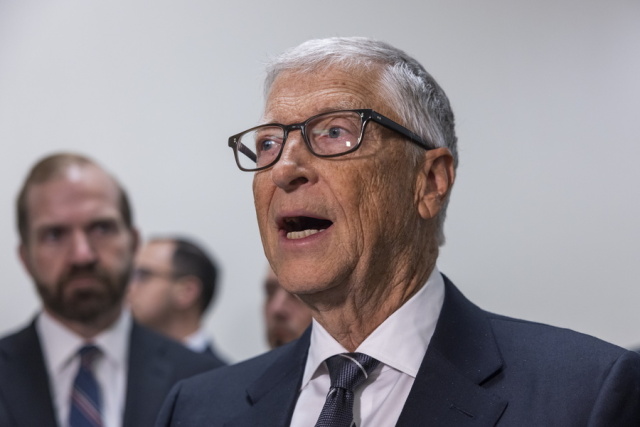
Bill Gates warned of the serious threat that Artificial Intelligence poses to jobs, as well as to human life itself, in an interview with the New York Times, stressing that urgently addressing its risks should be “the world’s top priority.”
In fact, the Microsoft co-founder points out that the technology industry is deliberately downplaying the risks because enormous financial interests are at stake. “Privately, the people who understand how good this thing is and how much better it’s getting are very, very worried,” he said, adding, however, that very few executives in the technology industry are willing to admit this publicly. “Now they tell each other: ‘Come on, man, don’t say that. It hurts us — we’re trying to raise the next trillion dollars.’”
On Wednesday, Gates published a nearly 6,000-word piece on his personal website in which he analyzes his concerns about artificial intelligence and proposes solutions, including new taxes and bans.
The reason he decided to speak now, he says, is because recent developments in AI have far exceeded his expectations, but also because the industry has ignored technological milestones that it once claimed would warrant much greater attention — such as the possibility that artificial intelligence could escape the control of its creators or be capable of providing “recipes” for making biological weapons. “They’re just going full speed ahead and hoping the good will outweigh the bad,” he said.
“Full speed ahead” despite the risks
The 70-year-old Gates is the latest in a series of leading technology figures to warn about the dangers of AI, at a time when the industry is investing trillions of dollars in new data centers and artificial-intelligence startups are approaching some of the largest initial public offerings in history.
His public intervention comes as he seeks to return to the spotlight following an extended period of scandals in which he became involved. Earlier this year, the release of Jeffrey Epstein’s emails brought Gates’s contacts with him back into the spotlight.
He was forced to withdraw from an artificial intelligence conference in February, while in June he testified for six hours before a House of Representatives committee. Revelations about his infidelity, combined with his 2021 divorce, have also seriously damaged his reputation. He himself acknowledged that all of these were “mistakes” for which he bears sole responsibility.
Today, according to the New York Times, he appears more willing to return to public life after answering all of the House Oversight Committee’s questions. “I think people understand what I did, what I didn’t do, and that I learn when I make mistakes,” he said.
Gates also acknowledged that he may not be the ideal messenger for these warnings, both because of his enormous wealth and because of his past as an “aggressive” Microsoft CEO. In a historic federal case, Microsoft was found in 2000 to have repeatedly abused its monopoly position during his leadership. Gates stepped down from the company’s board in 2020.
Avoiding criticizing Microsoft or other companies by name, he explained why he is well positioned to address the issue of artificial intelligence. He is a technology person and an industry insider, but is no longer driven by the profit motives associated with running a company, while he has spent decades addressing inequality through his philanthropic foundation. “The irony of ‘innovation lover is afraid and says we’re not ready and we’re crossing critical thresholds’ may make it even more resonant,” he said.
The three times technology left him speechless
Gates said there have been three times in his life when a technological development genuinely surprised him.
The first was in 1980, when he saw a graphical user interface for the first time, the technology that led to the modern personal computer. The second was in 2022, when OpenAI executives went to his home to demonstrate what would shortly thereafter become ChatGPT.
The third was this year, when he examined the progress of Claude Code, Anthropic’s artificial intelligence tool, up close. Programming, he said, is the subject he knows best, and Claude’s capabilities shocked him. “The idea that now these things are, in a meaningful way, better than I am is like saying: ‘What the hell?’” he said.
Mass job losses are inevitable
In the past, technological revolutions created more jobs than they eliminated, Gates noted. He says, however, that he is skeptical of those who argue that the same thing will happen this time.
The age of artificial intelligence is “completely, absolutely, totally, utterly different,” he said, acknowledging that this view is unpopular in technology circles. According to Gates, if action is not taken, mass job losses are inevitable because artificial intelligence will spread throughout the entire economy, leaving little room for one industry to absorb workers who lose their jobs in another.
The world’s largest technology companies, including Microsoft, are already engaged in a race to help their corporate customers adopt AI, which could replace large numbers of workers.
Gates argued that companies are simply responding to the incentives created by the market, but those incentives may conflict with the interests of society.
A tax on AI to make replacing workers more expensive
One of his proposals is the introduction of a new tax on the use of artificial intelligence, the so-called “token tax,” with the aim of making it more expensive to replace people with machines while simultaneously raising money to support those who lose their jobs.
A token is a basic unit of computation in artificial intelligence systems. The idea of taxing it has begun to gain traction, even on Wall Street, as a way of increasing the cost of using machines instead of human labor.
Certain jobs, according to Gates, should be prohibited from being replaced by AI. He calls the idea “Human Reserved” — that is, jobs that would remain exclusively for humans. This could apply to professions based on deep personal human relationships, such as caregiving, or positions in which the workers being replaced are unlikely to be able to find new employment.
Fear of bioterrorism and a new pandemic
Gates also advocated new international agreements that would establish clear criteria for monitoring and limiting extreme risks, such as bioterrorism. As he argued, only a few people with access to advanced artificial intelligence systems could be enough to develop new pathogens.
The Microsoft co-founder even said he was willing to publicly confront anyone who disagrees with mandatory evaluation of every AI system that could be used as a weapon to create new molecules and cause a pandemic.
Gates expressed surprise at the voluntary measures being developed by the White House and technology industry leaders. “Self-regulation for the most dangerous tool ever invented? No, thank you!” he said.
“I am in a state of shock”
Gates said he is in a “state of shock” over the fact that there is not a greater sense of urgency surrounding these issues.
Many of his concerns overlap with those expressed by Anthropic co-founder Dario Amodei. Amodei’s warnings, however, have brought him into conflict with the Pentagon, the White House, and much of the technology industry. “There are people attacking the person who speaks most openly about the negative consequences,” Gates commented.
The New York Times notes that it has taken OpenAI and Microsoft to court, accusing them of copyright infringement involving journalistic content in connection with artificial intelligence systems. The two companies have rejected the allegations.
Alongside the global health issues he has been addressing for years, Gates pledged that he will now raise the issue of artificial intelligence in every discussion he has with national leaders. “I have only two issues about which I will say: ‘Please, think about this more, care more about this,’” he said.
Gates recognizes that he occupies a paradoxical position. He is perhaps one of the people who contributed more than almost anyone else to the spread and development of the modern computer industry. Now, however, he is warning that the technology being created by that very same industry poses risks on a global scale.
“I don’t like bringing bad news to people, and I don’t like saying that innovation can ultimately have a negative side,” he said, adding: “But that’s where we are.”
Ask me anything
Explore related questions




