





Turkey mounted a fresh provocation on Friday morning when an unmanned aerial vehicle (UAV) entered the Athens Flight Information Region (FIR) and violated Greek national airspace.
According to reports, the Turkish UAV operated in the area between the islands of Samothraki and Limnos.
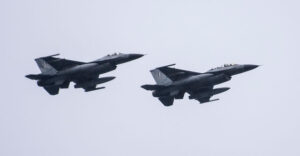
The Hellenic Air Force reacted immediately, activating standard procedures. A pair of Greek F-16 fighter jets scrambled to identify and intercept the Turkish drone.
Today’s incident comes just hours after Turkey’s defence ministry warned that a possible UAV base on Rhodes would “harm peace and stability in the Aegean,” a statement accompanied by a reference to taking “necessary measures.” It adds to a sequence of moves that have alarmed Athens.
Athens is trying to decode Turkey’s intentions, to establish whether the latest events amount to a forceful messaging exercise or whether they signal a definitive shift back to a policy of provocations on the ground and uncontrolled tension.
Ankara has sent numerous signals in recent months, while efforts by Greek Foreign Minister Georgios Gerapetritis and Turkish Foreign Minister Hakan Fidan to find common ground had already reached an impasse. The two had been seeking a special agreement that would allow the countries to submit their core dispute, the delimitation of maritime zones, to the International Court of Justice in The Hague for a definitive settlement.
For now, there is no plan for Greek Prime Minister Kyriakos Mitsotakis to meet Turkish President Recep Tayyip Erdogan on the sidelines of the UN General Assembly, where, given these circumstances, fresh dialogue would be extremely difficult. In New York, the Turkish president will be seeking to capitalise politically and diplomatically on Turkey’s growing regional standing, the demonisation of Israel, and moves such as the Mecca trilateral summit.
Athens faces a further challenge: it must reject and confront every Turkish attempt to impose facts on the ground, without the resulting tension drawing the attention of US President Donald Trump, who evidently does not want to see a new crisis erupt in the wider region while he struggles in vain to close existing fronts. This is all the more pressing given that Trump has shown little regard for international law and legitimacy, and favours a largely transactional style of diplomacy.
Violations
Following Turkey’s latest move to establish, via presidential decrees, two large marine parks in the North Aegean and Eastern Mediterranean, and its return to violating national airspace, no longer only with UAVs but with armed Turkish F-16s, it is clear that Greek-Turkish relations are entering a period of difficult testing.
Greece will soon be called upon to defend its sovereign rights on the ground, both by carrying out specific projects and initiatives despite Turkish objections, and by preventing, by every means, attempts to impose de facto restrictions on activities such as fishing and scientific research in international waters over Greece’s undelimited continental shelf.
It is also being noted with particular concern that in almost all of its recent statements responding to Greek initiatives, Turkey elevates the so-called “grey zones” theory to the top of the agenda, as it did again last Wednesday. This inevitably creates tension and, crucially, blocks the start of any serious discussion on delimitation, or even technical-level talks.
The Athens Declaration, a text with several problematic points, chiefly Turkey’s differing interpretation of the phrase “avoidance of provocative actions” (which Ankara has taken to mean Greek self-restraint in exercising its sovereign rights), exhausted its momentum long ago. It nonetheless provided a significant period of calm, sparing the Hellenic Air Force from exhaustion thanks to the absence of the usually dense illegal activity in Aegean airspace, allowed effective management of migration through reduced flows from Turkey (for reasons also linked to Ankara’s broader bargaining with the EU), and gave Greece time to carry out one of its largest defence procurement programmes in recent decades.
Polishing the image
At the same time, this period also helped polish Turkey’s image, since for three years Greek diplomacy had neglected to publicly condemn and actively counter Turkish revisionism. Ankara’s enhanced role and its rapprochement with Europe and the United States are, of course, not owed to “calm waters” alone.
Officially, in the absence of any other framework, the two countries remain informally bound by and continue to invoke the Athens Declaration. In practice, however, the credibility of these commitments is being undermined by Turkey’s attempts to impose its own interpretation, demanding that Greece limit the exercise of its sovereign rights. Crucially, Turkey now appears to be choosing not merely public condemnation of Greek initiatives, but is attempting to respond on the ground with provocative and illegal actions, which are directly driving the return of tensions.
In the Aegean, both sides have avoided moves such as seismic surveys that would amount to unilateral exploitation of the undelimited continental shelf, a step that would almost automatically lead to major military confrontation. That does not mean, however, that an informal moratorium can hold indefinitely for other activities, such as environmental protection, cable-laying, fishing, and offshore wind farms.
By publishing its Maritime Spatial Plan in April 2025, Greece demonstrated its determination to proceed, in line with the UNCLOS framework and the EU acquis, with exercising its sovereign rights within its territorial waters and its jurisdiction in international waters within the limits of its undelimited Exclusive Economic Zone (EEZ). It is worth clarifying that the outer limits of the EEZ, as shown on the maps, were set under Law 4001/2011, pending a delimitation agreement with the countries concerned.
Marine parks
Turkey’s reaction at the time was immediate: it published an informal map of its own maritime spatial plan, one that promptly overlapped large areas of Greece’s undelimited continental shelf and potential maritime zones around Greek islands.
Since then, Greece has systematically proceeded, in line with its EU commitments, with establishing marine parks and a dedicated spatial planning framework for tourism, including the islands, though confined to Greek territorial waters, as well as a spatial plan for renewable energy sources. Turkey’s response was almost identical each time, with statements on 9 April 2024, 21 July 2025, 7 August 2026 and others, again bringing the illegal “grey zones” theory to the fore.
There was also an attempt to survey the route for laying the Great Sea Interconnector (GSI) cable linking Cyprus and Crete, which was halted by the Turkish navy in July 2024, as well as the drawing, under Law 4001/2011, of the median line for two blocks south of Crete, which have since been awarded to Chevron.
The agreement with the French
In recent weeks there have also been further developments, both regarding the GSI, where a majority stake is now passing to the French company Meridiam, which will also be responsible for delivering the project, and in Cyprus, where authorities announced the start of development of the “Cronos” gas field in Block 6 of the Cypriot EEZ.
By formally establishing the two marine parks, Turkey is putting on record, on the ground, its maximalist positions, which fall outside the framework of the Law of the Sea:
That islands are not entitled to maritime zones beyond their current 6-nautical-mile territorial waters. It also holds that islands should not factor into the delimitation of the median line, which it arbitrarily places in the middle of the Aegean, equidistant from the two countries’ mainland coasts. This is a claim that would leave Greek islands trapped within Turkish continental shelf and zones of Turkish jurisdiction.
In the case of Kastellorizo in particular, for obvious reasons, Turkey is pursuing the complete severance of the island and the Megisti island group from the single maritime space shared with the Dodecanese, while erasing any maritime zone Kastellorizo could claim under UNCLOS. The maps presented by Turkey also attempt to erase the islands’ right to extend their territorial waters, where geography allows, up to 12 nautical miles.
With the North Aegean park, Ankara is wedging itself between Limnos and Samothrace, in areas of international waters and undelimited Greek continental shelf, at the mouth of the Dardanelles Strait, an area through which the undersea interconnections between Limnos and Thrace pass. Under Turkey’s claims, such projects, some of which are already under way, would now require the approval of the Turkish authorities.
The design of Turkey’s marine parks follows its continental shelf claims as previously set out in the Rhodes-Kastellorizo area, through blocks awarded to the Turkish state oil company TPAO since 2012, and in the North Aegean, through similar concessions to TPAO dating back to the 1970s.
At the same time, Turkey has reacted strongly to Greece’s efforts, as part of its major defence procurement programmes, to boost the deterrent capability of its islands, including with Israeli weapons systems. It may have gone largely unnoticed, but Patriot missile systems have remained on Karpathos despite fierce Turkish objections.
Through the two marine parks, which carry significance in their own right, and its return to the illegal practice of violating national airspace and breaching the Athens FIR with F-16s, Turkey wants to send a threatening message and a warning that it will not tolerate Greece exercising its sovereign rights, which it regards as a threat to its own interests, as expressed through the expansionist “Blue Homeland” doctrine.
Turkey also wants to dispel any impression that, because it is preoccupied with pursuing a leading regional role through its involvement in the major regional crises in the Black Sea, the Middle East and Iran, it is downgrading the Aegean and Eastern Mediterranean and leaving Greece free rein to act.
Political expediency
For reasons of domestic political expediency too, Turkey wants to show that it is reacting forcefully to what its political elite perceives as an attempt to exclude it from the Mediterranean and encircle it via Israel, believing that Greece is acting and being encouraged to take initiatives with the backing of its new regional rival. As a result, the traditional Greek-Turkish standoff over the Aegean is taking on an additional dimension, that of rivalry with Israel and its expanding influence, on top of the wider reshuffling of the region’s geostrategic landscape.
Turkey has been emboldened by recognition of its role in regional crises, both from the United States and Trump and from the EU itself, despite the caveats attached over the state of the rule of law and over its aggressive stance towards Greece and Cyprus.
As a result, the neighbouring country’s warnings to Greece are anything but rhetorical. By projecting a profile of strength across a wider geography, Turkey is determined to prevent what it sees as the imposition of facts on the ground and an attempt to encircle it in the Aegean and the Eastern Mediterranean. Fidan made this clear last week when, essentially trying to entice Egypt into joining the Mecca alliance, he presented the Greece-Cyprus-Israel trilateral as a threat, arguing that it cuts the Eastern Mediterranean in half while disregarding the countries on the opposite coasts, Turkey and Egypt.
Ask me anything
Explore related questions




