





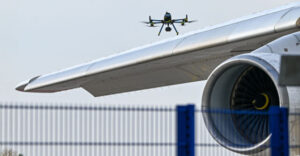
Relations between Germany and Russia have deteriorated dangerously since the attempted drone attack at Leipzig Airport in early August. The European Union has stood firmly behind Berlin, while Moscow is threatening a matching response after Germany’s latest measures against it.
Berlin has clearly identified Moscow as responsible for the hybrid-style attack, which failed to go ahead only by chance, and has moved swiftly to diplomatic measures with immediate effect.
At the same time, Germany has given the issue a European dimension, raising it at EU level and calling for action against Russia’s shadow fleet and new sanctions.
Germany’s partners in the European Union rallied behind it one after another, Greece among them, along with NATO and Britain. One question still to be answered is whether the United States will also come to Germany’s side.
Moscow responded immediately, with Russian Foreign Ministry spokeswoman Maria Zakharova saying Germany would receive a fitting response to its decision to close the Russian House cultural centre in Berlin and Russia’s consulate general in Bonn.
“Both have long irritated the ruling elite. Now they have found a pretext. Well, they will get the fitting response they are looking for,” she said.
She added that “on a completely baseless and far-fetched pretext, Berlin has once again escalated bilateral relations. As usual, no convincing or serious evidence has been presented. There simply is none, and there cannot be any.”
“Meanwhile, Berlin itself is thoroughly tainted, both by its involvement in the conflict in Ukraine and by its role in terrorist attacks against civilians. They are grasping at straws. Russia will respond to all anti-Russian decisions,” Zakharova said.
From the moment the incident came to light, Moscow has rejected any claims of its involvement.
EU solidarity with Germany
Germany’s decision to press ahead with measures against Russia, closing the consulate in Bonn on 18 September along with the Russian House, was welcomed by European institutions, Berlin’s partners and NATO.
“Greece expresses its full solidarity with Germany following Russia’s hybrid attack in Leipzig. Attempts to intimidate our democracies will not succeed. We remain steadfast and will maintain a credible deterrent force to protect our citizens and our security,” Greek Prime Minister Kyriakos Mitsotakis wrote in a post.
Greece stands in full solidarity with Germany following the Russian hybrid attack in Leipzig. Attempts to intimidate our democracies will not succeed. We remain steadfast, and will maintain credible deterrence to protect our citizens and our security.
— Prime Minister GR (@PrimeministerGR) September 1, 2026
In an initial reaction to Germany’s measures, NATO Secretary-General Mark Rutte welcomed them, adding that “Russia’s attempts to intimidate us, to undermine our unity and our determination to support Ukraine, are futile and will fail.”
“Hybrid attacks will not go without a clear response,” said European Commission President Ursula von der Leyen, who also welcomed Berlin’s measures.
French President Emmanuel Macron said he “supports the adoption of new European sanctions against Russia.”
“We must stand united in supporting Ukraine, and France will continue to play its full part,” he wrote on X, adding that “these hybrid attacks are increasing across Europe. They cannot go unanswered.”
Sweden struck the same note, expressing its solidarity with Germany.
“We will summon Russia’s ambassador in Stockholm to convey Sweden’s strong protest at Russia’s conduct,” Swedish Prime Minister Ulf Kristersson said at a press conference.
British Prime Minister Andy Burnham also stood by Germany, saying London’s resolve to prevent attacks on the UK’s freedom and security would not be shaken.
Poland expressed its full solidarity with Germany, while Finland, through President Alexander Stubb, said: “We know the Russian playbook very well.”
Russia’s hybrid attack is part of its aggressive strategy against Germany and the rest of Europe, Ukrainian Foreign Minister Andrii Sybiha said on the matter. Acts of sabotage, disinformation and election interference are not isolated incidents but part of Russia’s deliberate policy, he added.
“We are not at war, but under hybrid attack”
Earlier on Tuesday, German Interior Minister Alexander Dobrindt had presented a series of findings at a press conference indicating that Russia was responsible for the 4 August drone attack at Leipzig Airport.
As he stressed, the attack followed “the established pattern of Russian hybrid operations in Europe.” He explained further that German security services were recording a “high level of threats” from hybrid operations in Germany and other European countries.
The means used for the sabotage in Leipzig “are familiar to us from other hybrid operations carried out by Russia and from its war against Ukraine,” said Dobrindt, who gave details of the drone’s configuration, the components used and the explosives involved.
The German government has concluded that “Russia is responsible for the hybrid attack in Leipzig.”
For Dobrindt, the Leipzig incident “is not an isolated case, but part of a wider pattern of hybrid actions,” and he expects Germany to remain a target of Russian hybrid attacks. “Let us be clear: we are not at war, but we are a daily target of hybrid warfare,” he stressed.
Airport staff had spotted the drone, largely by chance, near Ukrainian cargo aircraft.
The drone was fitted with an explosive device that failed to detonate because the detonator was faulty. German authorities suspect a second drone also collided with a cargo aircraft that was nearby at the time.
Ask me anything
Explore related questions




