





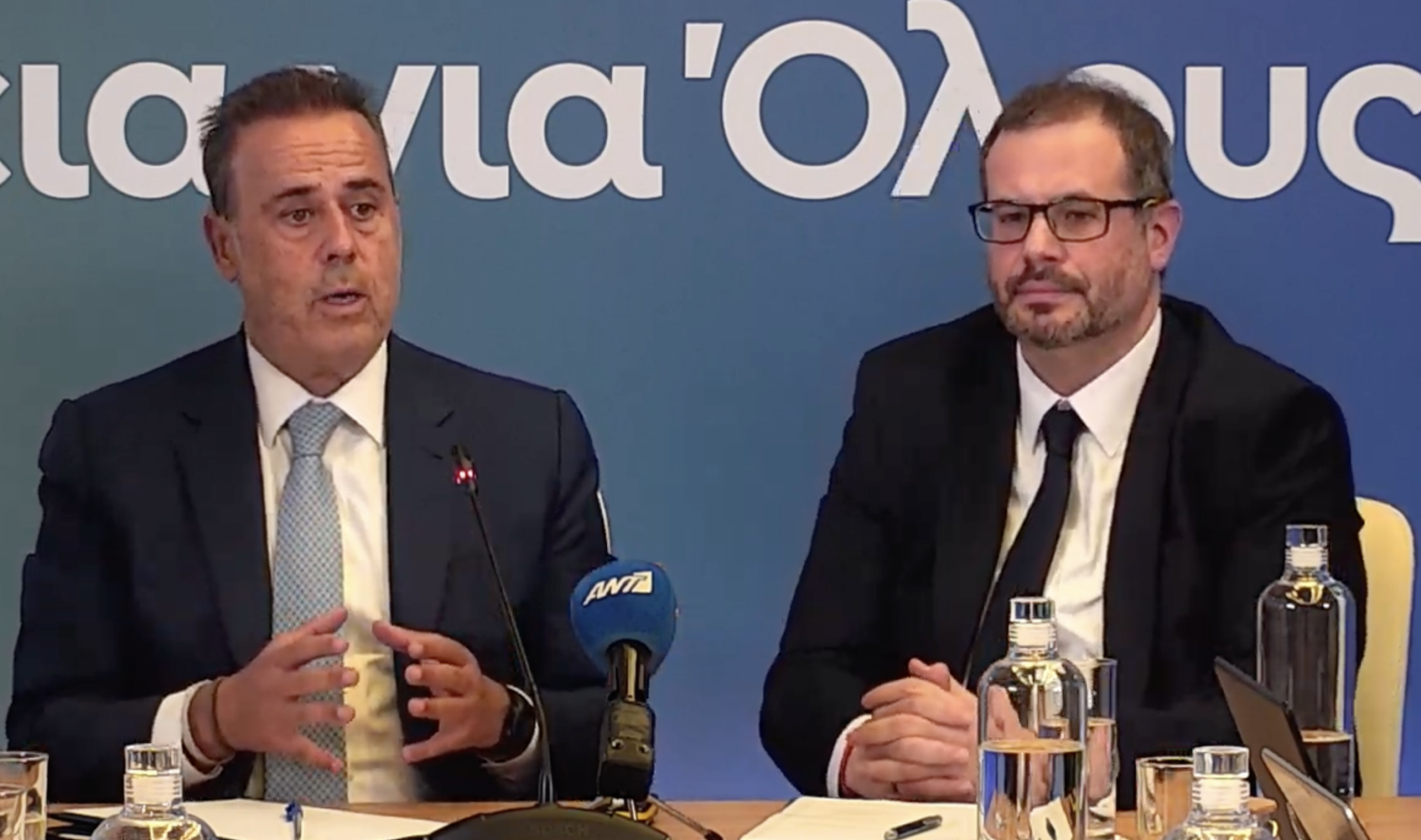
The Ministry of Environment and Energy is currently presenting the government’s plan for the gradual 30% reduction in electricity prices by 2029, first announced by Prime Minister Kyriakos Mitsotakis at the 90th Thessaloniki International Fair. Energy Minister Stavros Papastavrou and Deputy Minister Nikos Tsafos are taking part in the press conference detailing the measures.
At the heart of the plan are interventions in renewables, grid infrastructure, energy storage and efficiency, aimed at cutting energy costs for households and businesses.
‘Greece has become an energy exporting power’
In his opening remarks, Energy Minister Papastavrou said: “In recent years, our country has invested systematically in renewables, interconnections and the modernisation of the institutional framework. Since 2019 we have been working on an integrated plan, not piecemeal measures. That plan has delivered a significant result: from being an energy importer, Greece has become an exporting power, with prices now in line with the European average. This energy advantage must also translate into an economic benefit that reaches the citizen.”
He added: “The proposal we are presenting is not a subsidy scheme. It is a holistic plan of permanent changes. The plan is realistic, workable and measurable. We are moving into a new phase of energy strategy, shifting from a defensive stance to creating the conditions for permanently lower, structural prices. We are building a buffer against international turbulence. The energy market is not isolated from global developments, but the impact on our own market has been milder than elsewhere precisely because we have invested in domestic renewables.”
“The gradual 30% reduction in electricity prices by 2029 announced by the Prime Minister is the natural continuation of a policy that began in 2019,” Papastavrou added.
The Minister stressed that “we have tripled installed renewable capacity, we rank third in the world for solar power penetration and ninth for wind. The new Special Spatial Planning Framework for Renewables gives us the foundations for the future, with respect for the environment and local communities.”
According to the Minister, more than 50% of installed renewable capacity is now connected to the HEDNO grid (small-scale projects), with almost 100,000 connections made.
He also highlighted that Greece has been gradually phasing out costly lignite since 2005, with lignite-fired generation down 92% compared with 2005, including a 66% reduction already recorded between 2005 and 2019.
Greece has also been a net electricity exporter since 2024, for the first time since 2000. By July 2026, exports were already almost double the total recorded for 2025. The country now runs a trade surplus in electricity, with the turnaround now approaching €1 billion.
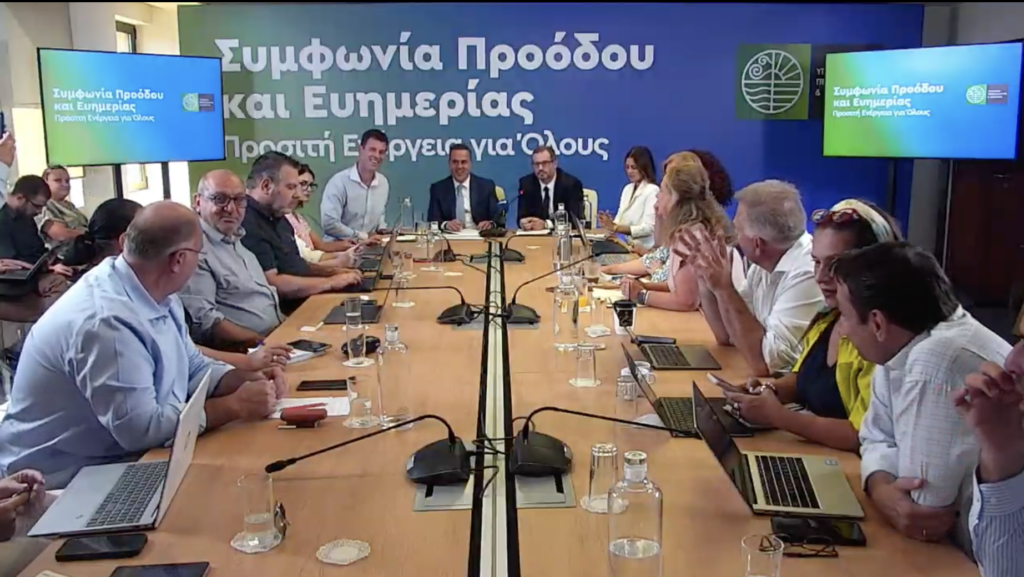
The six pillars for cutting electricity prices
According to the Minister, the reduction in electricity prices will be achieved through six key pillars, forming part of a comprehensive plan. Specifically:
- Continued investment in renewables
- Accelerating energy storage
- Island interconnections and small-scale renewables for self-consumption
- Reducing electricity theft and overdue debts
- Ongoing investment in energy efficiency for households and public buildings
- A new framework for energy self-sufficiency, allowing businesses and local authorities to generate and store their own electricity
According to Ministry officials, connecting the islands is a multi-year undertaking costing around €7 billion. Crete and the Cyclades have already been connected, while the Dodecanese and the North Aegean are currently under way.
“With these interconnections, we can reduce Public Service Obligation charges,” explained Tsafos. The 2027 budget includes provision of €200 million to cover the existing shortfall.
As noted elsewhere in the presentation, the highest prices stem mainly from the hours without sunshine. Additional storage capacity would significantly cut afternoon peak demand and reduce the need to burn costly natural gas.
Electricity theft and overdue debts
Non-technical losses cost around €450 million a year (2022-2024). Continuing to bring this figure down removes a significant burden from the final price of electricity. “Smart meters are helping us cut losses and giving consumers more flexibility. By the end of the year, two-thirds of HEDNO’s network will be operating with remote metering,” said Tsafos.
“We all pay the cost of electricity theft. Energy that is lost has to be recovered somehow,” the Deputy Minister continued, presenting the data on non-technical power losses.
He went on to present figures on overdue debts. A new flagging system is being set up for consumers with overdue debts. Once a customer has received three flags, they will be unable to switch supplier without first settling their debt. Overdue debts currently stand at around €3 billion, a burden that is passed on to all consumers.
“When someone doesn’t pay, we all end up paying that cost. So what are we doing? Over the summer, the Minister and I introduced a new framework so that, if someone has done this repeatedly, we can stop them simply moving on to the next supplier until they agree to a settlement,” Tsafos said.
Ask me anything
Explore related questions




