





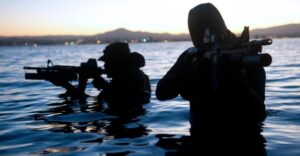
The US Navy carried out an extremely dangerous, four-month covert operation in the Strait of Hormuz aimed at locating and destroying Iranian mines. According to the Financial Times, the mission involved US Navy SEAL divers, unmanned vessels and advanced sonar systems, with most of the operations carried out at night.
American forces spent four months operating in one of the world’s most critical shipping lanes, working to clear explosive devices from the route through which a significant share of the world’s oil is transported.
According to the Financial Times report, the Navy SEAL divers had robotic vessels and specialised underwater equipment at their disposal, carrying out the dangerous missions mostly under cover of darkness.
How the mines were destroyed
The first stage of the operation involved locating the mines and securing the area. The most difficult and dangerous part of the mission followed: their destruction.
“Usually a navy diver follows, who has to get into the water, approach the mine, attach an explosive device to it, and then destroy it,” said Bill Hamblet, a retired captain in the US Navy with years of experience of operations in the Gulf, speaking to the Financial Times.
American forces are also believed to have used unmanned underwater vehicles to approach mines and destroy them with explosives. This method can be safer for personnel, but it is particularly time-consuming.
Robotic vessels and advanced sonar
Among the systems available to American forces was the Common Uncrewed Surface Vessel (CUSV), an unmanned surface vessel capable of towing advanced underwater systems.
These include the MK 18 Mod 2 Kingfish, an unmanned underwater vehicle equipped with sonar, capable of scanning the seabed to locate mines.
Despite the danger of the four-month operation, no casualties have been reported among the American forces involved in the mine-clearance effort.
About 80 mines in the Strait of Hormuz
The UN’s International Maritime Organization (IMO) estimated in June that around 80 mines had been laid in the Strait of Hormuz, the sea passage through which about 20% of the world’s oil shipments pass.
In August, US President Donald Trump announced that all mines had been removed from the Strait.
However, last week the US launched repeated strikes against Iran, after intelligence suggested an operation to re-lay explosive devices in the sea passage.
The relative ease with which the Strait of Hormuz can be re-mined continues to cause considerable uncertainty for shipping companies and the crews of vessels attempting to cross it.
Iran says active mines remain
Iran has repeatedly claimed that active mines remain in the Strait, while the Iranian military alleged that two attacks on oil tankers took place last week.
Shipping companies and analysts agree that the areas near the coast of Oman, where the US escorts commercial vessels, have likely been cleared of mines. However, there is no such certainty regarding the rest of the Strait.
“It’s hard to know what to believe. Iran is certainly trying to re-mine the area,” Ethan Connell, deputy director of the Taiwan Security Monitor and an expert on naval mines, told the Financial Times.
Shipping at lowest level since May
The threat from mines, combined with repeated missile and drone attacks in the Strait of Hormuz, has significantly reduced visible ship traffic in the area.
According to maritime intelligence firm Kpler, traffic has fallen to its lowest level since May.
Only two ships crossed the Strait on Saturday, while six crossings took place on Sunday, most of them via the route approved by Iran.
The actual number of ships crossing the area, however, remains difficult to calculate. Some switch off their tracking transponders and pass through the Strait at night, escorted by American military forces.
Ask me anything
Explore related questions




