





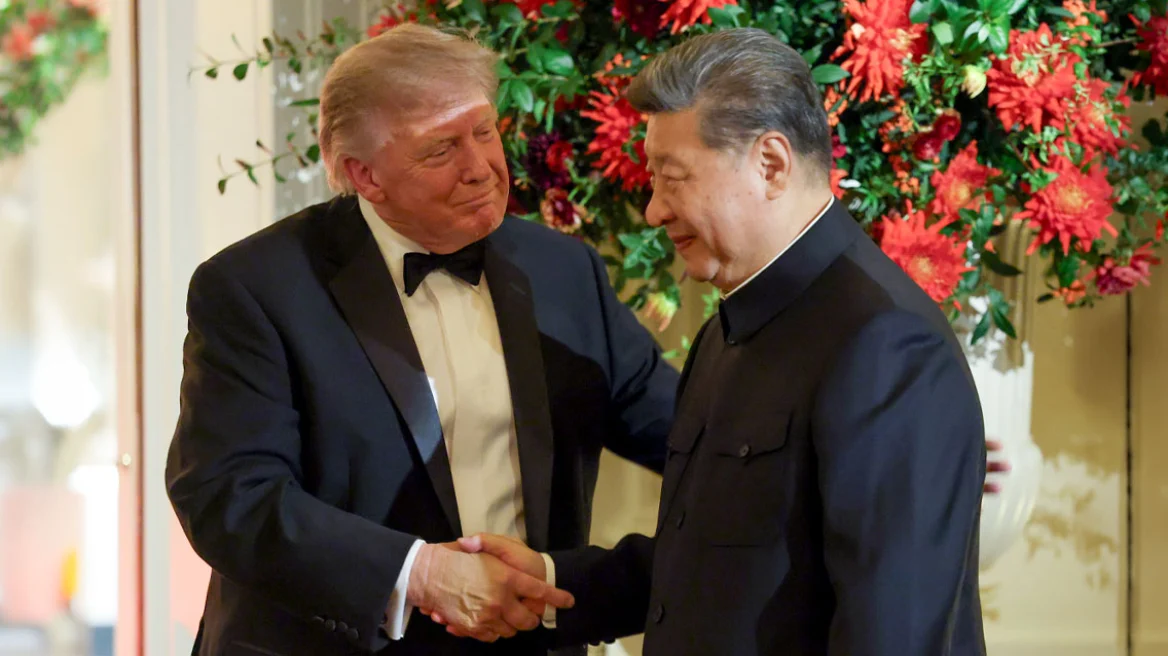
US President Donald Trump gathered a remarkable share of the world’s technological and financial might in the East Room of the White House on Thursday evening, hosting a state dinner in honour of Chinese President Xi Jinping as the contest between the two superpowers over artificial intelligence and advanced microchips takes on ever greater strategic weight.
The guest list read like a roll call of global business. Nvidia chief executive Jensen Huang, AMD chief executive Lisa Su and Tim Cook, who recently stepped down as Apple’s chief executive and now chairs its board, were joined by Tesla and SpaceX chief Elon Musk, OpenAI chief executive Sam Altman, Meta chief executive Mark Zuckerberg and Amazon founder Jeff Bezos.
The symbolism was hard to miss. The companies driving the technological revolution shared a room with the leaders of the world’s two largest economies, just as AI emerges as the new front line of geopolitical and economic rivalry.
The dinner came midway through Xi’s three-day visit to Washington, his first state visit to the US in more than a decade, and some four months after Trump travelled to Beijing in May.
Trade truce extended, for now
The US secured a further extension of its trade truce with China, but only a brief one, according to a Reuters analysis of the talks between the two leaders.
US Treasury Secretary Scott Bessent said the two sides had agreed to prolong by two months the deal that ended last year’s trade war, which had been due to expire in November. The truce now runs until 10 January. Bessent said the extra time would allow Washington and Beijing “more time to see what we can do on the economic front”.
Rather than delivering a lasting settlement, however, the move appears simply to push the thorniest questions, from tariffs and Chinese purchases of American goods to rare earth supplies and technology restrictions, into the next round of negotiations. Bessent said Beijing was meeting its commitment to buy 25 million tonnes of soybeans but was falling behind on a pledge to purchase $17bn of other farm produce.
For businesses, the result is a familiar kind of uncertainty. Tariff rates remain lower for the time being, but decisions must still be taken against a shifting policy backdrop.
Xi urges US “prudence” on Taiwan
As expected, Xi raised the issue of Taiwan with his host. According to Xinhua, China’s official news agency, he said Beijing hoped the United States would handle the Taiwan question “with prudence”.
The agency’s English-language service also reported that Xi wanted Washington to oppose Taiwanese independence. That would mark a tougher formulation than the longstanding US position that it does not “support” independence, and there is no sign that the Trump administration intends to change its wording.
The Thucydides Trap
Xi once again invoked the “Thucydides Trap”, an academic theory holding that rivalry between a rising power and an established one tends to end in war.
Although the Chinese leader said the danger “can be overcome”, the reference underlined how fears of a possible military clash between the US and China continue to hang over relations between the world’s two most powerful nations.
Xi argued that both countries had much to gain from cooperation and much to lose from confrontation, and called for regular military dialogue and stronger mechanisms to prevent crises.
Xi Jinping to Trump:
— Clash Report (@clashreport) September 24, 2026
The Thucydides Trap can be overcome. pic.twitter.com/p7wC0vR6P2
Trump, for his part, drew on the two nations’ shared history to stress the potential for partnership. He said they could achieve a great deal by pursuing common interests, pointing to their alliance in the war against Japan.
Divisions over artificial intelligence
Behind the glamour of the evening lay the deeper struggle between the two countries: which of them will lead the world in artificial intelligence.
Trump has championed rapid AI development with minimal state intervention, while China is trying to close the gap with American companies by pouring money into infrastructure, research and its own domestic technology groups.
During their talks, the two leaders spoke of the need for dialogue on AI and for managing the risks the new technology poses.
Xi said the two countries could exchange views on the benefits and dangers of AI, and insisted that its development must remain under human control.
The message behind the ceremony
The dinner was a showcase of American economic and technological strength, but it also laid bare the contradictions at the heart of relations between Washington and Beijing.
Both governments are working to keep channels of communication open and to extend the trade truce. At the same time, competition over technology, chips and AI is growing steadily fiercer.
Tellingly, while the heads of America’s most important technology companies filled the room, the Chinese side brought no business leaders of comparable standing. Their absence from the guest list pointed to the two sides’ contrasting approaches: Washington chose to parade its technology elite, while Beijing kept its delegation firmly political.
The evening had all the trappings of diplomatic tradition, from a lavish menu to carefully chosen symbolism and ceremony. Trump presented his guest with a statue of a bald eagle, while Xi reportedly brought Chinese rose seeds as a gift. Behind the pageantry, however, a far more consequential conversation was unfolding: who will write the rules of the AI economy.
The tech titans
Huang held a central place at the dinner. Nvidia has become the principal supplier of the advanced processors powering the AI boom.
Alongside him was Su, whose company AMD is another American firm fighting for a share of the AI chip market, and Cook, whose Apple retains deep manufacturing and commercial ties with China. According to CNBC, the two presidential couples shared their table with Cook, Huang and his wife, Musk and Su.
Altman was also among the guests. OpenAI, the company behind ChatGPT, is at the forefront of the global race to build so-called frontier AI models.
Musk attended alongside Zuckerberg, Bezos and Google chief executive Sundar Pichai.
Wall Street was out in force too, with JPMorgan Chase chief executive Jamie Dimon, Citigroup chief executive Jane Fraser, Blackstone chief executive Stephen Schwarzman, Goldman Sachs chief executive David Solomon and Mastercard chief executive Michael Miebach all present.
Arabella Kushner in the front row
One of the most talked-about guests was Arabella Kushner, the daughter of Ivanka Trump and Jared Kushner, who was given one of the most prominent places at the White House. The Daily Mail suggested the choice was almost certainly deliberate, given that Arabella speaks fluent Mandarin.
The British newspaper recalled that during Trump’s 2017 visit to Beijing, the president showed Xi a video of a young Arabella in a traditional Chinese-style silk dress, singing and reciting classical Chinese poetry in Mandarin. Xi remarked at the time that her performance deserved an A+.
When the Chinese delegation arrived at the White House, Arabella stood with her mother, US Vice President JD Vance and his wife, Usha. At dinner she was seated in the front row, beside senior members of Trump’s cabinet including Secretary of State Marco Rubio and War Secretary Pete Hegseth.
The president’s granddaughter began learning Mandarin at just 18 months old. She and her two younger brothers, Joseph and Theodore, were taught by the family’s Chinese nanny.
The menu
The three-course menu showcased “American ingredients with subtle Chinese influence”, according to the office of First Lady Melania Trump.
The meal opened with a toast of Schramsberg “Blanc De Noir” sparkling wine, in tribute to the “Toast to Peace” shared by President Richard Nixon and Chinese Premier Zhou Enlai in Beijing in 1972. The White House said the same American sparkling wine served on that historic occasion is still poured at White House functions today, although Schramsberg’s own records state that the wine served in Beijing in 1972 was its 1969 Blanc de Blancs.
The first course was a yellow squash velouté with a wild mushroom fricassée, topped with crispy pancetta and finished with a drizzle of spring onion oil.
THE WHITE HOUSE STATE DINNER
— MELANIA TRUMP (@MELANIATRUMP) September 17, 2026
Every detail considered. An experience thoughtfully conceived and exquisitely realized for our distinguished guests. pic.twitter.com/R3H1ryYEmj
It was followed by sesame-crusted sea bass on braised baby pak choi and roasted aubergine, completed with a fresh herb sauce verte.
Dessert was a fruit-shaped vanilla crémeux with a sour cherry compote centre, set on a walnut frangipane and served with ice cream made from White House honey.
The guest list
Leaders and government officials
President Donald Trump
First Lady Melania Trump
Chinese President Xi Jinping
Peng Liyuan, wife of Xi Jinping
Vice President JD Vance
Second Lady Usha Vance
Secretary of State Marco Rubio
Jeanette Rubio, wife of Marco Rubio
White House Chief of Staff Susie Wiles
US Ambassador to China David Perdue
Bonnie Perdue, wife of David Perdue
Treasury Secretary Scott Bessent
John Freeman, husband of Scott Bessent
War Secretary Pete Hegseth
US Trade Representative Jamieson Greer
Marlo Greer, wife of Jamieson Greer
The Chinese delegation
Cai Qi, member of the Communist Party’s Politburo Standing Committee and Xi Jinping’s chief of staff
Wang Yi, Politburo member and Chinese Foreign Minister
Vice Premier He Lifeng
Zheng Shanjie, chairman of the National Development and Reform Commission
Commerce Minister Wang Wentao
Ma Zhaoxu, executive vice foreign minister
Xie Feng, Chinese Ambassador to the US
The Trump family
Ivanka Trump, daughter of Donald Trump
Eric Trump, son of Donald Trump
Lara Trump, wife of Eric Trump
Tiffany Trump, daughter of Donald Trump
Michael Boulos, husband of Tiffany Trump
Viktor Knavs, father of Melania Trump
Arabella Kushner, daughter of Ivanka Trump
Silicon Valley’s tech titans
Jensen Huang, chief executive of Nvidia
Lori Huang, wife of Jensen Huang
Mark Zuckerberg, chief executive of Meta
Lisa Su, chief executive of AMD
Daniel Lin, husband of Lisa Su
Tim Cook, chairman of Apple
John F.W. Rogers, executive vice president and secretary to the board of Goldman Sachs
Lynn Martin, president of the New York Stock Exchange
Linda Mills, president of New York University
Eric Yuan, chief executive of Zoom
Kelly Ortberg, chief executive of Boeing
Sam Altman, chief executive of OpenAI
Greg Brockman, president and co-founder of OpenAI
Anna Brockman, wife of Greg Brockman
Sergey Brin, co-founder of Google
Satya Nadella, chairman and chief executive of Microsoft
Sundar Pichai, chief executive of Alphabet and Google
Jeff Bezos, executive chairman of Amazon
Lauren Sánchez Bezos, wife of Jeff Bezos
Elon Musk, chief executive of Tesla and SpaceX
Wall Street and business heavyweights
Larry Fink, chairman and chief executive of BlackRock
Stephen Schwarzman, chairman and chief executive of Blackstone
Jamie Dimon, chairman and chief executive of JPMorgan Chase
Michael Dell, chairman and chief executive of Dell Technologies
Mary Barra, chair and chief executive of General Motors
David Solomon, chairman and chief executive of Goldman Sachs
Jane Fraser, chief executive of Citigroup
Darren Woods, chairman and chief executive of ExxonMobil
Albert Bourla, chairman and chief executive of Pfizer
Bernard Arnault, chairman and chief executive of LVMH
Alexandre Arnault, LVMH executive
Ryan McInerney, chief executive of Visa
Michael Miebach, chief executive of Mastercard
Officials
Chief Justice John Roberts
Justices Amy Coney Barrett and Brett Kavanaugh
Speaker of the House Mike Johnson
Commerce Secretary Howard Lutnick
Federal Reserve Chair Kevin Warsh
CIA Director John Ratcliffe
Special Envoy for Peace Missions Steve Witkoff
White House Deputy Chief of Staff and Homeland Security Adviser Stephen Miller
Energy Secretary Chris Wright
Health Secretary Robert F. Kennedy Jr
Education Secretary Linda McMahon
Interior Secretary Doug Burgum
Transportation Secretary Sean Duffy
Additional reporting from newmoney.gr, Reuters, the New York Post and the Daily Mail
Washington and Beijing extended their trade truce by just two months as the Chinese leader urged prudence on Taiwan, warned of the Thucydides Trap and insisted that artificial intelligence must remain firmly under human control
Notes on corrections and additions
The Schramsberg correction: the White House says the 1972 toast used the same wine, but Schramsberg’s website reports that the wine served at that dinner was its 1969 Blanc de Blancs. I’ve kept the White House’s name for the wine in quotation marks and added the discrepancy.
Tim Cook: the source calls him Apple’s executive chairman. Current reporting describes him as having recently stepped down as the CEO of Apple and as chairman of the board of directors of Apple, so I’ve used “chairman”.
Stephen Miller: the source lists him as national security adviser, which appears to be a mistranslation. His role is White House deputy chief of staff for policy and homeland security advisor. Steve Witkoff’s title has also been updated to his current one, Special Envoy for Peace Missions.
Pete Hegseth is given as War Secretary, in line with the Pentagon’s secondary “Department of War” title. Switch to “Defence Secretary” if house style prefers it.
The new expiry date comes from this reporting: Bessent said the truce, which had been due to expire in November, now runs to January 10. The soybean detail is from the same round of coverage: Beijing was meeting its requirement in the earlier agreement to buy 25 million tons of soybeans but was lagging on its pledge to buy $17 billion in other agricultural goods.
The visit context comes from several reports. It was a three-day visit, Xi’s first state visit in more than a decade, and came roughly four months after Trump visited Beijing in May.
The seating and gifts are from CNBC and the Washington Examiner. Trump gave Xi a statue of a bald eagle. The U.S. and Chinese presidential couples were seated with Apple’s Tim Cook, Nvidia’s Jensen Huang and his wife, Elon Musk and AMD’s Lisa Su. The Examiner also reported that Xi gifts Trump Chinese rose seeds.
The fruit-shaped dessert detail comes from the White House’s menu description: a fruit-shaped dessert composed of a smooth vanilla crémeux with a sour cherry confit center over a walnut frangipane.
Ask me anything
Explore related questions




