





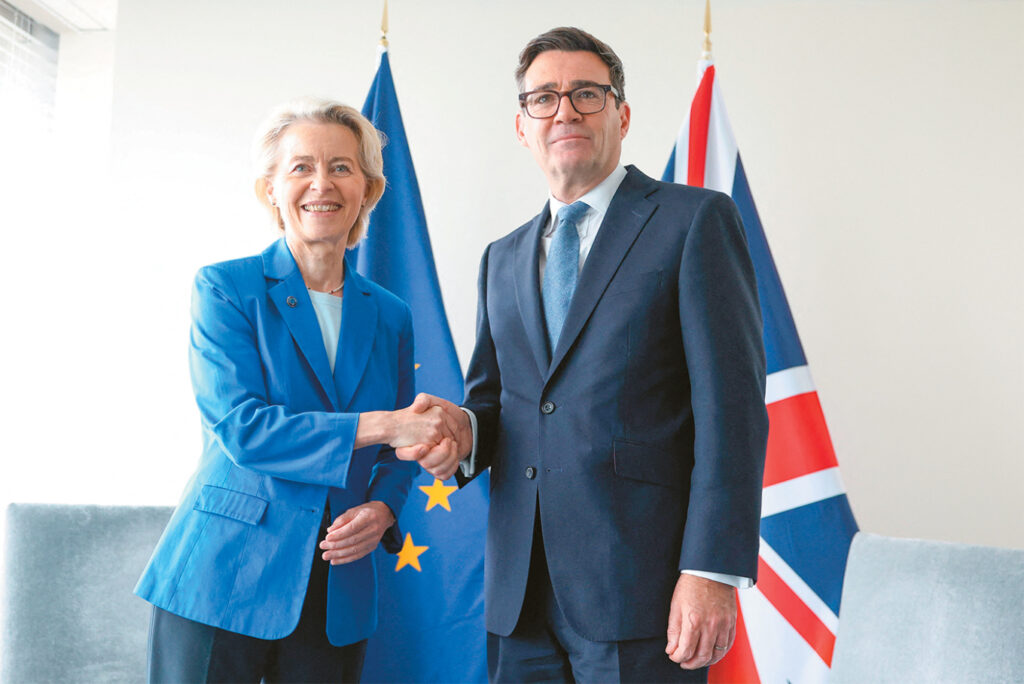
Britain’s recently elected Prime Minister Andy Burnham has dared to say publicly what a growing number of people privately admit about the prospect of the United Kingdom rejoining the EU. The reaction was loud, but the price the country is paying for its isolationism is steep and impossible to ignore.
Desperation or remorse? Compliance or humiliation? Recycled ideas or reopened wounds? Pragmatism, it seems, is leading the United Kingdom to put the prospect of rejoining the European Union back on the table. The EU, for its part, eyes that willingness to adapt with interest, provided that its forthcoming enlargement does not dilute its institutional structure.
The news did not land like a bolt from the blue. It was to be expected, given the social and political climate (and the weather) of habitually rainy Britain. A country enduring political instability (it has burned through seven prime ministers in a decade), anaemic growth and difficulties over migration is plainly having second thoughts about opening a crack in the door it once slammed on its way out.
That is understandable. Once the pride runs out, the sense of superiority fades and the uniqueness of the exception subsides, the bill becomes unbearable. The heavier it is, the more convenient the road back to the EU looks, if not inevitable. Last Wednesday, on BBC Radio 4’s Today programme, Burnham looked tired.
Prime minister since July, the former mayor of Greater Manchester allowed that rejoining the EU was among the options for what Britain’s future relationship with Europe might look like. He added that “we could stay as we are, if people think that is the right place to stay”.
All the way
Hardly a microphone toppled in the Portland Place studio in central London when he said he could go “all the way” towards that long-term prospect. Nor was any listener shaken by his remark that Brexit had done “more harm than good”. They have felt it for themselves. The day before, after all, from the podium of the Labour conference in Liverpool, in his first speech as party leader, Burnham had been rather more forthcoming.
Standing tall in front of a backdrop proclaiming “Hope Again” in large letters, he promised to examine “what is possible” to restore closer ties between the country and the EU. In the packed Bluecoat hall, pro-European MPs and activists applauded warmly. The most hard-line union leaders, by contrast, appeared to sour.
To the latter, the occupant of 10 Downing Street was performing yet another spectacular U-turn. In September last year he envisaged seeing the UK back in the EU’s embrace before the end of his life. This May, as a candidate in the Makerfield by-election that returned him to Parliament, he ruled out any prospect of rejoining. Now he has reverted to his old tune.
For the party’s internal hardliners, after all, Labour’s election manifesto, approved at the 2024 conference, had pledged to “make Brexit work”. How, nobody knows. On the strength of that vague aspiration, however, the party had cheerfully drawn indelible “red lines” ruling out rejoining the EU, its single market, the customs union and free movement of people. The question now becomes pressing: will the prime minister dare to break with the “immovable limits” and “inviolable rules” his own party voted for? Meanwhile, the debate has flared across the political arena of the British Isles, and the reaction from the opposition was scathing.
Senior figures in the Conservative Party and in Nigel Farage’s Reform UK accused Labour of reopening the old Brexit divisions. They condemned its attempt to drag Britain into Brussels by the back door, and branded any effort to rejoin or reconnect with the EU as treachery. That means the wounds left by the referendum ten years ago have not healed. Hot-blooded Brexit supporters are digging in their heels. All this comes despite recent polls consistently showing that most British voters have shifted. They back rejoining the EU and, full of regret, regard leaving as a historic mistake. In short, “if only I had known then what I know now”…
Negative consequences
The truth is that since the historic referendum of 23 June 2016 and the country’s departure from the European Union, the British political and social landscape has undergone a profound transformation, endured hardship and taken plenty of knocks. Brexit was initially presented as a definitive break with no way back, a mark of superiority and a promise of flourishing economic growth under global sovereignty. It withered.
It gradually gave way to what is now a dominant sociopolitical phenomenon: Bregret (regret over Brexit). In the intervening years the EU has grown ever more attractive as a regulatory pillar of stability for western democracies. It has also remained a strong economic and trading power, competitive on the global stage with its rivals the United States and China, despite its own vacillations.
How could the cut-off British not envy the EU its success? All the more so when they feel like poor relations, since in its recent announcement the president of the European Commission proposed granting Canada the status of the first “associate member” of the EU outside the continent. Nostalgia for old imperial grandeur lies in shards now that a former British colony is forging attractive rapprochement deals with the Union while Britain stands on the outside.
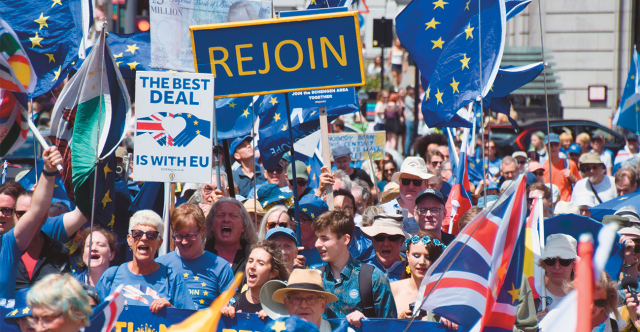
Throughout this period, the Rejoin movement has grown. From an academic think tank it evolved into a dynamic political current that regularly organises demonstrations and national marches in favour of rejoining, usually gathering beneath Big Ben. Famous figures have signed up to its cause, among them the Beckhams, Daniel Craig, Elton John, Hugh Grant, J. K. Rowling, Benedict Cumberbatch and Gary Lineker.
The main weight of the movement’s aims, however, is carried by certain think tanks, such as the institute of former prime minister Tony Blair (TBI) and the Institute for Public Policy Research (IPPR). They have abandoned abstract or emotive rhetoric in favour of detailed technical proposals. They no longer debate whether Brexit was positive or negative, but how, when and under what conditions the UK should plan its return to the EU bloc.
Their experts unanimously propose a phased return. In their tiered architecture, the foundational and most critical bridge is not trade, fishing or migration, but security and defence. At first glance, they are not wrong. The UK is deeply aggrieved at having been excluded from SAFE (Security Action for Europe).
As a non-EU country, it was blocked from drawing on the ambitious €150 billion EU fund aimed at research, development and joint procurement of cutting-edge military equipment. Brexit, along with other misfortunes, dealt a serious blow to the aerospace and defence sector, one of the country’s industrial engines, and cut it off from direct financial access to part of the European funds. Inevitably, the UK is making a virtue of necessity, which makes it a more flexible, if not conciliatory, recipient of Brussels’ complex demands.
For its part, the EU undoubtedly looks favourably on the UK returning to the bloc. The country offers the Union a value that is hard to replace. It is a nuclear power, holds a permanent seat on the UN Security Council, is a founding member of NATO and has top-tier intelligence networks. For London, its stature and military capability are its main bargaining chip.
For Brussels, meanwhile, British participation represents a first-class opportunity to consolidate its strategic autonomy. The highly trained human capital and logistical capacity of a state with historic experience in defence diplomacy and the handling of complex crises would be useful. That does not mean the EU will welcome a British return without conditions.
After all, ever since joining the Community in 1973, the UK has been an awkward, uneasy and semi-detached player. It was willing enough where free trade was concerned, but opposed to political integration and to monetary and fiscal union. On top of that, it periodically played the Trojan horse for US interests. In light of that past behaviour, the EU is no longer inclined to experiment. In any case, with its mistaken choices, the UK shot itself in the foot.
French president Emmanuel Macron may be tossing his cap in the air in delight and opening his arms, and Spanish prime minister Pedro Sánchez rolling out the red carpet with enthusiasm, but there are, all the same, institutional preconditions. The EU has long since ceased to be a reception desk for fussy customers.
New terms
The old terms no longer apply. The conditions now imposed on all member states require adopting the euro, joining the Schengen Area and contributing to the general budget. Full rejoining would also require invoking the relevant articles of the Treaty on European Union, which demands a formal application. That in turn would have to be approved unanimously by every current EU member state. Admittedly, a second referendum is not technically necessary in order to submit an application to rejoin.
In theory, Labour could submit an application if it wins the next general election in 2029, making use of the favourable mood of the electorate. In all likelihood, though, a referendum will be needed to provide a firm mandate to open negotiations with the EU, because Brussels would want to see that this is the settled will of the United Kingdom.
After all, why would the EU commit to serious negotiations if a different government might be elected that would back away from its predecessor’s commitments? One can see the real danger of political life in Britain descending into chaos, not least given the separatist tendencies in Scotland, Wales and Northern Ireland.
Benefits for Greece
However it turns out, it is broadly judged that a return of the UK to the EU would have a beneficial impact on member states. For Greece, the resonance is considered particularly favourable. The country has consistently run a trade surplus in its bilateral trade with the UK, which is Greece’s seventh-largest export destination. In 2025, Greece exported €1.942 billion of goods to the UK.
At the same time, Greece has far greater exposure to the British economy through services such as shipping, transport, finance, telecommunications, IT and education. Rejoining could reduce customs, regulatory and bureaucratic barriers, which is expected to help Greek exporters as well as British investment in Greece.
The big asset for Greece is that Britain remains, even outside the EU, one of its most important tourist markets. Roughly one in every eight visitors to Greece is British. Last year around 4.9 million visitors came from the UK and left close to €3.74 billion in the country. A return to the single European market could, in the long term, make travel, investment, air links and business activity in that sector easier.
Meanwhile, for the thousands of Greek undergraduate and postgraduate students in Britain, rejoining could bring tangible benefits. These include much lower tuition fees, if equal treatment with British students were restored, as well as free movement without a student visa and easier access to study, work placements and interdisciplinary collaboration.
The question is how long the journey back will take. It may be ten years or more before things settle. Former Conservative prime minister Sir John Major, however, sets an urgent timetable of a return within five years at the most.
What is certain is that the UK’s expressed wish to return will not come with a loud admission that it was wrong to leave. As far as the EU is concerned, it will be enough that Britain privately reflects that, while the world moved forward, it was trying, with mere notions, to turn the clock back. With just one caveat: changing course and returning to the right path does not guarantee avoiding the next impasse.
Ask me anything
Explore related questions




