





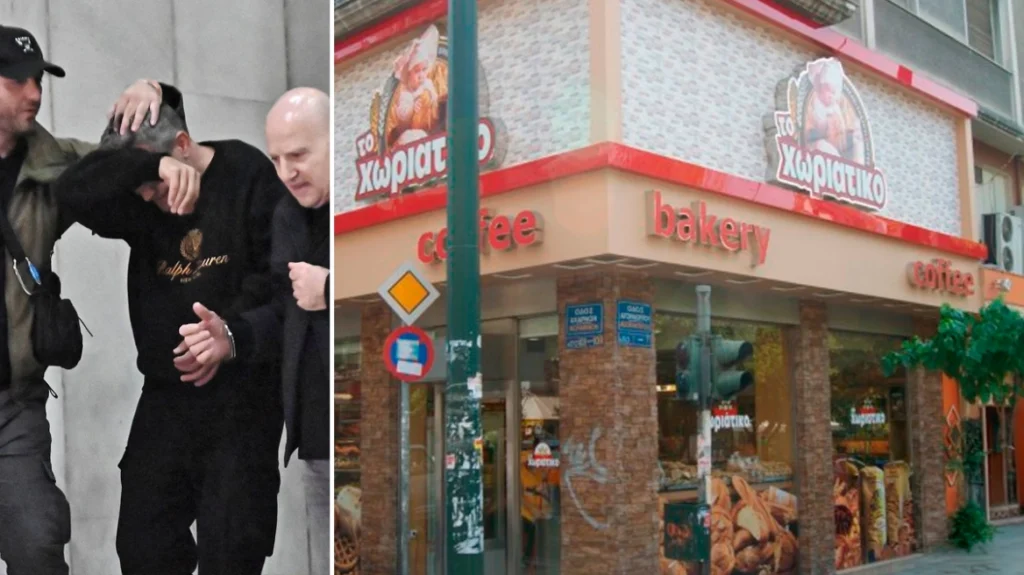
An apparently extensive illegal network, with activities ranging from neighborhood bakeries to luxury restaurants, nightclubs, and organized beach venues at popular tourist destinations, is at the center of a criminal investigation. Serious charges involving nine felonies and two misdemeanors have been brought against the 59 defendants in the case involving the Horiatiko bakery chain.
The arrest of Angelos Giannakopoulos and dozens of people alleged to be connected to his business network has triggered a chain of developments. Attention is now focused not only on the financial violations being investigated by the authorities, but also on what comes next for the businesses and their employees.
Behind the hundreds of companies, millions of euros in debts, and complex financial transactions that officers from the Directorate for Combating Organized Crime (DAOE) are attempting to map out are people who work every day in bakeries, restaurants, entertainment venues, and tourist facilities.
For these workers, the main question concerns not only how the judicial investigation will unfold, but also whether the businesses employing them will continue operating smoothly.
Thousands of employees
An indication of the scale of the case is that, in Rhodes alone, businesses linked to Giannakopoulos are estimated to employ approximately 500 people. If the staff of the Horiatiko bakeries, other bakery businesses, food-service establishments, and tourist facilities in Mykonos, Attica, and other areas are included, the number of jobs connected to the wider business network could reach several thousand.
The biggest question arising from the latest developments concerns whether the businesses will be able to continue operating without disruption, as in the case of Pizza Fan. The freezing of assets and bank accounts adds another layer of uncertainty, since the day-to-day operation of the businesses requires a continuous flow of funds to pay suppliers, purchase raw materials, cover operating expenses, and, above all, pay employees.
According to information made public, payroll accounts are exempt from the asset freezes so that the payment of employees’ wages is not obstructed. This is a particularly important provision, although it does not, by itself, answer the question of the businesses’ long-term viability.
So far, no confirmed information has emerged indicating a widespread shutdown of the businesses. However, the scope of the investigation and the involvement of different corporate entities have understandably raised concerns about the potential consequences in the coming period.
The Horiatiko chain, which for decades was one of the most recognizable names in the bakery sector, is only one part of the business activity being examined by the authorities. The chain’s official website lists nine outlets, while the wider business environment also includes other activities in the bakery and food-service sectors.
The 500 companies under investigation, Mykonos, and Rhodes
The investigation, however, is much broader. According to information that has been made public, more than 500 companies are under scrutiny, while the activities being examined are linked to more than 200 physical business locations.
Investigators from the DAOE are attempting to establish which companies conducted genuine commercial activity, who actually managed them, and how liabilities were transferred from one corporate entity to another.
Particular attention is being paid to Angelos Giannakopoulos’s business presence on two popular Aegean islands, Mykonos and Rhodes. In Mykonos, his name had been associated for years with significant business activities in restaurants, nightlife, and tourism-related ventures. His presence was so extensive that people familiar with his activities on the island used the hyperbolic expression that he had “bought half of Mykonos.”
Similarly, in Rhodes, businesses linked to him are alleged to employ approximately 500 people at prime, high-visibility commercial locations. The fact that these businesses operate across different sectors, with different corporate structures and management teams, makes it even more difficult to establish the case’s actual financial and employment-related implications.
The front men
At the center of the police investigation is the alleged operation of an extensive network of companies, with the total estimated loss to the state and social security funds approaching €120 million.
According to information made public, approximately €43 million of that amount relates to unpaid or unremitted VAT, €39 million to social security contributions, and €38 million to other tax liabilities and repayable state advances.
According to the authorities’ assessment, the alleged mechanism relied on the successive creation of companies that took over the operation of businesses and were then replaced by other entities, leaving substantial debts behind. In several cases, people who allegedly had no actual control over the businesses appeared as their managers.
These so-called “front men” allegedly provided their personal details in exchange for payment, while investigators are examining the role of accountants and other associates in establishing and operating the corporate entities in question.
Particular emphasis is being placed on financial transactions between the companies, the movement of funds, and the identification of the individuals who made the actual business decisions.
Alongside the criminal investigation, authorities are also working to identify assets and sums of money that may be connected to the activities under investigation. They are examining bank accounts, real estate, company shareholdings, and financial transactions, with particular attention being paid to the movement of money and possible transfers of funds abroad.
In this context, investigators are looking into whether money allegedly derived from the reported financial violations was channeled into other business activities or reinvested through different corporate entities.
Rizos Rizos and Giannakopoulos’s contacts
The police operation has so far led to the arrest of 59 people, including Angelos Giannakopoulos. The case file includes charges related to the operation of the alleged financial network. The judicial investigation is expected to clarify the degree of involvement of each person implicated and the actual role each allegedly played in the operation of the companies.
Meanwhile, the authorities’ investigations are also extending to contacts that Angelos Giannakopoulos allegedly maintained with senior figures in the Hellenic Police. According to reports, investigators are examining, among other things, his contacts with a former senior police officer who had served in the Morals Police Department.
Particular interest has also focused on the arrest of Rizos Rizos, the former organizational secretary of GENOP-DEI, the federation representing employees of Greece’s Public Power Corporation. He is among the 59 people arrested in connection with the Horiatiko case. The once-influential trade unionist allegedly developed a close working relationship with Angelos Giannakopoulos and was one of the people in his inner circle.
According to reports, the businessman allegedly consulted him before making important decisions, while officers from the Directorate for Combating Organized Crime are examining the role he may have played in the operation of the extensive corporate network.
More specifically, Rizos allegedly acted as an intermediary between Giannakopoulos and people who appeared on paper as business managers but who, according to the authorities’ assessment, did not exercise actual control over the companies.
Ask me anything
Explore related questions




