





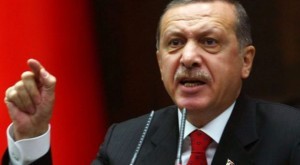
For the past year, Turkish President Recep Tayyip Erdoğan has exploited his country’s state of emergency to rule by decree, purging government ranks, imprisoning political dissenters and crushing independent media. But for all the attention paid to Turkey’s slippage in democratic norms, critics have largely ignored the heavy toll his brand of authoritarianism has taken on the country’s economy. The effects could be disastrous for Turkey’s future.
When Erdoğan first became prime minister in 2003, he inherited a struggling economy with a long list of structural problems. His greatest achievement during the first half of his 15-year tenure at the pinnacle of political power was to stick to a reform plan devised by the World Bank’s former Vice President Kemal Derviş and reorient Turkey’s foreign policy toward trade diplomacy.
But as he has consolidated power, he has become both more self-confident and more corrupt, replacing his original reform agenda with cronyism, nepotism and graft. Unless he ends his disastrous meddling in Turkish markets, the country’s volatile economy may well become the next casualty of last year’s abortive coup.
Turkey was already suffering from slowing growth and the highest percentage of youth not in employment, education or training, and the lowest labor force participation among OECD members. Morgan Stanley branded the country as one of “the Fragile Five” — overly dependent on short-term investment to finance its gaping current account deficit.
The failed coup exacerbated these shortcomings — and added new ones.
A key challenge for Turkey’s economy has long been weak governance. In 1995, a grand coalition of center-right and center-left parties established the Economic and Social Council, a quarterly consultative body to assemble labor, public, and private sector representatives to facilitate good governance.
But Erdoğan has refused to convene the Council since 2009, despite repeated calls to do so from the opposition. Under the current state of emergency, most economic decisions no longer involve parliament deliberations. They are simply the result of arbitrary decrees.
Erdoğan, for example, transferred the government’s stakes in Turkey’s flag carrier airline, two top public lenders, and fixed-line phone operator to the country’s newly-established sovereign wealth fund — and he did this simply with a decree. The controversial fund is neither transparent nor accountable, and it’s exempt from the oversight of the Court of Accounts, which is responsible for auditing public administrative bodies.
To make matters worse, the fund is managed by cronies, including an Erdoğan adviser who once claimed foreign powers were trying to kill the president by “telekinesis.”
Turkey’s deteriorating rule of law has also eroded private property rights. In the past year alone, the government seized 879 businesses with assets worth over $11 billion, prompting potential buyers to worry about prolonged legal battles over ownership. The appointment of party loyalists to run these firms has only aggravated cronyism and mismanagement.
The erosion of rule of law has also hit investors from the European Union, Turkey’s top trading partner and source of foreign direct investment. Ankara recently filed a complaint with Interpol against 681 German companies, accusing them of financing terrorism.
Although the Turkish government later withdrew its blacklist of German firms, the diplomatic spat undermined European investor confidence, as Berlin announced a review of state guarantees for investment in Turkey. The German government’s recent call for the European Commission to suspend its efforts to modernize the customs union agreement with Turkey could hinder not only bilateral trade, but also hurt Turkey’s export-oriented businesses.
Perhaps most ominous for economic future, Turkey’s talent pool has come under sustained attack in the aftermath of the coup. Purges hit universities particularly hard; the government closed 15 of them and fired more than 5,000 academics. The crackdown has frayed international academic collaboration and exchange, and led to a sharp drop in research output.
There are frequent reports of brain drain, pointing to a reversal of an earlier trend of Turkish expats returning to Turkish universities and research centers. The number Turkish citizens applying for asylum in the EU has spiked dramatically in the past year.
Ankara’s response to worsening social and economic indicators has been to cook the books rather than address root causes. When the country’s economy contracted in the third quarter of 2016, interrupting 27 quarters of continuous growth since 2009, the government reaction was not structural reform, but a questionable revision of the GDP math, boosting the average growth rate of the last five years from 4.4 percent to 7.1 percent.
Last year’s abortive coup and the ensuing state of emergency have dealt a heavy blow to Turkey’s democracy. But the country’s free market economy, too, has become a casualty of Erdoğan’s power grab, scaring away new investors and branding Turkey “the crisis candidate” among emerging markets.
Erdoğan has so far ignored calls by his transatlantic allies to respect political liberties — with no real cost to his power. If he similarly dismisses the warning signs from global markets, this time the consequences could be much worse, both for the Turkish economy and his own reelection potential.
By Aykan Erdemir, senior fellow at the Foundation for Defense of Democracies and a former member of the Turkish parliament.
Ask me anything
Explore related questions




