

×
GreekEnglish

×
  • Politics
  • Diaspora
  • World
  • Lifestyle
  • Travel
  • Culture
  • Sports
  • Cooking
Thursday
05
Feb 2026
weather symbol
Athens 13°C
  • Home
  • Politics
  • Economy
  • World
  • Diaspora
  • Lifestyle
  • Travel
  • Culture
  • Sports
  • Mediterranean Cooking
  • Weather
Contact follow Protothema:
Powered by Cloudevo
> World

Feeding the Gods: Hundreds of skulls reveal massive scale of human sacrifice in Aztec capital (interactive map)

Death was just the start of the victim's role in the sacrificial ritual...

Newsroom June 24 10:30

The priest quickly sliced into the captive’s torso and removed his still-beating heart. That sacrifice, one among thousands performed in the sacred city of Tenochtitlan, would feed the gods and ensure the continued existence of the world.

Death, however, was just the start of the victim’s role in the sacrificial ritual, key to the spiritual world of the Mexica people in the 14th to the 16th centuries.
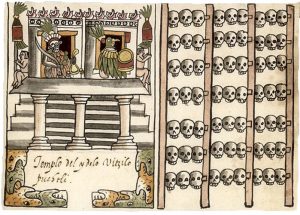
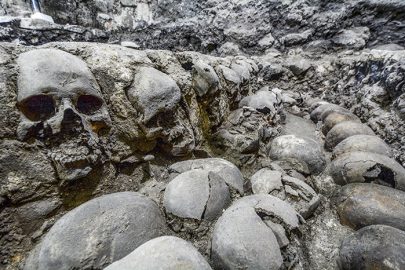
Priests carried the body to another ritual space, where they laid it face-up. Armed with years of practice, detailed anatomical knowledge, and obsidian blades sharper than today’s surgical steel, they made an incision in the thin space between two vertebrae in the neck, expertly decapitating the body. Using their sharp blades, the priests deftly cut away the skin and muscles of the face, reducing it to a skull. Then, they carved large holes in both sides of the skull and slipped it onto a thick wooden post that held other skulls prepared in precisely the same way. The skulls were bound for Tenochtitlan’s tzompantli, an enormous rack of skulls built in front of the Templo Mayor—a pyramid with two temples on top (interactive map). One was dedicated to the war god, Huitzilopochtli, and the other to the rain god, Tlaloc.
>Related articles

Cuba to the US: Yes to dialogue, but we will not discuss regime change

Hellenic Heritage: The new digital hub connecting visitors with 350 archaeological sites and museums

EU, Japan, and the US to sign memorandum on critical minerals next month, aiming to reduce dependence on China

Eventually, after months or years in the sun and rain, a skull would begin to fall to pieces, losing teeth and perhaps even its jaw. The priests would remove it to be fashioned into a mask and placed in an offering, or use mortar to add it to two towers of skulls that flanked the tzompantli. For the Aztecs—the larger cultural group to which the Mexica belonged—those skulls were the seeds that would ensure the continued existence of humanity. They were a sign of life and regeneration, like the first flowers of spring.

But the Spanish conquistadors who marched into Tenochtitlan in 1519 saw them differently. For them, the skulls—and the entire practice of human sacrifice—evinced the Mexica’s barbarism and justified laying waste to the city in 1521. The Spanish tore down the Templo Mayor and the tzompantli in front of it, paved over the ruins, and built what would become Mexico City. And the great rack and towers of skulls passed into the realm of historical mystery.

Read more HERE

Ask me anything

Explore related questions

#archaeology#aztecs#gads#history#interactive#map#Massacre#mexico#Mexico City#photos#Priest#sacrifice#spanish#temple#Templo Mayor#Tenochtitlan#tzompantli#world
> More World

Follow en.protothema.gr on Google News and be the first to know all the news

See all the latest News from Greece and the World, the moment they happen, at en.protothema.gr

> Latest Stories

“Clelia, you have breast cancer. Come back to Athens” – A moving personal testimony

February 5, 2026

Lagarde: International uncertainty is a key risk factor for the Eurozone

February 5, 2026

Giannis Panagopoulos: Who is the “eternal” GSSE president under investigation for embezzling €2.1 million

February 5, 2026

Greece – Italy 15-8: Greece “sinks” Italy and wins bronze at the European Water Polo Championship – Video

February 5, 2026

Researchers reconstruct the scents of ancient civilizations

February 5, 2026

Cuba to the US: Yes to dialogue, but we will not discuss regime change

February 5, 2026

Hellenic Heritage: The new digital hub connecting visitors with 350 archaeological sites and museums

February 5, 2026

The 12th International Summer University on Greek language, culture & media in Sydney

February 5, 2026
All News

> Greece

Arrest of 28-year-old in Glyfada for possession of drugs, he was hiding them in the car’s air vent

Dozens of packages containing narcotic substances were found hidden in the air vent of his vehicle by OPKE police officers

February 5, 2026

Account freezes of up to €2,096,344 for Panagopoulos and five others – Facing two felony charges

February 5, 2026

Armed Forces officer arrested for transmitting classified information, endangering national interests

February 5, 2026

Supreme Court rules trial over Tempi rail disaster will be held in Larissa

February 5, 2026

The Anti–Money Laundering Authority has frozen the bank accounts of GSEE’s Panagopoulos over alleged misappropriation of funds

February 5, 2026
Homepage
PERSONAL DATA PROTECTION POLICY COOKIES POLICY TERM OF USE
Powered by Cloudevo
Copyright © 2026 Πρώτο Θέμα



