

×
GreekEnglish

×
  • Politics
  • Diaspora
  • World
  • Lifestyle
  • Travel
  • Culture
  • Sports
  • Cooking
Friday
13
Feb 2026
weather symbol
Athens 14°C
  • Home
  • Politics
  • Economy
  • World
  • Diaspora
  • Lifestyle
  • Travel
  • Culture
  • Sports
  • Mediterranean Cooking
  • Weather
Contact follow Protothema:
Powered by Cloudevo
> World

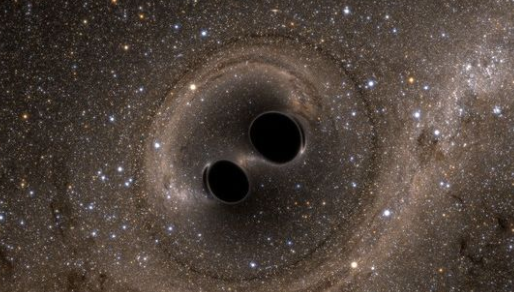
Two Black Holes are merging at the center of a distant Galaxy

But astronomers aren’t holding their breath: They expect the meeting won’t happen for another 100.000 years...

Newsroom February 21 08:07

Strange things are happening in dark corners of the universe.

Astronomers have been tracking bright jets of high-energy particles that periodically wriggle their way through the universe and into sensors here on Earth. The Kepler space telescope picked up the latest such flare in 2011. Ever since then, scientists have been stumped.

Years ago, scientists proposed that the flares could be caused by a strange, amorphous celestial object—two supermassive black holes, trapped in two different galaxies, circling each other. They playfully named the cosmic object “Spikey.”

>Related articles

New questions about Epstein’s death: Coroner speaks of “possible strangulation” and calls for a review

“Maximum security” regime in prisons in Peru

The unknown story behind Ferrero Rocher: How the famous chocolates of the €10 Billion Empire got their name

As supermassive black holes scoot closer and closer to each other, they begin to gobble up bits of dust and gas and belch particles out into space. These high-energy flares, which can be picked up from telescopes orbiting Earth, suggest the supermassive black holes really are on a collision course. But astronomers aren’t holding their breath. They expect the meeting won’t happen for another 100,000 years—an astronomical blink of the eye.

Scientists clued in on the interstellar dustup thanks to a theory proposed in 2017 by two Harvard astrophysicists. They suggested that such a cosmic meeting might be visible thanks to gravitational lensing, when light traveling toward a hypothetical merger bends and warps around the feature, sending out a bright jet of high-energy particles. “It’s a very distinctive signature,” Harvard’s Rosanne Di Stefano told Scientific American, which first reported on the story. Unfortunately, the flares are largely unpredictable.

Read more: Popular Mechanics

Ask me anything

Explore related questions

#astrophysics#black hole#Black Holes#cosmos#galaxy#merging#phenomenon#physics#science#space#technology#universe#world
> More World

Follow en.protothema.gr on Google News and be the first to know all the news

See all the latest News from Greece and the World, the moment they happen, at en.protothema.gr

> Latest Stories

From Faliro to Voula: Who is building the Athenian Riviera

February 13, 2026

Hatzidakis: The twelve-month tourist season in our country is feasible

February 13, 2026

Care packages in the crossfire – How Ukraine’s drone deliveries bring hope to the front

February 13, 2026

Mitsotakis on the donation from the Pavlos and Alexandra Kanellopoulos Foundation: Major multi-million intervention at KAT with 16,000 surgeries per year

February 13, 2026

Bloomberg: US back-and-forth forces Europe to consider developing a unified nuclear deterrent

February 13, 2026

New questions about Epstein’s death: Coroner speaks of “possible strangulation” and calls for a review

February 13, 2026

Clash between Stournaras and Tsipras: “I’m being accused by the man who believed the Bank of Greece should remain silent” – “A third term is sweet”

February 13, 2026

Kyriakos Mitsotakis met with Archbishop Makarios of Australia

February 13, 2026
All News

> Diaspora

Kyriakos Mitsotakis met with Archbishop Makarios of Australia

The postal vote of the expatriates is a great achievement, the Prime Minister stressed, among other things

February 13, 2026

American Hellenic Institute Foundation launches 2026 College Student Foreign Policy Trip

February 13, 2026

Sustainable infrastructure boost for SOS children’s villages with support from The Hellenic Initiative

February 13, 2026

Ignorance is the Greatest Sin – Why education is sacred across civilizations

February 12, 2026

St Nicholas Greek Orthodox Church: Feeding the Homeless – Sunday, February 15

February 11, 2026
Homepage
PERSONAL DATA PROTECTION POLICY COOKIES POLICY TERM OF USE
Powered by Cloudevo
Copyright © 2026 Πρώτο Θέμα



