

×
GreekEnglish

×
  • Politics
  • Diaspora
  • World
  • Lifestyle
  • Travel
  • Culture
  • Sports
  • Cooking
Thursday
16
Jul 2026
weather symbol
Athens 31°C
  • Home
  • Politics
  • Economy
  • World
  • Diaspora
  • Lifestyle
  • Travel
  • Culture
  • Sports
  • Mediterranean Cooking
  • Weather
Contact follow Protothema:
Powered by Cloudevo
> World

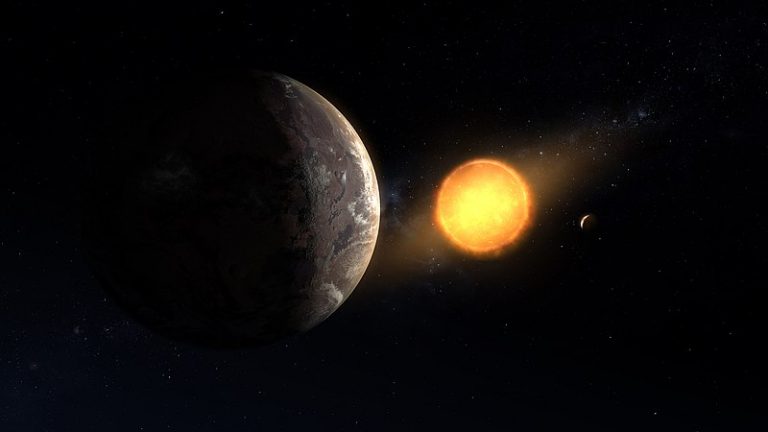
An exoplanet the size of Neptune discovered 32 lightyears from Earth

AU Mic is a young star between 20 and 30 million years old

Newsroom June 25 09:02

Δείτε περισσότερα άρθρα μας στα αποτελέσματα αναζήτησης

Add Protothema.gr on Google

An exoplanet the size of Neptune has been discovered around the young star AU Microscopii, thanks in part to the work of Jonathan Gagné, a former iREx Banting postdoctoral researcher who is now a scientific advisor at the Rio Tinto Alcan Planetarium.

Astrophysicists have been searching for exoplanets in this system, a unique laboratory for studying planetary formation, for more than a decade. The breakthrough, announced today in Nature, was made possible in part by NASA’s TESS and Spitzer space telescopes.

also read 

Leroy Merlin opens new store

>Related articles

After the Moon and Mars, scientists set their sights on Titan: The ambitious plan for a human mission to Saturn’s largest moon

Elon Musk & SpaceX: How the “failed idea” and the Russians’ “NO” led to the launch of a $2 trillion company

Air leak on the International Space Station: Astronauts prepare for possible evacuation

Located about 32 lightyears from Earth, AU Microscopii, or AU Mic, is a young star between 20 and 30 million years old, which is about 180 times younger than our own Sun. In the 2000s, it was found to still be surrounded by a large disc of debris, a remnant of its formation. Since then, astrophysicists have been actively searching for planets around AU Mic, since it is within such discs of dust and gas that they form.

“AU Mic is a small star, with only about 50 per cent of the Sun’s mass,” said Gagné, who participated in the observations and data processing. These stars generally have very strong magnetic fields, which make them very active. That explains in part why it took nearly 15 years to detect the exoplanet, called AU Mic b. The numerous spots and eruptions on the surface of AU Mic hampered its detection, which was already complicated by the presence of the disc.”

more at eurakalert.org

Ask me anything

Explore related questions

#discovery#earth#exoplanet#Neptune#space
> More World

Follow en.protothema.gr on Google News and be the first to know all the news

See all the latest News from Greece and the World, the moment they happen, at en.protothema.gr

> Latest Stories

Mitsotakis: We can win a third term – The political center defeats populism through results and consistency

July 16, 2026

Video: US halts tanker with Hellfire missiles as shipping in the Persian Gulf goes on ‘red alert’

July 16, 2026

UN announces Antonio Guterres’ visit to Cyprus from July 27 to 29

July 16, 2026

Global initiative documents traditional diets before they disappear

July 16, 2026

AADE: Deadline for fertilizer purchase subsidy applications extended until July 31

July 16, 2026

Alexander the Great: Uzbekistan proposes joint film and exhibition with Greece on the Macedonian conqueror

July 16, 2026

The rise of Albanians in Greece’s construction sector: From labourers to contractors and construction company owners

July 16, 2026

Very high wildfire risk tomorrow in Attica, Crete and areas of Central Greece, the Peloponnese and the North Aegean

July 16, 2026
All News

> Greece

In reverence, the emotional deposition in Jerusalem, see photos & video

The Holy Temple of the Resurrection opened after many days due to the war between Israel and Iran

April 10, 2026

In the final stretch for the accreditation of joint master’s degrees: Aiming for their launch in the coming academic year

April 10, 2026

Schedule for Epitaph Procession today (10/4)

April 10, 2026

Perfect weather for Easter excursions, according to Tsatrafyllia’s forecast

April 10, 2026

Easter in Greece: The customs that continue in Greek tradition – From Nafpaktos to Corfu

April 10, 2026
Homepage
PERSONAL DATA PROTECTION POLICY COOKIES POLICY TERM OF USE
Powered by Cloudevo
Copyright © 2026 Πρώτο Θέμα



