





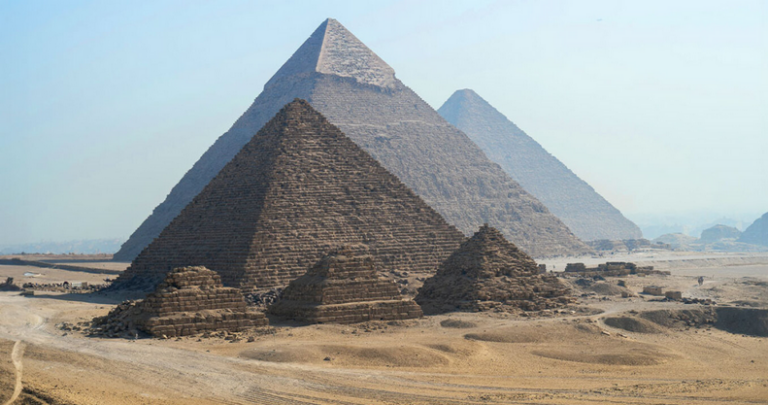
For centuries, the pyramids around Giza have intrigued scholars with their enigmatic construction methods and locations. Researchers have long wondered how the ancient Egyptians moved massive limestone blocks, some weighing over a ton, without using wheels, and why they built these monumental burial sites in the remote, harsh desert.
A recent study published in Communications Earth & Environment provides new insights, suggesting that an extinct branch of the Nile River, called the Ahramat Branch, once flowed through the Giza area during a wetter climate period. This ancient waterway likely facilitated the transportation of materials necessary for constructing the pyramids. The researchers propose that the river enabled the movement of stone and other building materials by boat, with raised causeways connecting the pyramids to river ports along the Nile’s bank. Over time, environmental changes such as drought and seismic activity caused the river to dry up and fill with silt, obscuring its traces and transforming the landscape into the desert seen today.
The study utilized advanced techniques such as satellite radar data, sediment cores, and early 20th-century maps to trace the ancient waterway’s path. This approach has allowed scientists to map the ancient Nile, now buried under desert sand and agricultural land, more comprehensively. The findings reinforce the long-held suspicion that boats played a crucial role in transporting workers and materials, expanding on previous research and providing a more detailed understanding of how the ancient Egyptians used waterways for construction.
Eman Ghoneim, a study author and professor at the University of North Carolina Wilmington, highlighted that the new evidence indicates that waterways were used more extensively for transportation than previously thought. The study examined 31 pyramids between Lisht, south of Cairo, and Giza, constructed over approximately 1,000 years starting around 4,700 years ago. These complexes included royal tombs and nearby burials of high officials, showcasing the significant logistical efforts involved in their construction. Harvard University professor of Egyptology, Peter Der Manuelian, noted that some granite blocks used in pyramid construction were sourced from hundreds of miles away, underscoring the Egyptians’ remarkable capabilities in transporting massive materials over great distances, likely aided by the ancient Nile’s waterways.
Sharon Stone, Liam Neeson insist Kevin Spacey should be un-canceled
Furthermore, Ghoneim and her team explained that the Ahramat Branch shifted eastward over time, likely driven by a drought around 4,050 years ago, before eventually drying up and becoming covered in silt. The researchers plan to expand their mapping efforts to identify additional buried branches of the Nile floodplain. By determining the ancient river branch’s outline and shape, they hope to locate remains of settlements or undiscovered sites before these areas are developed. Manuelian emphasized the importance of such efforts, noting that modern housing developments are encroaching near the Giza plateau, and stressed that Egypt, likened to a vast outdoor museum, still holds many undiscovered treasures waiting to be found.
Ask me anything
Explore related questions




