





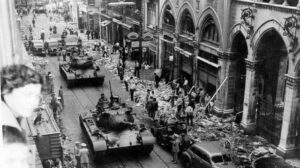
Today marks 69 years since the day when the Hellenism of Constantinople became the scapegoat for the beginning of the EOKA struggle for the unification of Cyprus with Greece. Two seemingly unconnected events, in two different geographical areas, but with the same “object”. Turkey’s intention to impose itself in the eastern Mediterranean by pushing aside the “obstacle” of the Greeks.
For Turkey, Cyprus – Aegean – Constantinople have always constituted a unity in the context of foreign policy, which was not limited to diplomacy. As for the Hellenism of Constantinople the Greek minority has almost disappeared, with the only strong symbolic basis being the presence of the Ecumenical Patriarchate, which is under concerted attacks from Ankara and Moscow.


The events of September 6-7, 1955, were decisive for the future of Greek-Turkish relations and the Cyprus problem, creating conditions of constant tension, which sometimes reached the limits of armed conflict, which was not avoided in 1974.
Intercession with English blessings
A year before the start of the Cypriot struggle for the union with Greece, Turkey had held elections with Adnan Menderes as the all-powerful winner, while post-Civil War Greece was ruled by Marshal Alexandros Papagos. The British did not want to hear about the union of Cyprus with Greece, although they knew that colonialism was coming to an end. For this reason they involved Turkey, thus strengthening its interest in the Turkish Cypriot minority. The beginning of the EOKA struggle was exploited by Menderes within Turkey, by creating a sense of danger for the Turkish Cypriots in Cyprus, but also for the Turks in Turkey itself from the Greek minority that had rallied around the Ecumenical Patriarchate.
Patriarch Athenagoras, was the first target, as he refused to condemn the EOKA struggle and “restore Makarios to order”. At the same time, the Turkish newspapers led by Menderes created a climate of hostility against Greeks, with false news about fundraisers of the Greeks of Constantinople in order to strengthen EOKA which “slaughters Turkish Cypriots”. The student organisation “Cyprus is Turkish” (Kibris Turktur) and the newspaper Hurriyet, which had been founded with the help of the British, played a leading role. The fuse was ready and Menderes lit it on 24 August 1955, in a public statement that had the same content as the articles. The first incident, something of a rehearsal, was the entry of Turks into a church in Constantinople a few days later. They drove out the worshippers and destroyed two more churches.


Provocations in Thessaloniki
On September 6, 1955, a bomb exploded at the Turkish consulate in Thessaloniki, which was housed in what was allegedly thought to be the house where Kemal Atatürk was born. The consul and his family had left for Constantinople the day before. The explosion caused minor damage to the outer wall, but it was enough to mobilise the system that organised the pogrom that followed. The Muslim guard at the Turkish consulate later admitted that he had planted the bomb himself, which had been given to him by a Muslim law student from Komotini. After his arrest and imprisonment, the Muslim student fled to Turkey where he had a…brilliant career as a police chief and later prefect.
A chronicle of brutality
Much has been written and countless testimonies have been recorded about what preceded, what happened and what followed September 6 and 7, 1955 in Istanbul.
In the book September 1955. He reports that initially the Turks maintained formal relations and kept their distance, despite the fact that nothing had happened between them. Then something began to change: “But every afternoon, while a program about Cyprus was being broadcast, they would turn up the volume of the radio on the diaspora and open the windows. The whole neighbourhood echoed with the shouts of fanatical demagogues. On the barge, where most of the passengers knew each other, the greetings of the Turks began to become sharper and sharper and their looks more grim. We Greeks, of course, tried to give no cause and spoke as little as possible. In the café they sold maps of Cyprus which the children bought and painted with their blood after pricking their finger with a needle.”
Another of the Greeks in Constantinople who lived through the 1955 September riots was Byron Theodoropoulos, a diplomat, writer and one of the most authoritative analysts of Turkish politics. In the book by Irini and Kati Sarioglou, “Fifty Years since the September riots” published in Athens in 2005, the “diary” of Byron Theodoropoulos’ events was published:
– “At 13:30, the news of a bomb at Atatürk’s house in Thessaloniki is broadcast on the radio.
– At 16:00, a special supplement of the “Istanbul Express” circulates with the news, publishing a falsified photo of the allegedly destroyed house.
– At 16:30, groups of youths walk the main streets of Peran, writing insulting slogans against Greeks on the walls.
– At 17:30, the first groups of demonstrators gather in Taksim Square.
– At 18:00, the gathering in Taksim Square hears various orators making inflammatory speeches against Greeks and Greece.
– At 18:30, the gathering turns into a demonstration, one group of which reaches up to the General Assembly Hall. A group of people arrives at the Consulate and is dispersed by the immediate appearance of police forces, who close all access to the Consulate.
– At 19:00, the breaking of the glass panes and iron doors of the expatriate shops in Taksim Square and Peran Street begins. Almost at the same time, with little difference, violence begins to occur in the other districts and within two hours it has become widespread…
– Just after 2 a.m. the declaration of martial law is touched and the first military units appear. After that the situation calms down.”


Vyron Theodoropoulos noted in his book “50 Years since the September riots” that on the evening of September 6, 19955 in Constantinople “there were looting groups, who had come from Eastern Thrace and were riding in trucks. After completing their vandalism, they left with their loot. The perpetrators were not only vagrants, peasants, villagers and ‘raggedy types of Qassim Pasha’. There were among them female students, bourgeoisie ladies and even lawyers! The main slogans were: ‘To hell with the Greeks’ and ‘Down with Greece’. Later the slogan ‘Today the plunder, tomorrow the slaughter’ dominated.”
Testimonies published in the years that followed recorded crimes of rape, even of underage girls in front of a crowd, humiliation of priests and humiliation with Greeks forced to shout “Cyprus is Turkish” under the threat of knives. The incidents were organised as signs had been placed in the houses of the Greeks beforehand so that the ‘demonstrators’ would know where to strike, just like the “Krystall Nacht”. In total 16 people were killed and 200 women and girls were raped. Dozens of churches and thousands of Greek homes and businesses were destroyed. Similar incidents on a smaller scale took place in Izmir and Ankara.
Great costs were paid by the priests of the Ecumenical Patriarchate. Journalist Noel Barber, a correspondent for the Daily Mail, wrote in a report, “The Yendi Koule church was completely destroyed and one priest was thrown from his bed, had his hair ripped from his head and literally had the beard ripped from his chin. Another elderly priest in a house belonging to this temple, who was very ill and could not move, was left in his bed and his house was set on fire, and he was burned alive. At the Genikioi temple, a beautiful site on the edge of the Bosphorus, a 75-year-old priest was taken out into the street, stripped naked, tied behind a car and dragged through the streets. In the church of Genia Mahalle, a priest was stripped, tied to the back of a truck and carried naked through the streets. They tried to tear out a priest’s hair but failed to scratch his skull like they did to many others.”
Parole and hanging
Initially the Turkish government attempted to blame the communists for the riots, even making hundreds of arrests. The attempt failed and under international outcry, Ankara apologized to Greece and in a show of goodwill honored the Greek flag in a ceremony in Smyrna. In 1960 the Menderes government was overthrown and he and Foreign Minister Zorlou were also tried for the September 1955 incidents and sentenced to death by hanging.
It is noteworthy that in one twenty-four hour period there was property damage which international organizations estimated at $150,000,000. The greatest cost, however, was not financial. The Hellenism of Constantinople has drastically decreased from the over 150,000 it numbered, and today there are only about 3,000 left, unlike the Muslims of Western Thrace, who are multiplying.
Ask me anything
Explore related questions




