





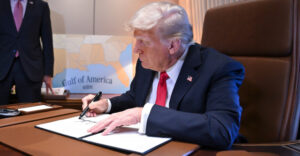
US President Donald Trump, has announced his upcoming moves from Air Force One, revealing that he plans to tariffs of 25% on all steel and aluminum imports into the United States, starting today. Continuing an undeclared trade “war,” Trump explained that “we will also announce steel tariffs on Monday,” adding, “any steel that comes into the United States is going to have a 25% tariff,” not excluding aluminum.
At the same time, economic analysts and political operatives alike are waiting with bated breath for the press conference the U.S. President has announced for mid-week, where he intends to announce massive new reciprocal tariffs, which could match other countries’ tariffs on U.S. goods dollar for dollar. “Quite simply, it’s if they charge us, we charge them,” Trump said, without elaborating further, still avoiding specifying whether the new steel and aluminum tariffs would be on top of tariffs already in place on exports from countries such as China.
Note that Trump had triggered a bunch of tariffs on steel and 10% tariffs on aluminum in 2018, from which he exempted Mexico and Canada a year later. But also beginning his second term, he imposed 10% tariffs last week on all Chinese products imported into the United States, in addition to the tariffs already in place on China. The latter responded almost immediately with economic “retaliation” of its own, introducing controls on 25 rare metals, investigating Google and placing PVH, owner of brands Calvin Klein and Tommy Hilfiger on the “undesirable” list. In addition, Beijing’s tariffs on US products include a 15% tax on imports of US coal and liquefied natural gas products, and a 10% tariff on US crude oil, farm machinery and large-engine cars.
At the same time, the new tariffs on steel and aluminum announced by President Trump cannot be ruled out to significantly hurt the US economy, as both are used in industries such as: automotive, aerospace, oil production, as well as construction and infrastructure. In this light, there is a fear of a possible increase in production costs for industries, which in turn could increase the price of their products.
Indeed, given that the biggest exporters of steel to the US are Canada and Mexico, the situation is further complicated by the US President “freezing” for a month at least the tariffs he had intended on their products. At the same time, however, Canada accounts for nearly a quarter of the steel imported by U.S. companies by weight, while Mexico accounts for about 12%, according to the American Iron and Steel Institute. However, domestic production in the US fell about 2% last year compared to 2023 and down nearly 10% from where it stood a decade ago.
Is the EU next in line?
The fact, however, that President Trump has refrained from expanding on the type of tariffs he intends to impose has already raised alarm in European capitals, given that the POTUS has made no secret in recent days of their discomfort with EU tariffs on US car imports, considering them to be far higher than US levies. In this context, speaking to the BBC the other day, the US President commented that tariffs on EU goods could happen “quite soon“, but singled out the UK, for which he could “work out” a special deal. In any case, US tariffs are influenced by different import policies for goods, but also by economic partnerships, as in the case of the EU.
On the possibility that the European Union could be targeted by Donald Trump’s sanctions, French President Emanuel Macron told CNN yesterday that “I think we have to be ready (…) to react. I think that, more broadly, the EU must be ready to defend what it wants and what it needs.” “When I think about the situation, my first question for the US is: what is your first problem? Is it the EU? I don’t think so. Your first problem is China,” said the French president, who expressed himself in English, stressing that the EU remains an “ally” of Washington. “If you want Europe to invest more and commit to security and defence (…) I think it is in the interest of the US not to turn against Europe, not to threaten it with customs tariffs,” he continued.
At the same time, Emmanuel Macron openly warned of any consequences that measures of this nature would have for Americans, saying that “if you proceeded to impose tariffs in various sectors, this would lead to a rise in prices and increase inflation in the United States. Is that what the people want? I don’t think so.”
Tsunami of reactions
Aside from President Macron, an initial reaction to Donald Trump’s announcements was registered by Ontario Premier Dug Ford, who accused Trump in an online post of “shifting goalposts and constant chaos, putting our economy at risk” given that Canada’s steel production is concentrated in Ontario. Almost simultaneously, Donald Trump’s announcements of new tariffs have caused the stocks of major South Korean steel and auto manufacturers to fall, when South Korea is a major steel exporter to the US. Specifically, according to the BBC, shares in steel company POSCO fell as much as 3.6%, those of Hyundai Steel as much as 2.9% and automaker Kia Corp fell 3.6% during morning trading.
Ask me anything
Explore related questions




