





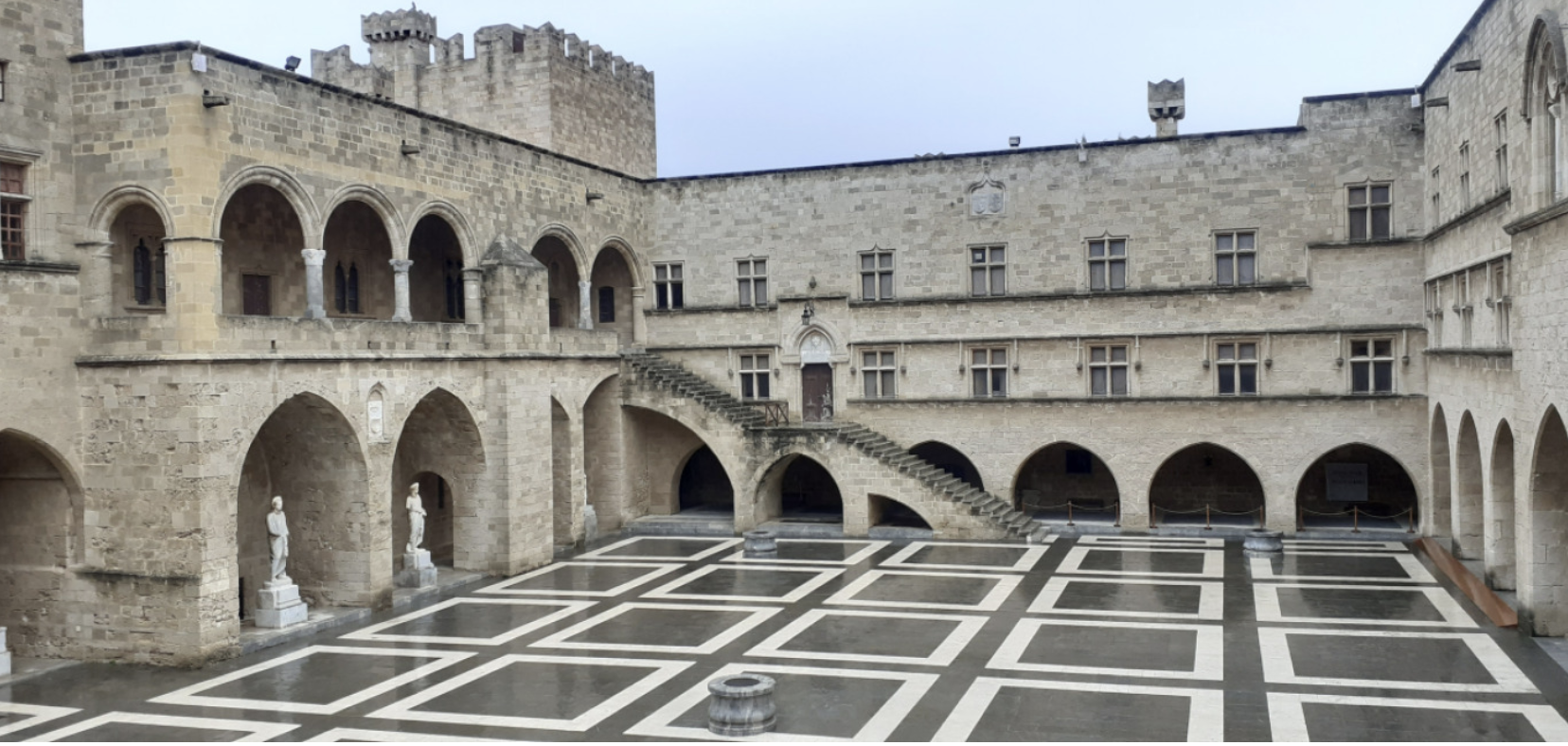
The Ministry of Culture is launching a project for the protection and enhancement of the Palace of the Grand Master, located in the Medieval City of Rhodes, a UNESCO World Heritage Site. To this end, the Technical University of Crete has been commissioned to conduct a research program aimed at documenting the current condition, analyzing the structural pathologies, and developing proposals for the restoration of this iconic monument.
The research includes historical documentation of the construction phases and previous interventions on the monument, architectural mapping, analysis of building materials, damage assessment, structural integrity checks, and proposals for structural restoration. These efforts will be aligned with the architectural morphology of the complex, facilitating the integration of new functions inside the monument and within its outdoor areas, including the courtyard and gardens. The plan also includes electromechanical system upgrades, a fire protection study, and improved accessibility for people with disabilities across most of the site.
The Minister of Culture, Lina Mendoni, stated:
*”The Medieval City of Rhodes is not just a major asset for Rhodes and the Dodecanese—it is one of Greece’s great comparative advantages. It is a unique urban ensemble in our country, preserved almost intact with its fortifications, urban layout, public buildings, churches, and residences. We must invest in this space, which has been declared a UNESCO World Heritage Site, to secure a better future for both the city and its residents.
A dominant and significant landmark is the Palace of the Grand Master. The Ministry of Culture, in collaboration with the School of Architecture of the Technical University of Crete, has developed a research program, which, following the positive recommendation of the Central Archaeological Council, sets the roadmap for a series of restoration and redesign projects at the palace.
There are also functional challenges, particularly accessibility for people with disabilities. Visitors are largely restricted to the courtyard and a few sections of the building, while the existing elevator provides limited access. Despite the presence of an accessible restroom, general accessibility remains inadequate. Ensuring full access for people with disabilities and adapting modern uses to the monument is a priority for us. Additionally, the palace’s connection to its surroundings is limited.
This complex project is part of our broader plan for enhancing the monuments of the Medieval City of Rhodes. Through targeted actions and projects, our goal is to contribute to the sustainable utilization and protection of the monumental ensemble. By restoring and showcasing the Palace, alongside the revitalization of the ancient shipyards and medieval gardens, the integration of an outdoor sculpture gallery in Perivola, and the functional connection with the palace gardens, we are creating a unique, unified archaeological site in the heart of Rhodes—unprecedented in Greece.”*
Architectural Features and Restoration Challenges
The Palace of the Grand Master stands at the northernmost edge of Rhodes’ fortified medieval city and was shaped by the urban planning of the ancient city. Its architectural composition is marked by asymmetries and variations in mass distribution, reflecting successive construction phases. The complex extends over four above-ground levels (ground floor, mezzanine, upper floor, rooftop) and three underground levels.
According to research, in terms of spatial organization, the ground floor features non-monumental spaces except for the chapel and the eastern colonnade. This level currently houses visitor reception, ticketing, a gift shop, offices, security checkpoints, restrooms, and exhibition halls dedicated to Rhodes’ history and post-Byzantine antiquities, as well as a café and a small chapel. The mezzanine accommodates conservation laboratories and archaeological storage.
The main museum space is located on the upper floor (piano nobile), featuring a perimeter route that leads visitors through the most important and monumental rooms of the palace. Exhibits include Hermes Balducci pinxit: Mosaic Floors from Kos and From the Knights of St. John to the Knights of Malta. The rooftop spaces are currently unused, while part of the permanent exhibition on Rhodes’ history is housed in the basement.
The current state of the palace presents structural and construction challenges, primarily due to moisture, thermal stress, disintegration of mortars, stone erosion, and seismic wear. Regarding visitor facilities, the functional layout is fragmented, making navigation difficult. Issues include insufficient restrooms relative to the high number of visitors, poorly organized café and gift shop, inadequate signage for pathways and information, and problems with lighting and ventilation. The lack of clear signage makes it difficult for visitors to navigate both to the exhibits and to service areas. Facilities are scattered, rather than forming a cohesive visitor experience, limiting the connection between the palace, the fortress, and the gardens.
The Palace’s Historical Evolution
The Palace of the Grand Master is located within the early Byzantine acropolis at the northern tip of Rhodes, incorporating sections of earlier structures into its late medieval construction. Byzantine remnants are preserved up to the ground floor, while the northwest tower contains Hellenistic elements, possibly the base of the Colossus of Rhodes.
During the Knights’ period (from 1309 onward), the palace functioned as the administrative center of the Order of St. John, undergoing significant renovations until the 15th century. After the Ottoman siege of 1480 and an earthquake in 1481, extensive repairs were carried out. The layout of the Knights’ period included a ground floor and upper level, with towers and an outer wall. The 1522 Ottoman siege caused severe destruction, and the palace was never fully restored to its original form.
Over the following decades, the palace was used first as a prison for princes and later as a general prison. In 1856, an earthquake and gunpowder explosion destroyed the upper floor and much of the ground level. During the late Ottoman period, the building was used as a women’s prison.
Under Italian rule (1937–1948), the palace was restored to emphasize Rhodes’ Latin past and converted into a grand complex for housing officials, the governor’s residence, and the summer residence of the King of Italy and Mussolini. The main areas included the Hall of Kings and the Hall of the Governor, along with living quarters for the governor and the king.
After the Italians left in 1948, and with the Dodecanese’s union with Greece, the Palace of the Knights was declared a preserved monument and designated as a public heritage site for visitors and cultural events.
Ask me anything
Explore related questions




