





The most beautiful open-air theater of Athens, synonymous with beautiful nights with full moon under the Acropolis and the Athens and Epidaurus Festival, will remain closed for three years, as restoration works and its maintenance were deemed necessary.
According to information from Proto Thema, the closing of the Herodeion will have a celebratory tone with an important performance by Dimitris Papaioannou, dedicated to his work, in collaboration with the Museum of Cycladic Art and the Goulandris Foundation.
The works at the Herodeion had been deemed necessary for three years now, as there is a matter of danger and deterioration of many critical points — relevant statements have been made in the past also by the Minister of Culture Lina Mendoni — but the load of the program and of the events had not allowed for something like this to be possible. Now, however, the works on the monument from the wall of the cavea to the passageways and the seats are considered necessary due to its almost exhaustive use and the wear from the weather conditions.
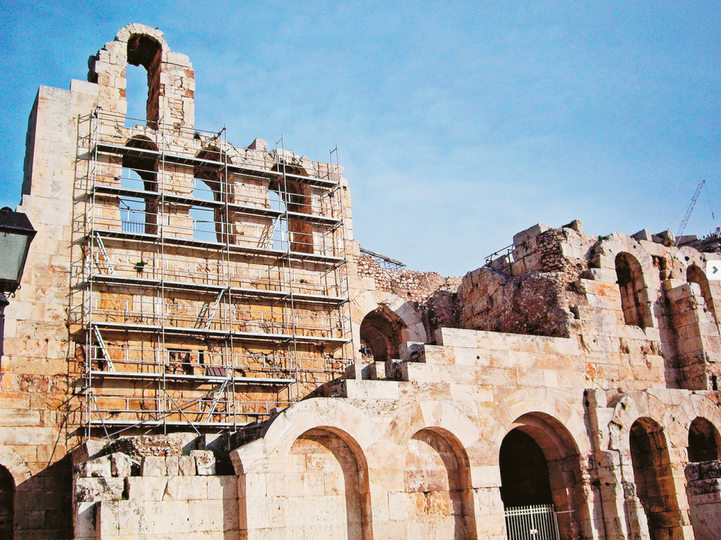
The restoration works at the Herodeion may be scheduled to begin immediately after its closing, this coming October, but essentially they are a continuation of a laborious project that has started for years now and constitutes a continuation of the previous NSRF, which included studies and works of maintenance and restoration of the monument.
So that, indeed, the works may be done as they should and the studies — which, according to information, have already progressed — may be implemented in the proper way, a special team had been formed in the past, which possesses the necessary knowledge so as to supervise the works: by the civil engineer of the Ministry of Culture Vasilis Chandakas, but also the award-winning for his work and deep knower not only of the Herodeion but also of the neighboring Theater of Dionysus, the Sanctuary of Asclepius, and the entire southern slope of the Acropolis, Michalis Lefantzis, and of course the now permanent “resident” of the Acropolis, directly connected with the restoration works on the Sacred Rock and the Herodeion, Manolis Korres. These are the ones who ensure that everything is done in the proper way at the Herodeion and that mistakes from previous works — which had even created static (structural) problems at the monument, which is not a simple theater but an operating emblematic space with enormous history — may be avoided.
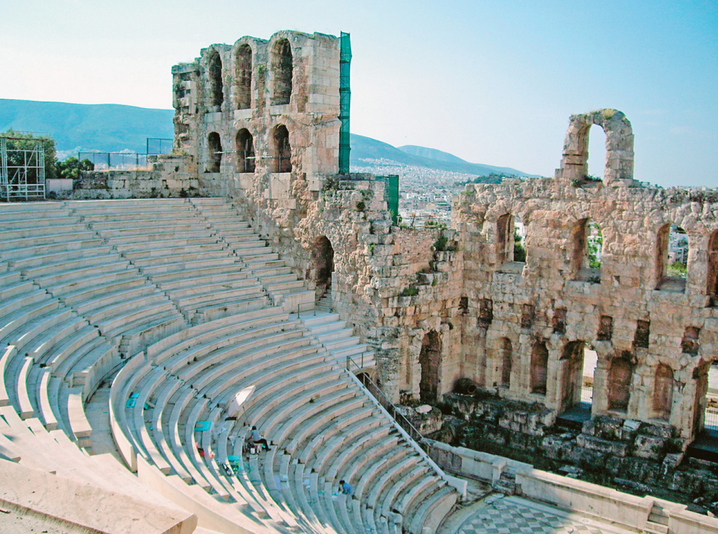
The roofed Herodeion, the bullfights, and its endless stories
For ten whole years they built the masterpiece of architecture, which was founded by the art-loving Tiberius Claudius Atticus Herodes, one of the renowned sons-in-law and patrons of the time, who loved philosophy and the arts and aimed to turn the city into a point of reference. Especially the theater that he dedicated to the memory of his unjustly lost and music-loving companion Aspasia Annia Regilla, who died in 160 AD, was meant to host musical contests — that is, concerts — and to be among the most beautiful and imposing of its time, with white marble slabs covering the floor of the orchestra, while the walls were adorned with elaborate mosaics, which over time were covered with slabs, and with a series of statues decorating its surroundings.
Indeed, contrary to what was believed, the Herodeion had a wooden roof, according to research conducted by Manolis Korres, who knows well every corner of the theater. The roof, according to the findings he discovered, was a true architectural marvel, as it was built without intermediate columns. The construction, in fact, is due to an inconceivable-for-the-time technology, which helped so that precious wooden parts from cedar, weighing almost one ton, were transported and installed. Obviously, nothing less would fit such a theater, which aimed to compete with the magnificent preexisting Odeon of Pericles.
However, the Herodeion, over the passage of time, was not fated to always host beautiful spectacles — in its space even bullfights have taken place — but it managed to remain untouched for 100 years, until its destruction by the Heruli in 267 AD, following the fate of many corresponding emblematic ancient buildings, except for the Acropolis.
In the years that followed, the monument would be transformed into a fortress in order for the inhabitants to be protected from raiders, while the entrances that lead to the upper tier would be closed. It is, however, this covering with earth that would help it to escape from the successive raiders — Catalans, Franks, Venetians — and later from the fighting Greeks, such as Makrygiannis, who would find refuge there. During the 18th century, that is during Turkish rule, the so-called serpentzès would be built on the western side of the perimeter wall of the cavea. The testimonies come from the countless travelers who visited Athens, who record that the theater was in an idyllic spot, filled with earth and therefore almost invisible, with sheep grazing just below and very few realizing its historical importance.
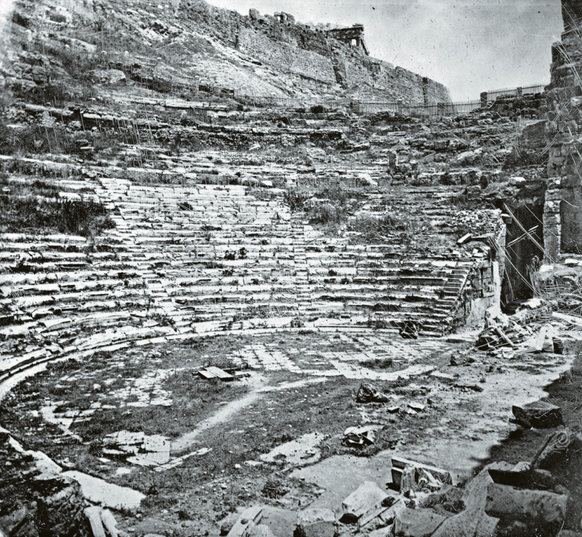
As the years passed, various speculations began about what exactly its ruins were: some said it was the school of Aristotle, others believed it was the Areios Pagos or the Theater of Dionysus found a little further down. We had to reach post-Ottoman Athens for excavation work to begin and for the soil that covered the Odeon to be finally removed.
The first who correctly realized that it was an Odeon was the British archaeologist Richard Chandler, who, however, fell into a mistake of identification, thinking that it was the earlier Odeon of Pericles, next to the Theater of Dionysus, which had been built in 435 BC by Pericles for the holding of the musical events of the Panathenaia, which was burned by Sulla, and Pausanias referred to it as the most “magnificent of all the buildings of the Greeks.” This is also one of the emblematic destroyed monuments of antiquity and indicative of the great importance that the Odeons and music had for the Ancient Greeks.
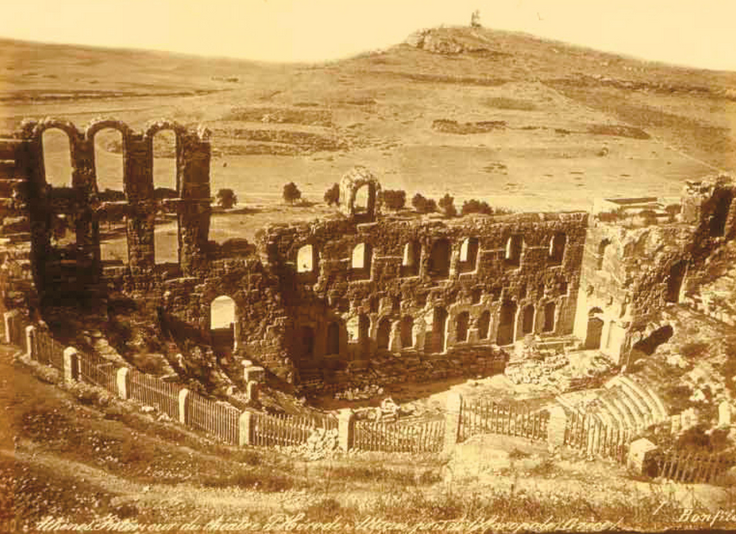
Queen Olga inaugurates the Herodeion
The modern history of the Herodeion essentially begins in the 19th century and specifically in 1867, when for the first time a performance takes place in honor of the newly-crowned Queen Olga, while in 1926 Richard Strauss gives a series of historic concerts, sealing the significant stature of a theater that never stopped highlighting quality performances.
The Delphic Festivals that the Sikelianos couple revived in 1927 and 1930 helped for ancient drama to come back to life in its natural space and for the Herodeion to remember again its glorious past. It was then that they were thinking the theater should operate exclusively for performances of ancient Greek drama, until requests for musical concerts began to arrive. Shortly before the outbreak of World War II, the National Opera of Berlin would inaugurate the summer events of 1939 with a concert under the direction of Herbert von Karajan, which would make history. The necessity of hosting more spectators led to its expansion.
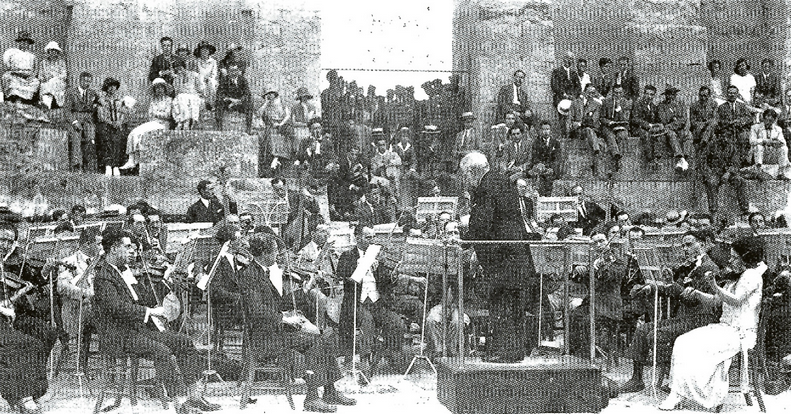
(Richard Strauss during a concert at the Herodeion, in May 1926)
This need arose especially when, in 1957, Maria Callas was invited to Greece to inaugurate the Athens Festival and the postwar cultural scene. The enormous amount given for her appearances was considered a scandal for a Greece that was struggling financially to stand on its feet, while the refusal of the great diva to appear at the Herodeion due to illness had caused a huge political issue. Eventually the performance was given, after many adventures, and Callas’s presence was the beginning of the arrival of top names within the framework of the Athens Festival and at the Herodeion, which was synonymous with its course.
In the same year, at the Herodeion will be staged Koun’s “Persians,” which will make History, while no one will forget great personalities who passed through the Herodeion, from Luciano Pavarotti and José Carreras to Rudolf Nureyev and Martha Graham, contributing decisively to its great history.
One cannot but feel awe as one is called to appear in the shadow of the Acropolis, with the cicadas giving the rhythm and the summer moon lighting up the white marbles. Admirable also its acoustics, since the architecture helps so that the sound reaches the upper tiers: in the lower tier from the beginning of its construction it is speculated that there existed bronze loudspeakers that contributed to the sound’s intensity, justifying its use.
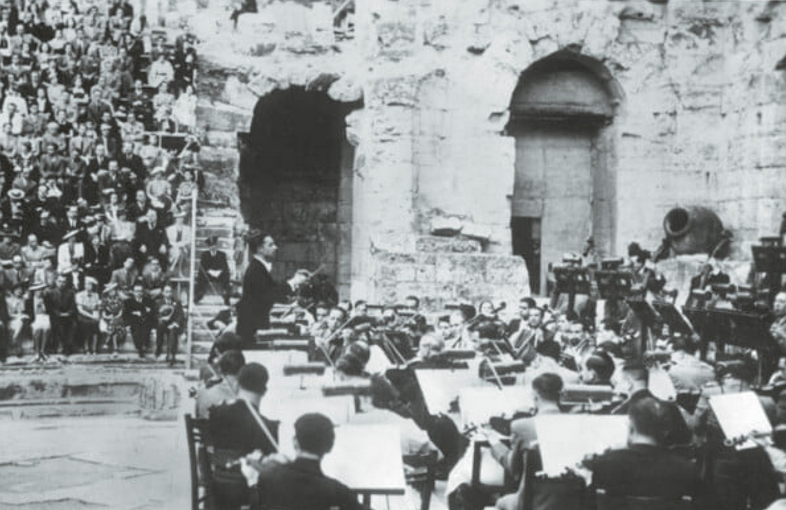
(Concert of the Symphony Orchestra of the Athens Conservatory with conductor Herbert von Karajan at the Herodeion, in 1939)
The reconstruction works – How they are expected to take place
To understand the importance of the Herodeion, one must, however, have a general picture of the broader area into which it is included, which touches the whole southern slope of the Acropolis and reaches up to Dionysiou Areopagitou, where the main entrance is, with the emblematic stone pavements constructed by Pikionis. It is no coincidence that the Herodeion borders the Sanctuary of Asclepius and Dionysus, in honor of whom the brightest festival of Athens was celebrated, synonymous with the history of theater, the City Dionysia. The fact that it is located at the western edge of the southern slope of the Acropolis is not at all a coincidence, since it constitutes part of the larger sacred area.
Reconstructions took place at the Herodeion already from 1997 and for this reason a special committee was organized, which exists to this day and supervises the works, which is called the Committee of the Monuments of the Southern Slope of the Acropolis. From then began the restoration works of the stage and the repair of the vaulted passages and the staircases, while restored to a large extent — since pieces had detached — were the eastern and western arch of the impressive vaulted stage façade.
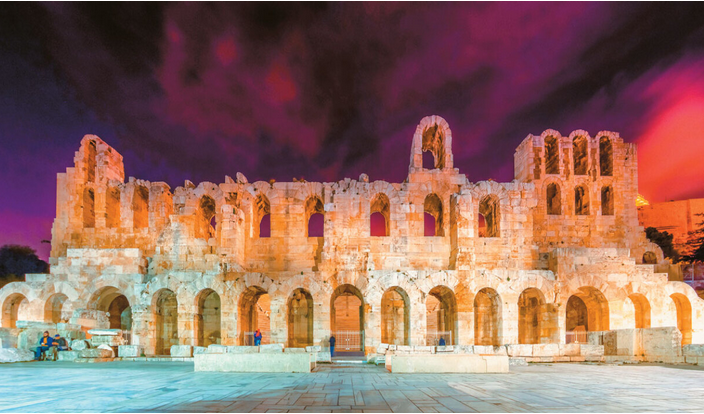
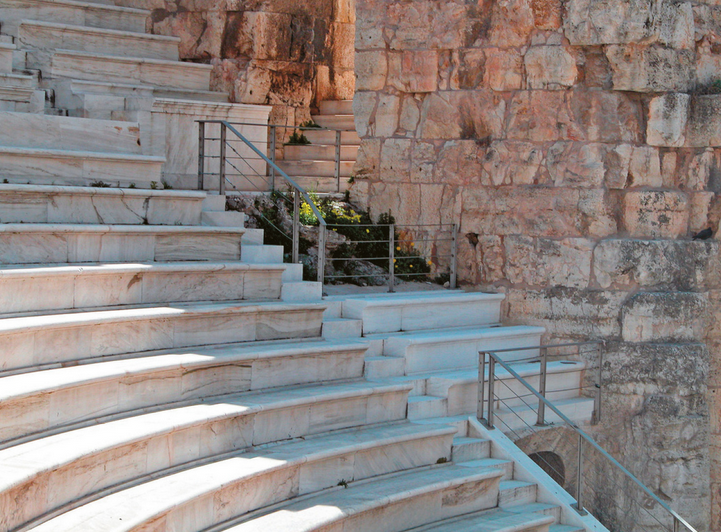
For the shaping, moreover, of the additions so that they would not look foreign to the original façade, casts were taken and with the use of a pantograph they were constructed from new Piraeus stone — and not from other added material that could create structural problems. Simultaneously with the reinforcement works on the walls of the monument, began from then and are expected to continue the works on the ancient marble seats and the stairways which remain always exposed to both strenuous use and to the weather conditions. It is enough, also, for one to see how the passages and especially the vaults were in the early 2000s and the appearance they have after their restoration, since they are among the first things affected by the weather conditions, while necessary is the removal of the mosses that grow between the stones.
The greatest damage due to extended use has, however, been suffered by the seats, and thus both the maintenance and the repair of the damages must be very careful, the material must be studied, the specific marble, and the previous studies and restoration works must also be taken into account. The most demanding part, however, with regard to the restoration, is always the vaults, as in previous corresponding works it was found that they had a different tilt, resulting in their surface resembling more a cone, making the restoration work even more difficult.
To this helped to a huge extent — and is expected to help again — technology, since it managed to study with precision the vaults in a 3D model and the birthplaces (starting points) were recorded. Also, the major errors that had been made in previous restorations were corrected, even the structural problems that were created from poor interventions in the past, where damages had been hastily covered with cement mortar. The important thing with today’s works is that they follow the logic of the original construction, preferring in many cases the in situ joining and the hand carving, no matter how time-consuming and costly it may seem.
Enormous are also expected to be the damages on the floor of the orchestra, since unfortunately the rules are not followed which strictly prohibit high heels, which wear down not only the interior but also the exterior space of the Herodeion, causing further destruction to the seats and the passages.
Despite whatever problems, though — and others that are expected to arise along the way — the Herodeion will continue to operate normally until the end of October with a series of important performances, among them a new version of “Inside” by Dimitris Papaioannou, but this time transferred not only to the urban landscape but also to the Cyclades, an external representation of the inner world of the great creator and artist.
Closing with Dimitris Papaioannou
In a year when the Herodeion saw more performances than any other year, since many were the organizations, apart from the Athens Festival, that wanted to use it, a performance had to be found that matched the space and meant much for art and History. Therefore, there could not have been a better occasion than the special performance being prepared by Dimitris Papaioannou with axis the Cyclades and inspired by previous ways of evaluating the urban landscape, as we had seen in “Inside.”
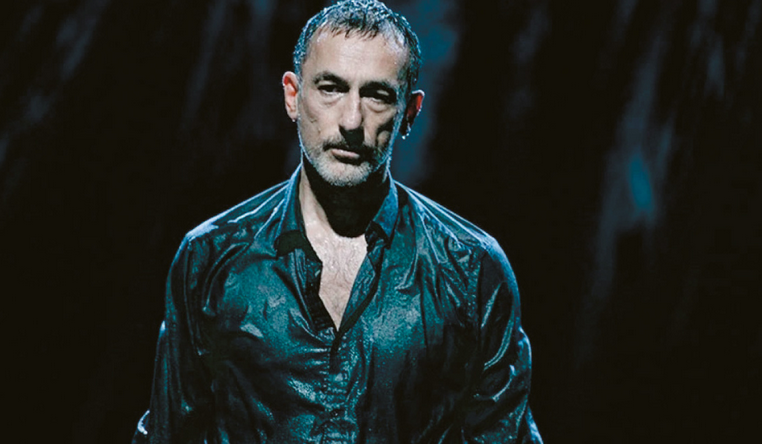
The various soundscapes, the use of technology, and the manic devotion to every tangible, bodily detail that the performance presupposes are the basic elements that compose this surprise-show that he will stage at the Herodeion, “Hors série,” as they usually say in France. The emblematic artist and creator submits this dynamic composition through his many years of experience from the parallel cohabitation in the noisy environment of Athens and in the authentic landscape of the Cyclades, a connection and influence from his early apprenticeship beside Tsarouchis and the generation of the ’30s and his later reference to the elements of modernism.
As a result, the performance, which has already received approval from the Central Archaeological Council (KAS), will accompany in the best way the conclusion of the cultural events at the Herodeion and its closing for a three-year period, and it is a collaboration of the artist with the Goulandris Foundation and the Museum of Cycladic Art.
Ask me anything
Explore related questions




