






The payroll for uniformed personnel is being radically overhauled, effective 1.10.2025 – though payments may be made one or two months later, retroactive to October.
The new payroll for the Armed Forces and Security Services, announced yesterday by Minister of National Economy Kyriakos Pierrakakis and Deputy Minister Thanos Petralias, brings average increases of €128 per month for more than 150,000 staff, with significant variations depending on branch and category.

With these changes, in the Armed Forces the average raise will be €145, but with variations:
• Category A (senior officers): average raise €276/month
• Category B (non-commissioned officers): average raise €128/month
• Category C (contracted volunteers, etc.): average raise €103/month
In the Police, the average raise will be €111: in Category A €236, Category B €128, Category C €92, and Category D (Special Guards) €63 gross per month.
In the Fire Service and Coast Guard, the same applies as in the Police, with the same multipliers and an average raise of €111 – again with differences depending on category.
Raises every 2–3 years
Currently, there are 35 pay scales based on a combination of years of service and rank. In some cases, personnel at the same scale may be either in a higher rank with fewer years or in a lower rank with more years, creating inconsistencies where for up to 15 years some receive the same pay.
This system of 35 scales is being fully restructured. A new system based on years of service (like a service allowance) is introduced so that pay changes every two or three years.
The philosophy of the new payroll changes radically:
• The base salary no longer depends only on rank, but primarily on years of service.
• The old logic of 35 scales is reduced to 20, directly linking base salary with years of service. An NCO or officer will no longer move into a higher category only through administrative decisions or promotions, but will automatically see improvements in pay based on service duration.
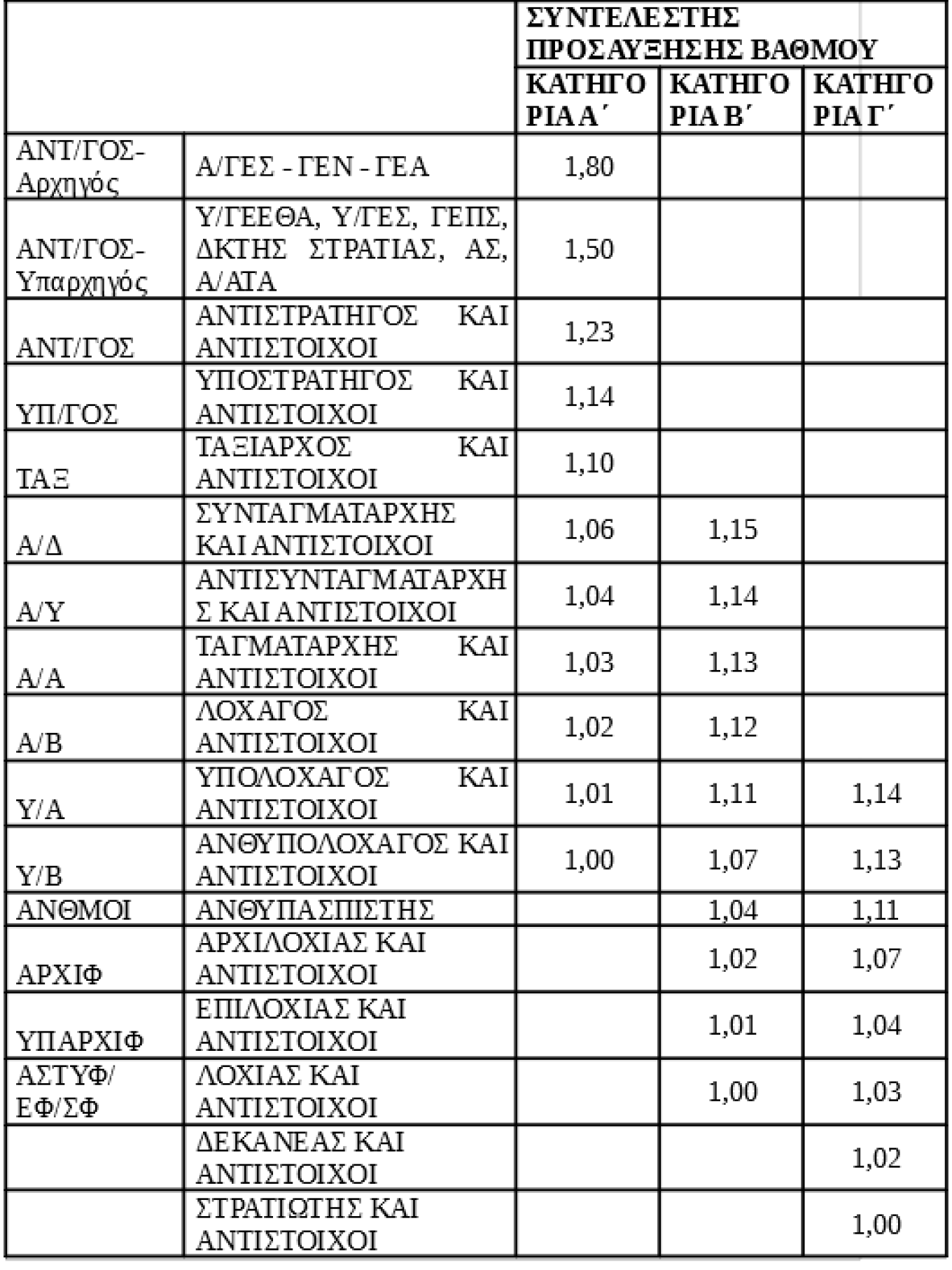
• On top of this new base salary, rank multipliers will be applied, to be announced by the competent ministries. At the same time, the responsibility allowance is increased (e.g., for colonels from €78 to €100), and for the first time, a command allowance is introduced in the Armed Forces.
This means that the higher the position of responsibility, the greater the multiplier, resulting in senior officers having a significant difference compared to newly appointed NCOs.
The base salary will be common for the Armed Forces and Security Services (Police, Fire Service, Coast Guard). However, there will be small differences in the multipliers and ranking system in the Armed Forces, meaning a different process of rank advancement. They will share the same base salary based on years, but the rank multiplier will differ slightly. Responsibility allowances also increase. A Major, for example, will go from a €39 allowance to €100.
How the raises are determined
• The largest raises go to Category A personnel (graduates of military academies and officer schools). Their average boost exceeds €250, reaching up to €276/month, especially for those in command positions.
• Category B (NCOs, warrant officers, constables, firefighters, coast guard personnel) will see more moderate increases of about €110–130.
• Category C (volunteers, contract soldiers, etc.) will see smaller raises, averaging €90–100.
• Special Guards and Border Guards (Category D in the Police) will see the lowest raises, around €60.
• Fire Service and Coast Guard follow the Police, with average raises of €111.
Examples of raises
• Captain (Category A) with 15 years of service: net raise ~€230/month
• Police Constable (Category B) with 10 years of service: raise ~€110/month
• Special Guard (Category D) with 5 years of service: raise ~€60/month
On an annual basis, raises amount to about €1,500 more per year per uniformed member (on average), while for higher categories the benefit exceeds €3,000 annually.
By contrast, in lower categories, raises are noticeably smaller. In Category B (NCOs, warrant officers, constables, firefighters, coast guard), the average raise is €128 in the Armed Forces and €108 in the Police. In Category C (volunteers, contract soldiers, etc.), raises are about €103 in the Army and €92 in the Police. In the final Category D (Special Guards, Border Guards), raises do not exceed €63, placing them at the lower end.
Changes in responsibility allowances
At the same time, the new payroll significantly increases responsibility allowances. For example, the colonel’s allowance rises from €78 to €200, while that of a lieutenant general goes from €325 to €400. In addition, for the first time, the Armed Forces will have a special command allowance, starting at €100 for majors and reaching €400 for top officers. This new tool highlights the government’s emphasis on experience and responsibility.

In practice, the picture looks as follows:
• A Category A captain with 15 years of service will see a net raise of about €230/month.
• A Category B police constable with 10 years of service will see about €110, while a Special Guard with 5 years of service will get about €60.
• For the highest ranks, raises in some cases exceed €300 net.
Overall, with an average Armed Forces raise of €145, the total annual cost reaches €152.5 million including employer contributions. For the Police, with an average monthly raise of €111, the annual cost is €88.5 million. For the Fire Service and Coast Guard, the average raise is also €111, costing €20 million and €13 million respectively. The total cost of the reform amounts to €279 million.
All these raises for uniformed personnel will be paid starting in October. If payroll systems are not ready by October due to legislative processing, payment will be made in November retroactively from October.
It should be noted that thousands of uniformed personnel already received in July this year the hazard allowance of €100/month, in April the €30 raise given to civil servants, and in January they will benefit further from income tax cuts, while next April they will also see a new raise based on the minimum wage – with the overall impact reflected in their net pay, as shown in the tables below.


Ask me anything
Explore related questions




