





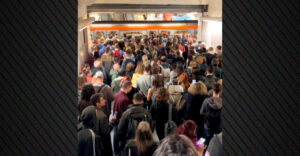
Suffocatingly crowded platforms, passengers who can’t even fit on the next service, overcrowded carriages, and complaints of constant delays. The Metro of Athens is experiencing days of intense overcrowding, with the morning and afternoon rush hours turning into an ordeal for thousands of citizens.
The early morning and early afternoon hours and the early morning and early evening hours of the city are a major source of stress for many people.
In Syndma, the scenes of suffering are repeated almost daily, as streams of passengers meet from all lines of the network. The station remains the network’s heavy artillery, with an average daily throughput of 64,000, not counting passengers transferring internally from one Line to another without validating a fare.
The highlight came on the morning of last Monday, October 20, when traffic on Line 3 “broke” the usual records and throughput soared to 68,400 crossings.
It goes without saying that when a train is hastily withdrawn due to an indication of a fault for safety reasons, it goes without saying that a temporary slowdown is caused. Since the next day of the incident, the flow, as they point out, has returned to normal levels with 10 train crossings and an average time difference of 3.5 minutes.
According to STASY, October is historically the month with the highest ridership, as it coincides with the full return of all city activities. At the same time, following the extension of Line 3 to Piraeus, distances and routes have lengthened, increasing operational requirements and the need for fleet maintenance.
The company is implementing an extensive fleet and infrastructure upgrade program that aspires to improve times and create a more modern and efficient network.
Operational trains have increased from 40 to 56 compared to 2019, with 16 trains already relocated and 5 more returning to the network soon.
Air conditioners are being installed on 12 trains, 24 are being completely refurbished on Line 1, while projects are progressing to replace 32km of track and refurbish stations. At the same time, through Hellenic Metro SA, the order of 15 new trains has been initiated, which will strengthen the network in the coming years.
At the same time, passenger traffic is recording a remarkable increase. In 2024, it increased by 8% compared to 2023, while the first nine months of 2025 saw a new 5.1% increase with 159,510,570 validations, up from 151,430,600 in the same period in 2024.
Remarkable, and for many impressive, is the resilience and the growth in ridership, despite delays and difficulties, which reflects the magnitude of the city’s traffic problem.
STASY stresses that safety comes before frequency and states that the technical interventions currently underway will gradually improve the operation of the network and reduce crowding.
Ask me anything
Explore related questions




