





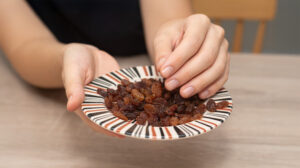
Greek raisins are considered a unique product worldwide. Delicious, historically rich, and highly nutritious, they stand out not only for tradition but also for their health benefits. Packed with natural sugars—mainly fructose—they provide immediate energy, while their fiber content supports healthy digestion. For decades, raisins have been a staple for endurance, energy, and daily nutrition. Yet for those who grew up in the raisin fields of Corinthia, they are more than a superfood—they are a way of life, a family memory, and an economic foundation.
The “Black Gold” That Shaped Greece
Raisins were not just an agricultural export; they were the “black gold” of the Greek economy for centuries. By the 16th century, the Ionian Islands were part of major trade routes for raisins, with the Peloponnese later becoming the primary production and export hub. The late 19th century brought a turning point: phylloxera, imported from the New World, devastated French vineyards and drastically reduced wine production, boosting demand for Greek raisins and cementing their role in international trade.
After 1880, exports skyrocketed, creating wealth and transforming cities such as Patras into dynamic commercial centers. A new bourgeoisie, the so-called “raisin society,” emerged around this trade. Ships known as primarolia sailed from Peloponnesian ports to Europe, fueling investment, commerce, and urban development. Neoclassical buildings, schools, shops, and cultural associations remain lasting symbols of this prosperity.
Yet the raisin’s dominance also carried risks. Monoculture and poor management made the industry vulnerable. Price fluctuations triggered crises, culminating in the 1893 bankruptcy famously declared by Charilaos Trikoupis. Still, raisins continued to drive infrastructure projects, such as railways and the Corinth Canal, leaving an indelible mark on Greek social and economic history.
From Generation to Generation
“For us in Corinthia, raisins are not just a crop,” says George, a local producer. This sentiment reflects a reality that numbers cannot capture: raising families, supporting parents and children, and passing fields from grandfather to father to son—not merely as property, but as a responsibility.
This generational continuity defines the story of Greek raisins. It is neither a fleeting investment trend nor a modern agricultural fad. The production endures because it has deep roots—not just in the soil, but in family history. Raisins have historically provided income, stability, and prospects to communities that might otherwise have been left behind. Even today, they remain a vital anchor for those who choose to stay on the land.
A Natural Advantage
In an era of industrialized agriculture, Greek raisins retain a defining characteristic: they are naturally sun-dried, without additives. This is more than a technical detail—it is a competitive advantage. Unlike other countries that use artificial drying methods, Greek raisins grow at the rhythm of the land. Sun and climate shape the product, giving it distinct size, taste, and character. It is authenticity, not uniformity, that sets Greek raisins apart in international markets.
Facing Climate Challenges
In recent years, environmental challenges have intensified. Heat waves and water shortages have reduced grape production, testing the resilience of raisin cultivation. Producers continue despite increased risks, driven by the product’s enduring value and demand. For them, giving up is not an option when the heritage they nurture belongs to more than themselves.
Supply and Demand
Despite these difficulties, Greek raisins consistently find buyers. Demand is strong, and prices remain higher than in many other countries. Yet production quantities are limited, particularly for sultanas, which has gradually eroded foreign market share—not due to quality, but insufficient supply. Strategic planning, not just individual effort, is essential for the future of this iconic crop.
The Future as a Strategic Choice
Greek raisins have a future if treated as a product with modern relevance, not a relic of the past. Their revival requires a long-term, strategic plan: state support, adaptation to climate conditions, water management, strengthened production, and a narrative that highlights their history, identity, and high value.
In the world of business and fine living, Greek raisins do not need to prove themselves—they need space. Behind every small, dark fruit lies something far greater: the continuity of a land, the perseverance of families, and the ability of a nation to build its future on the foundations of its past.
Ask me anything
Explore related questions




