





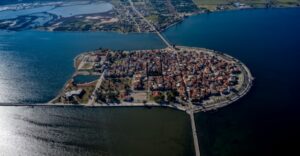
Built literally in the water, Aitoliko is no ordinary small town. Where once there were a few small islands in the middle of the lagoon, joined together by wooden bridges by the first fishermen inhabitants, today an entire “state” with a distinct identity is developing.
Aitoliko, also known as the “little Venice of Greece” is a municipal unit of the Municipality of the Holy City of Messolonghi and has 5,349 inhabitants. It is located about ten kilometres northwest of Messolonghi and is built on a low island in the centre of the Aitoliko-Messolonghi lagoon. Its connection with the mainland is achieved through two stone arched bridges, east and west, each about 300 metres long.
The bridges that now serve vehicular and pedestrian traffic were built in 1882-1885, extending older stone bridges of 1848, the work of the then mayor Konstantinakis Kourkoumelis. The historic municipality of Aitoliko was abolished in 2010 with the administrative reform “Kallikrates”, and the area was incorporated into the new municipality of Messolonghi.
The Aitoliko-Messolonghi lagoon is one of the most important fishing grounds in the country and part of an extensive wetland system extending from the mouth of the Evinos to the Acheloos. It is one of the largest and most valuable wetlands in Europe. For centuries it has been a key source of wealth for Aetoliko and Messolonghi, with the former having developed in the “heart” of the lagoon, several centuries before Mesolonghi.
In its waters species such as sea bream and mullet abounded, from the female of which – the “bafa” – the famous “egotaracho of Messolonghi” is produced. Until a few decades ago, the majority of the inhabitants were engaged in fishing, either as fish farmers – managing seven fish farms of the lagoon on lease from the state – or as free fishermen.
The naval tradition of Aitoliko has also been remarkable. Until World War II, it had a fleet of about 35 ocean-going merchant ships, in addition to smaller vessels. It is no coincidence that in Piraeus there is a street named “Aetoliko”. In a 1764 report, the Venetian vice-consul Lappos listed 29 Aetoliko ships, giving the names of masters, capacity and place of construction.
This merchant fleet was destroyed by the pirate fleet of the Dulcinians during the Orlofika, and after World War II, governmental renewal opportunities were not taken advantage of, leading to the gradual loss of the city’s maritime presence. At the same time, the extensive drainage and degradation of the lagoon in the 1970s – which reached about 50% of its area – contributed to the decline of fishing activity and fish stocks. Today, several residents are engaged in agriculture and livestock farming, making the most of the fertile plain, while others are engaged in trade and services.
Aitoliko is surrounded by a unique ecosystem of wetlands, where more than 250 species of birds are recorded, many of which are rare or endangered. The entire area is protected by the international Ramsar Convention and other international agreements for the conservation of wetlands.
According to the historical narrative of Andreas Demetriou, in the centre of the lagoon there were originally four or five very small islands, which in winter were often covered by water. The first inhabitants, probably fishermen, connected them with wooden bridges and, by continuous filling, created a single, irregularly shaped island about 300 metres in diameter, only slightly higher than the sea level. The waters often flowed into its interior, especially in winter, a fact that justifies the name “Little Venice”.
The embankments continued to fill in over the years, gradually changing the island’s extent. The most extensive intervention was carried out in 1969 by the State, with major siltation to the north and south. In the northern part, where the foundations of the houses rested on the water and small bays and canals were formed – a ‘watery lace’ where the fishermen’s shoals were tied up – new plots of land, parallel roads and a coastal zone were created. Similarly, to the south, the shallow lagoon facilitated landings, giving the island a more square shape.
Despite the changes, Aitoliko still stands out for its location and beauty, largely retaining its picturesqueness and the feeling of a “Neretian State” in the lagoon.
Ask me anything
Explore related questions




