





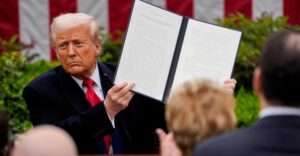
The Trump administration’s sweeping changes during his tenure so far have reshaped the global trade landscape at a rapid pace, Alpha Bank notes in its Economic Developments in the Global Economy bulletin. In particular, it focuses on tariffs, as well as trade agreements with the EU, UK, and Japan.
The US Supreme Court decision, which by a 6-3 vote rejected most of Trump’s tariff agenda and ruled that the US president had exceeded his powers, prompted a reaction from the president, who responded with a new tariff, causing what European policymakers said was a chaotic situation. Notably, last Sunday, Bernd Lange, chairman of the European Parliament’s International Trade Committee, called it a “tariff chaos” by the U.S. government.
President Trump has been implementing a new 10% across-the-board tariff for all US trading partners since last Tuesday (leveraging a different trade law – Trade Act of 1974), instead of the 15% announced a few days earlier, according to a statement from the US Customs Service. In addition, the White House hinted that the President is still committed to establishing a global 15% tariff and that the new temporary 10% tariff is in effect for 150 days. Delaying the implementation of the higher single tariff could provide a “window” for governments and businesses to lobby for exemptions to secure preferential treatment under the new regime.
Predictably, the new global tariff has sparked a backlash among America’s European trading partners, including the United Kingdom (UK) and Japan, which last year struck trade deals in exchange for lower tariffs in key sectors and are now seeing the benefits of those deals eroded. At the same time, the market reaction reflects the strong concern.
Ask me anything
Explore related questions




