





Greece is the focus of the international community for the third time in five years over the same matter. In 2010, and 2012, the country was pulled back from the cliff of payments suspension, receiving two huge aid packages from the EU, the ECB and the IMF. Now, the country has to face the possibility of not being able to pay the tranches and the debt of about 320 billion euros. Greece will have to pay 1.65 billion euros by 11th of May for pensions and salaries, 190 million in interest to the IMF, 1.4 billion on renewing T-bills, and 150 million to foreign investors. The 12th of May will mark the day of payments up to 747 million euros to the IMF. The 7.5 billion euros held by the ECB in July and August are still a problem, whereas afterwards, the long-term financial gap is also a cause of worry.
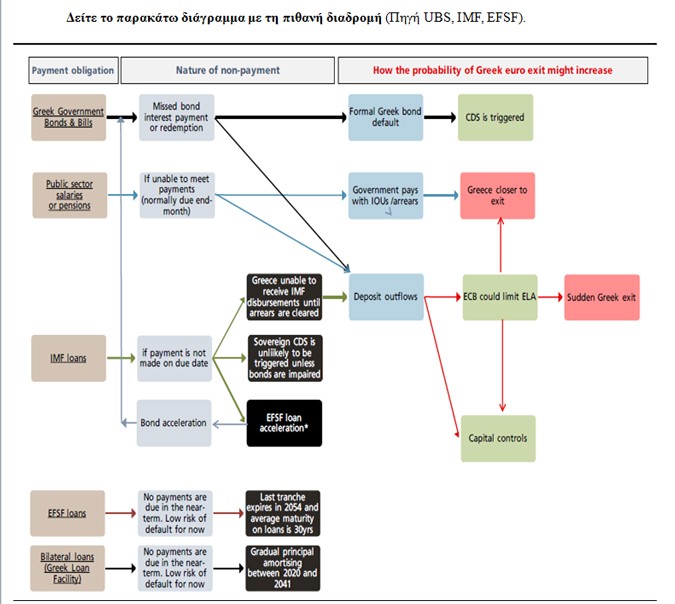
The IMF considers a Greek bankruptcy “systemically controlled”, according to the UBS director who attended a Fund meeting. Axel Weber believes that such an event will have a minor effect on the Swiss bank. At the same time, a bank memo titled “How Greece Will Leave” describes a Grexit step-by-step and enumerates the reasons.
The following diagram describing possible ways that this could go:
Ask me anything
Explore related questions




