





Ankara is exploiting the new instability in the Eastern Mediterranean to further strengthen its military presence in the occupied territories, setting up a multilayered surveillance, air defense, and intelligence gathering grid that is not only limited to the air but also extends to the sea.
According to today’s Cyprus Times report, in Lefkosia, the Turkish plan includes already deployed air defence systems, state-of-the-art radars, and a new maritime surveillance network, with all data being channelled directly to Turkey.
According to the report, Aselsan’s Korkut system, designed to counter low-altitude aerial threats, particularly drones, has been installed in the occupied territories since last summer.
Subsequently, the Hisar anti-aircraft system was also deployed in the Kyrenia area, with capabilities to detect and engage aircraft, helicopters, and drones. The Vural electronic warfare system, which, according to the paper, had already been deployed in the occupied territories since last year, is also part of the same grid.
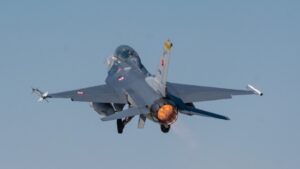
Added to the frame is the Şahın, another short-range anti-aircraft system with a 40mm gun, which there are Turkish reports that it was transferred in recent days along with the six Turkish F-16 fighters deployed in the occupied territories.
The Turkish Defense Ministry officially confirmed on March 9 that six F-16s and air defense systems were deployed to the pseudo-state, without naming all types of systems in detail.
The most troubling aspect is not just the weapons but the control architecture.
According to what Turkish Transport Minister Abdulkadir Uraloglu said, construction work on three maritime traffic surveillance stations in the occupied territories has been completed as part of the Doğu Akdeniz Gemi Trafik Hizmetleri project, i.e., the Eastern Mediterranean Ship Traffic Services System.
These stations are connected to a control centre in the occupied territories, while the data will also be transmitted to the corresponding Turkish centre in Mersin.
He said the goal is for the system to become operational in the second half of 2026 and that it will allow for 24/7 monitoring with radar, cameras, communications equipment and an automatic reconnaissance system.
Turkey is not limited to a flag display or an occasional military boost. It is gradually building an integrated surveillance and control system, through which it will have a constant overview of air and naval movement in the region.
Strategic movement
The emerging picture shows that the occupied territories are becoming more and more deeply integrated into Turkey’s military and operational umbrella.
Ground-based anti-aircraft systems, electronic warfare assets, radar on high ground, and the new navigation control system do not operate as isolated tools. They are connected in an integrated network, with Turkey gaining more early warning, surveillance and operational control capabilities in the Eastern Mediterranean.
This is the real message behind the so-called Turkish “Steel Dome” in the occupied territories. It is not just about defense.
It is about the steady transformation of occupied Cyprus into a forward hub of Ankara’s military surveillance against the Republic of Cyprus, and against any movement in the wider maritime and air area of Cyprus.
Ask me anything
Explore related questions




