





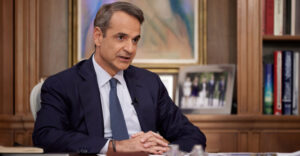
“I reject any discussion about early elections on the occasion of a rebound in the polls.” With this phrase, Kyriakos Mitsotakis ruled out any scenario of early elections in the coming months, speaking yesterday to Iefimerida.gr. At the same time, just as he dismissed the election scenario, he also dismissed the possibility of a cabinet reshuffle at this time and, in any case, before the elections.
Mitsotakis’ eagerness to “close” these two issues was not accidental, nor was the intensity of his remarks. Starting with the issue of elections, Mitsotakis has said in every possible way—publicly and privately—that elections will take place in the spring of 2027. Exactly when in the spring remains open, but most likely the first round of voting will be held before Easter, which next year falls in early May, given that Greece will assume the presidency of the EU in the second half of the year.
Privately, Mitsotakis even challenges his interlocutors, saying that in 2023 his insistence on completing the four-year term was also questioned, yet he followed through with his plan. It should be noted that in the coming months several projects funded by the Recovery Fund will still be delivered, while the Thessaloniki International Fair (TIF) in September is also pending—although war-related uncertainties cast doubt on the plans of the government’s economic team.
Mitsotakis also has another argument against early elections, linking this view to his insistence on the need for political stability in a turbulent period. “How could I lead the country into early elections in the coming months, risking exactly this argument—that this government can take decisions quickly and act for the benefit of Greek citizens?” the prime minister asked rhetorically yesterday, responding to concerns circulating among some “blue” discussion circles of MPs and party officials who have been encouraged by recent polling.
The reshuffle and the “bench”
As for a cabinet reshuffle, Mitsotakis had not seemed “warm” to the idea for some time, despite scenarios about changes and the inclusion of more New Democracy MPs who had not yet held ministerial posts ahead of the elections.
It is clear that geopolitical challenges are strengthening this conviction of Mitsotakis, who also observes that the pool of choices within New Democracy’s parliamentary group is not unlimited.
“We have a government formation that I believe works satisfactorily,” Mitsotakis stressed, while also describing a number of significant pending matters for each ministry amid the current geopolitical turmoil.
However, Mitsotakis is politically experienced enough to know something else: a cabinet reshuffle a few months before elections satisfies some, but also displeases those who see the exit door. And this is not desirable at a time when New Democracy seeks the greatest possible unity of forces.
“We will support society”
For the prime minister, the priority at the moment is to steer the country safely in an environment of heightened uncertainty. Beyond the handling of national issues, Mitsotakis’ attention is also focused on managing economic problems that may grow as uncertainty intensifies in the Strait of Hormuz.
In this context, and ahead of next week’s European Council summit, Mitsotakis clarified that the government maintains reserves in case intervention is required at a later stage.
“The margins are specific, and obviously it’s not as if there is excess money. If we need to support society, we may have to make some adjustments to our plans for 2026 and 2027. But we are not there yet. We will know much more in a few weeks,” Mitsotakis emphasized.
Ask me anything
Explore related questions




