





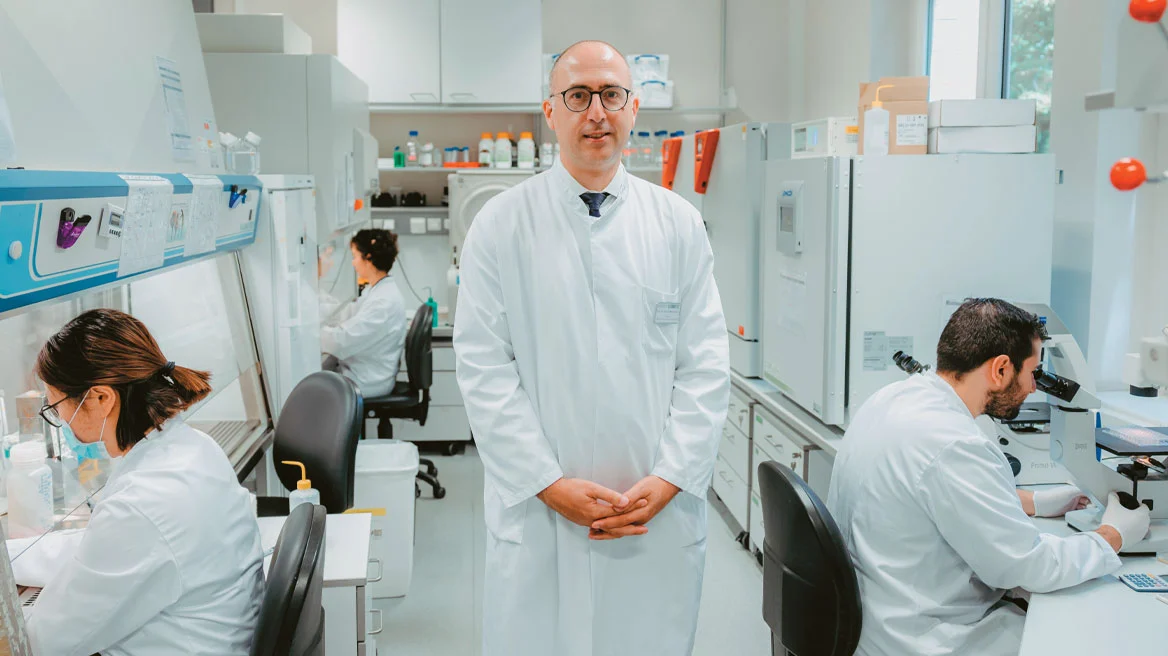
In 2021, in the midst of the coronavirus pandemic and while laboratories had just succeeded in developing effective vaccines against COVID-19, a Greek scientist in Germany continued steadily along his own research path, aiming to treat diseases using CAR-T cells.
At the time, Associate Professor and physician at the University Hospital of Erlangen in Bavaria, Dimitris Mougiakakos had been dedicated since 2017 to developing CAR-T lymphocyte therapies against cancer. However, during that difficult period for science and humanity, he and his team gained critical knowledge in the lab that led them to a key therapeutic milestone: applying cellular therapy to autoimmune diseases as well.
Since then, his team has carried out pioneering clinical applications of CAR-T cells worldwide for systemic lupus erythematosus (SLE), myasthenia gravis, and immune thrombocytopenia, leaving a strong mark on the evolution of cellular therapies for autoimmune diseases. Professor Mougiakakos’ research is playing a decisive role in transferring a therapeutic approach initially developed for hematologic cancers to conditions where the immune system attacks the body itself, opening new pathways for treatments that until recently were considered impossible.
Given that autoimmune diseases — such as rheumatoid arthritis, multiple sclerosis, lupus, scleroderma, and myasthenia gravis — affect approximately 10% of the population, the importance of research in this field is clear. The use of CAR-T cells for autoimmune diseases is now being studied by major pharmaceutical companies.
“Currently, there are more than 300 clinical trials worldwide for the treatment of autoimmune diseases with cellular therapies. The interest from the pharmaceutical market is enormous, and this is what drives research. Our publications helped pave the way for these therapies beyond hematology-oncology. However, our ultimate goal as doctors is to be useful to patients — to cure them. In this field, results are what matter,” says Professor Mougiakakos, now director at the University Clinic of Hematology-Oncology at the University of Magdeburg.
“Since 2021, when we confirmed the observation that CAR-T cell therapy destroys not only cancerous B-cells but also normal B-cells of the immune system — which are responsible for producing antibodies and triggering various autoimmune diseases — we focused on this,” he explains.
His team essentially produced the cellular therapy for autoimmune diseases in a similar way as for cancer:
“T-cells are isolated from white blood cells, then genetically modified to target and destroy normal B-cells, and finally reinfused into the patient.”
The first positive results
The first patient to receive the cellular therapy was a young German woman with severe lupus. CAR-T cells were then administered to a patient with myasthenia gravis, and more recently to a patient with autoimmune thrombocytopenia.
All are now in remission from the autoimmune disease they had developed — for which existing treatments had been ineffective — a key requirement for receiving CAR-T therapy.
“We know our journey is still long. These three cases, although very successful, are isolated. Clinical trials are needed, as required by the legal framework, to prove the effectiveness of CAR-T cell therapy. Fortunately, many studies are now underway — our center collaborates with centers in the U.S., Italy, France, and countries in Asia. We are also in discussions with centers in Greece, which makes me particularly happy, both because of the responsiveness of Greek colleagues and the possibility of patient participation in experimental therapies,” he notes.
Systemic lupus erythematosus and scleroderma are among the main autoimmune diseases currently under clinical investigation, with encouraging preliminary results, while the international scientific community awaits final Phase 3 outcomes.
The €300,000 cost
Another issue that concerns the professor is the broader research framework.
“Beyond strict adherence to legal requirements in research, it is very important to share knowledge and experience with other hospitals, both in Germany and internationally. As the pandemic showed, this can significantly accelerate medical progress when scientists rapidly share data and expertise,” he says.
He also stresses the importance of establishing a strong ethical framework around these innovative and very expensive cellular therapies. Notably, a CAR-T treatment for cancer patients costs at least €300,000.
“The obvious question is whether healthcare systems will be able to bear the cost. This is not only an economic issue, but a deeply ethical one, concerning equal access of patients to new therapies,” he says.
Despite his concerns, his optimism remains strong when discussing rapidly advancing scientific data that is opening new paths.
“We are now exploring allogeneic CAR-T therapies. Instead of using the patient’s own cells, which we genetically modify and reinfuse, we aim to achieve the same result using cells from healthy donors. The research field is highly dynamic, and in 2026 we expect results from clinical trials on allogeneic CAR-T therapies,” he says.
This approach aims to create “off-the-shelf” cellular therapies, overcoming the costly and time-consuming process of producing personalized treatments, as well as addressing ethical concerns related to high costs and limited access.
A passionate researcher
He describes himself as “lucky to be part of such a development, which is the dream and goal of every scientist in the laboratory.” His impact is significant: he has published more than 170 scientific papers in journals such as Lancet, Lancet Neurology, New England Journal of Medicine, Nature, and Nature Medicine, and has secured research funding exceeding €25 million.
He is clearly a passionate researcher who sees science not just as a profession, but as a personal mission.
“When you love something, when it fascinates you, you don’t see it as work. For me, research is a field full of challenges and personal bets. I am never satisfied and always aim higher,” says the 47-year-old professor.
He tries to instill this same passion in his team, which includes four trainee doctors from Greece. He is also encouraged by the strong interest from Greek colleagues in research and cellular therapies.
“I am in contact with colleagues in Greece, and we are trying to create the framework for this innovation so that clinical trials can also take place in Greek hospitals, benefiting Greek patients,” he says.
He wanted to become a doctor from his early teenage years, even though no one in his family worked in medicine. The child of immigrants — his parents moved from Skoutari in Laconian Mani and Nea Peramos in Attica to Hanover, Germany, in the late 1960s — he devoted himself to school and excelled academically.
Academic career
He began his academic journey in 1998, studying medicine at Hannover Medical School. He later specialized in hematology and oncology at university centers in Freiburg, Regensburg, and Erlangen.
His interest in research was also inspired by his older sister, who pursued doctoral studies after graduating from the National Technical University of Athens. From 2008 to 2011, he worked at the Karolinska Institute in Stockholm with a scholarship from the German Research Foundation (DFG).
After returning to Germany, he led the Max Eder research group funded by German Cancer Aid and completed his habilitation at Friedrich-Alexander University of Erlangen.
In Magdeburg, alongside his academic career, he has built his family life with his wife, also a doctor, and their three sons. Despite his strong focus on research, he has not forgotten his roots. He visits Greece as often as possible with his family, especially Skoutari in Mani, where his parents settled after years of working in Germany.
Ask me anything
Explore related questions




