





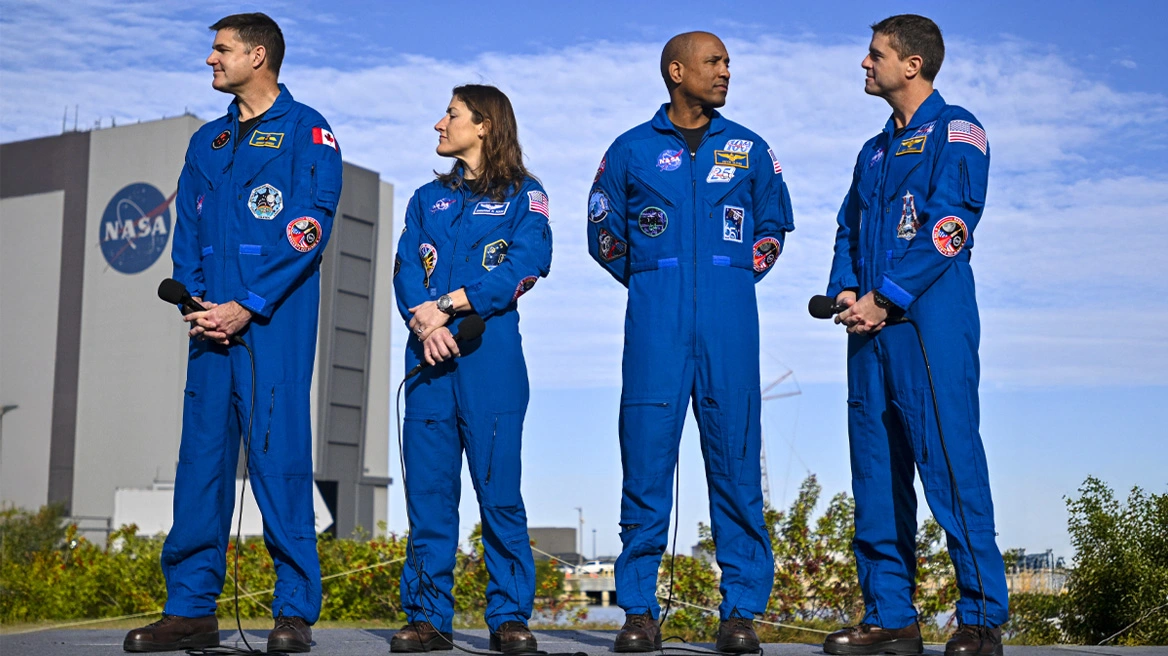
It has been more than 50 years since a human last set foot on the Moon. Humanity is preparing to take another step in space exploration by sending four astronauts farther than ever before.
NASA’s Artemis II mission is expected to provide scientists and the public with stunning images of the Moon and a new approach to understanding the environment on Earth’s satellite. It also paves the way for a human landing, taking the first step toward establishing a base.
However, this will not be an easy journey. The mission carries serious risks, with astronauts traveling in a spacecraft humanity has never used before. At the same time, they will spend 10 days cramped into a space the size of a mini bus while in space.
The Beginning of the Journey
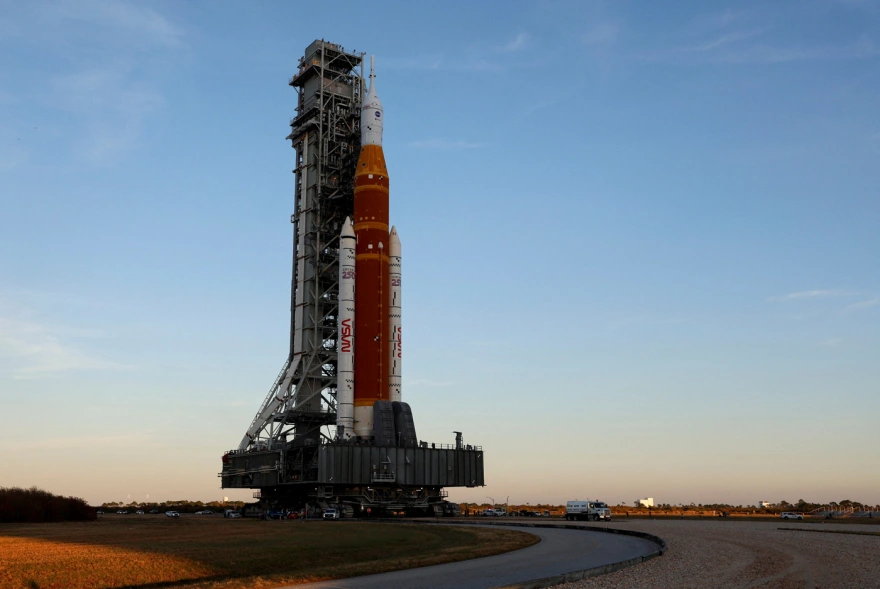
The astronauts will start their journey aboard NASA’s giant Space Launch System rocket bound for the Moon. It is the most powerful rocket ever built by the U.S. space agency and will launch from Kennedy Space Center at Cape Canaveral, Florida.
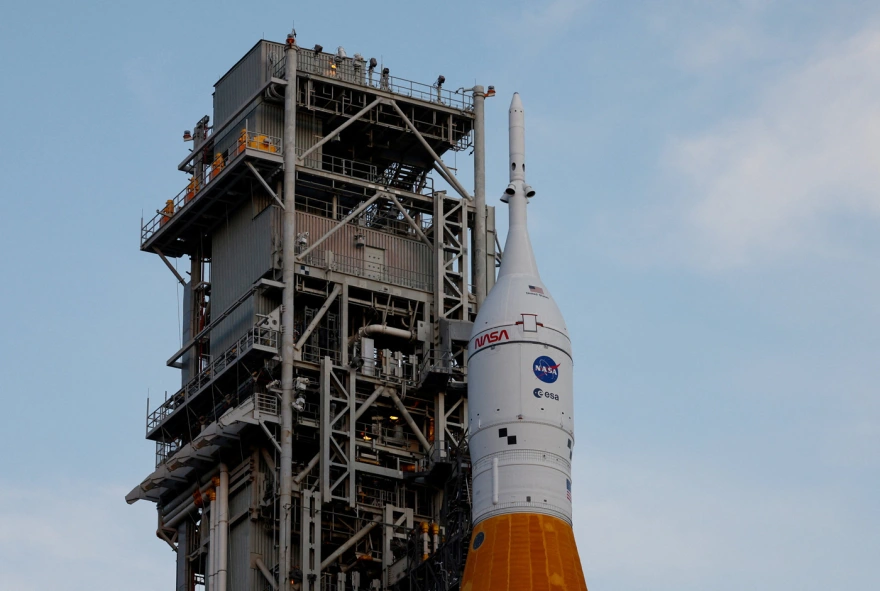
Standing 98 meters tall, the SLS has flown only once before, in 2022, during the Artemis I mission without astronauts on board. It has two massive boosters and four engines providing the necessary thrust for liftoff. Fuel is supplied by a giant tank containing over three million liters of liquid hydrogen and liquid oxygen.
The role of the Space Launch System is to carry the Orion spacecraft into space, which sits atop the rocket and houses the astronauts.
If something went wrong during the initial stages of launch, the Launch Abort System on top of the rocket would carry the astronauts to safety. Launch is one of the most dangerous parts of the mission, as everything must go perfectly.
The mission astronauts have already briefed their families on the risks involved.
“Everyone has someone, an astronaut, who will be with our family members as they watch the launch, which can be simultaneously thrilling and terrifying,” says mission pilot Victor Glover.
Glover is one of four astronauts—three Americans and one Canadian—training for Artemis II for more than two years. They have decades of experience, although one has never been to space.
Mission Crew: The Veteran Afraid of Heights, the “Know-It-All,” the Electrical Engineer, and the Pilot with the Cookies
“This is a test mission, and we’re ready for anything… It’s going to be amazing,” mission commander Reid Wiseman tells the BBC. The 50-year-old is a Navy veteran, has spent six months in space, and has 16 years of astronaut experience. Reid says he has always loved flying, though he fears heights on the ground.
The 49-year-old Victor Glover is the mission pilot, with 12 years of experience and six months in space. During his military service, his callsign was “IKE,” meaning “I Know Everything.”
The 47-year-old Christina Koch is a mission specialist and electrical engineer with 12 years of experience and one year in space. Christina made history participating in the first all-female spacewalk while aboard the International Space Station (ISS).
The 50-year-old Jeremy Hansen, a former fighter pilot, has 16 years of experience but has never spent time in space. He says he will bring maple syrup and cookies on the trip to the Moon.
“You reach a point where you no longer need to communicate—just listen to what’s happening, and the four of us watch each other and the mission, and we don’t need to speak—we just know,” says Reid.
Life in Orion: The First Toilet on a Spacecraft
The astronauts will spend their 10-day mission in Orion, which is about five meters wide and three meters high.
It has a conical shape with a flat top. Its exterior is covered with white ceramic tiles and a pair of small square windows, with two even smaller ones outside them.
There are various black and gray circular connection points scattered across the exterior. The curved lower section is covered with larger beige tiles forming the heat shield.
To get used to living in such a confined space, the crew spends as much time together as possible. “I’m starting to feel a bit awkward about my height. Canada took on a larger share than usual in the mission, assigning me this position,” says 1.88-meter-tall Jeremy Hansen.
Orion resembles the spacecraft used in the Apollo missions, but its interior is very different. Within this small space, the crew will work, exercise, eat, and sleep.
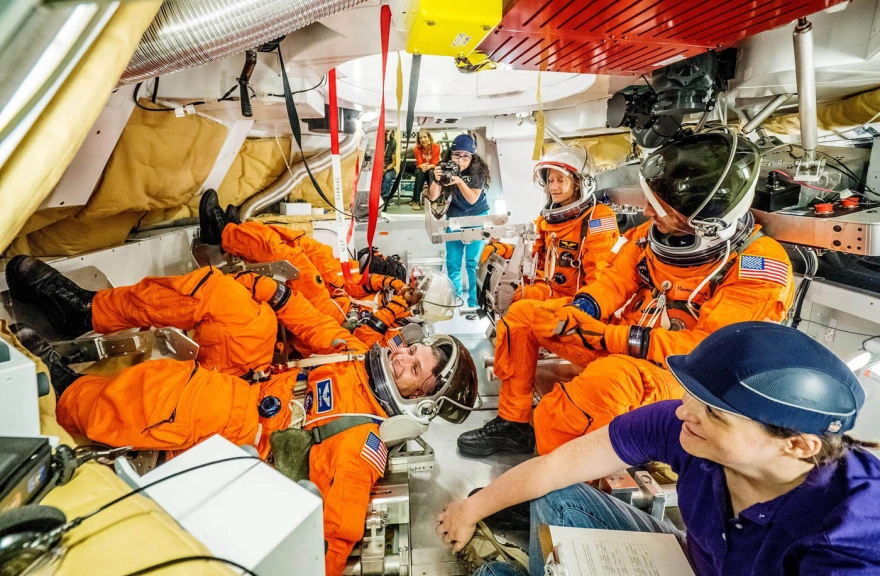
Inside are four launch seats, which will be stowed once in orbit to open up space. In zero gravity, all surfaces of Orion will be accessible. The spacecraft has fresh water for drinking and food hydration, and each astronaut has chosen favorite meals for the 10-day journey.
Under the hatch is a step that doubles as exercise equipment. Astronauts will do 30 minutes of cardiovascular and resistance training each day.
Perhaps the most important piece of equipment is hidden under the floor: a toilet—something Apollo astronauts did not have 50 years ago. It is specifically designed for the challenges of using the bathroom in space but offers little privacy.
“On the ISS, the toilet is much more isolated. Ours… is on the floor. We’re all cramped in there, so any noise is heard by everyone. So yes, it’s different,” says Christina Koch.
The mission to the Moon and back will last about 10 days. The “about” depends on the exact launch time and the positions of the Earth and Moon.
70,000 Kilometers from Earth
On the first day, astronauts will orbit Earth at around 70,000 kilometers high. By comparison, the ISS orbits about 400 kilometers above Earth.
“I think we’ll need to adjust a bit once we get up there… I’ll learn how to float, fly, and bump into things. And I’ll probably need a little help,” says Hansen.
The astronauts will also check the spacecraft’s life-support systems and perform Orion’s first test flight. About three hours after launch, the rocket’s upper stage (Interim Cryogenic Propulsion Stage, ICPS) will separate from Orion.
Testing and the Journey to the Moon
The crew will manually maneuver Orion, approaching and moving away from the ICPS to see how the spacecraft behaves—a rehearsal for future docking missions.
The team will decide whether to return to Earth depending on any problems that arise. Near Earth, returning is relatively simple if unsolvable issues occur. Mission control must be fully confident before giving the green light for the “Trans-Lunar Injection” maneuver, which activates Orion’s main engine to escape Earth’s gravity and begin the journey to the Moon.
Once underway, the return will be neither easy nor quick—the astronauts are committed to a long round trip to the Moon and back.
Experiments on Astronauts and the Risk of Solar Storms
During this period, the crew will continue monitoring the spacecraft systems, while the astronauts themselves will undergo evaluation. The crew will serve as test subjects: experiments aboard will reveal how their bodies respond so far from Earth.
Radiation is a major concern, as the Sun can emit harmful particles. The astronauts will carry dosimeters to measure exposure and practice using the radiation shelter under the spacecraft floor. The crew must also know how to quickly enter it if a solar storm is detected.
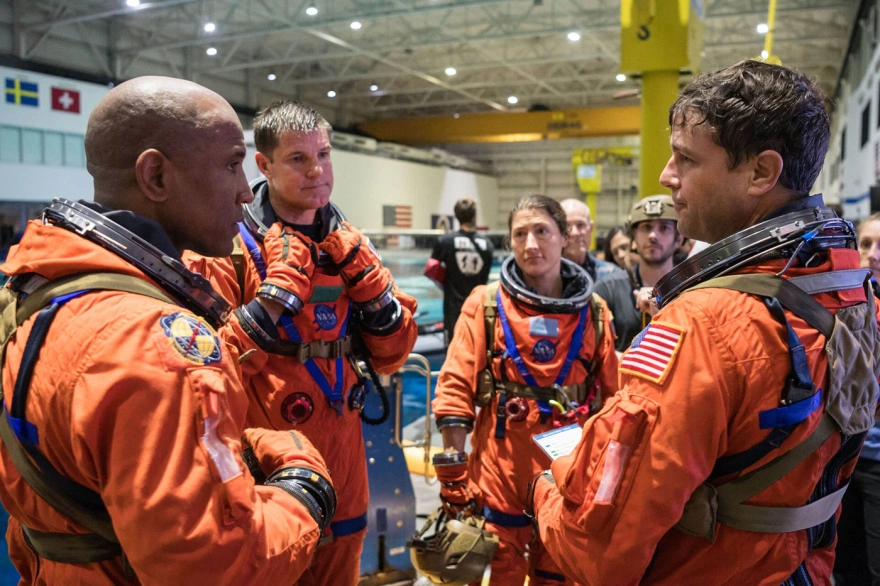
Training for emergencies includes putting on bright orange spacesuits called Orion Crew Survival System (OCSS). These suits protect the crew during launch and reentry and act as a life-support system in case of capsule issues. The suit is like a miniature spacecraft worn on the body, pressurized with integrated life-support systems.
In emergencies during the journey to or from the Moon, astronauts will don the suit, which can keep them alive for up to six days while returning to Earth.
The crew will also participate in tests studying balance, muscle performance, microbiome changes, and eye and brain health. Saliva samples will be collected before, during, and after the mission to analyze the immune system, which can weaken in space.
“One exciting aspect of the space environment is that it changes our immune system, which is really important for us and our colleagues. Many of us experienced this on the ISS, and we need to control it for long-duration missions,” says Christina Koch.
Seeing the Moon: Human Eyes Are Among the Best Scientific Instruments We Have
If all goes according to plan, humanity will witness what it has awaited for over 50 years: a return to the Moon. Astronauts will orbit the far side (the side not visible from Earth) at distances of 6,500 to 9,500 kilometers from the Moon’s surface.
Orion will orient toward the Moon for the best view. The crew will have three full hours to observe, photograph, and study the Moon’s geology, aiding future landing planning.
“Depending on launch time and the lighting on the far side of the Moon… we could see parts never seen by human eyes. And believe it or not, human eyes are among the best scientific instruments we have,” Koch emphasizes.
From this vantage point, they will see both the Earth and Moon from Orion’s windows, with the satellite in the foreground and Earth in the background.
What the Astronauts Will Bring
Each astronaut may bring personal items for this unique moment. Victor Glover chose a Bible and some family heirlooms; Christina Koch brings handwritten notes from loved ones; Jeremy Hansen will carry moon-themed pendants belonging to his wife and three daughters.
Reid Wiseman chose something simple: “I have a blank sheet of paper, a pen, and a pencil, and I look forward to writing thoughts on it. I don’t know what to expect and don’t want to go in with preconceptions.”
Loss of Communication: “I Wish Eight Billion People Could Just Hope and Pray”
While the astronauts will have a chance to admire the Moon, it will be tense for mission control and anyone watching from home. As they fly behind the Moon, they will lose communication with Earth for 30–50 minutes.
“While we won’t be able to communicate with the planet and our friends even on the ISS, I wish the whole world—eight billion people—could unite and just hope and pray for us to receive the signal and reconnect,” says Victor Glover.
Once mission control regains the signal, the astronauts will begin their return journey.
The Dangerous Return
The return will take four more days, but the final stage is one of the most dangerous.
For reentry, the spacecraft will separate from the rest of the vehicle, orienting the capsule so the heat shield bears the brunt of the extreme temperatures, keeping the astronauts inside safe.
The spacecraft will enter Earth’s atmosphere at 40,000 km/h, enduring temperatures around 2,700°C.
Significant attention has been given to the heat shield, which suffered damage during the first unmanned Artemis mission. By adjusting the reentry angle, engineers are confident the issue is resolved.
Once safely through, a series of parachutes will deploy to slow the capsule. Astronauts will splash down in the Pacific Ocean off the coast of California, where a recovery team awaits.
The capsule can land upright, upside down, or on its side, and bright orange airbags will help it right itself so the crew can exit safely.
Victor Glover says the return home is the part he’s most excited about: “I really look forward to seeing those three beautiful parachutes and the Pacific splashdown. I know my wife will take her first real, deep breath, which means a lot to me. It’s a very hard trial for families, and I know that moment will be special for her, making it special for me too.”
With the mission complete, the astronauts will return to Earth—the first chance to step on solid ground and reflect on their journey. They will join an elite group: only 27 astronauts have ever flown around the Moon.
But this is just the beginning of the Artemis missions. The data and scientific findings collected will be thoroughly analyzed, as the next steps will be even more demanding: returning humans to the Moon’s surface, this time to stay.
Ask me anything
Explore related questions




