





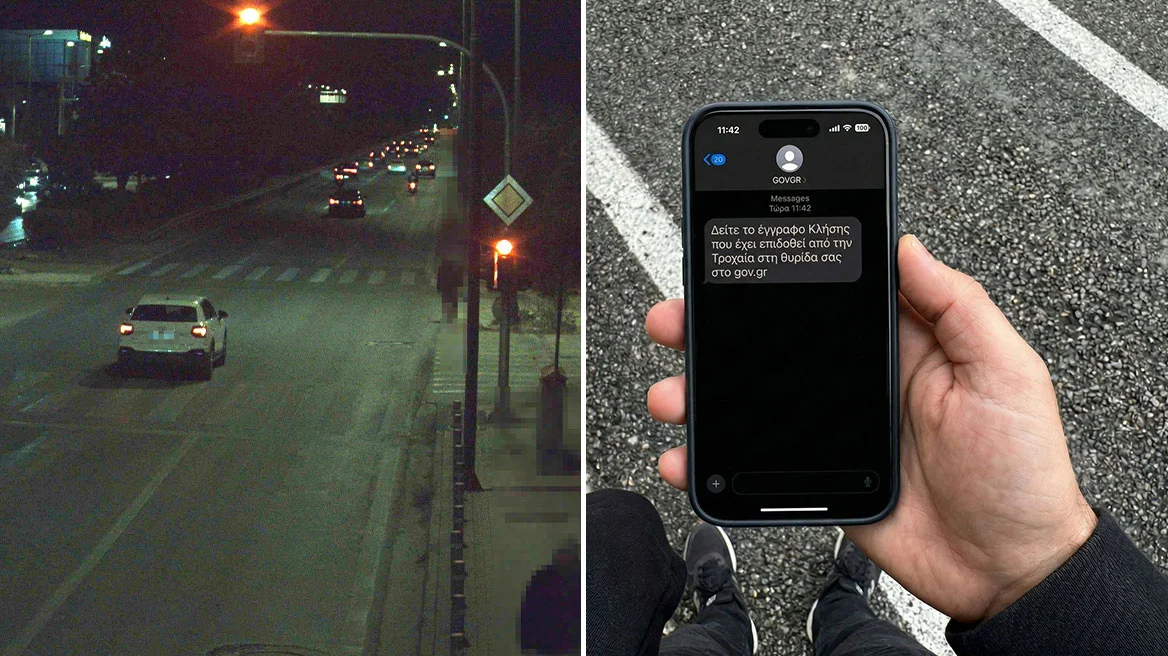
The first 130 traffic tickets, mainly for running red lights by car drivers and not wearing helmets by motorcyclists, reached the mobile phones of traffic law violators, as AI cameras installed in Athens began operating last Saturday. The fines started being sent electronically to the offender’s mailbox on gov.gr, while for cases where this is not possible, they will be sent the…traditional way.
For several weeks now, the Ministry of Citizen Protection has asked the relevant ministries and services to ensure full operational readiness of the cameras and their management systems so that the final table test (a full operational test of the cameras and their peripheral systems) could be conducted and the system activated.
At present, in the system that records and sends fines electronically, AI cameras installed on a pilot basis at eight high-risk points in Attica are “participating,” as well as cameras placed on ten buses to monitor illegal driving in bus lanes, as part of the reform for digital enhancement of road safety and in continuation of the relevant law by the Ministry of Digital Governance and Artificial Intelligence.
The initiative is implemented through the collaboration of the Ministers of Digital Governance and AI, Dimitris Papastergiou, Citizen Protection, Michalis Chrysochoidis, and Deputy Minister of Infrastructure and Transport, Konstantinos Kyranakis, aiming to reduce traffic accidents and improve driving behavior.
After integration with the existing Traffic Police information system, violations recorded by the cameras are confirmed and sent electronically to citizens via the Citizen’s Mailbox on gov.gr and the Gov.gr Wallet. The first 130 administrative fines, confirmed since the operational start of the system on Saturday, March 28, 2026, were sent there. Most violations recorded by the cameras concerned running red lights and not wearing helmets by motorcyclists.
How the cameras work
The cameras of the Pilot Information System, with integrated AI algorithmic analysis installed by the Ministry of Digital Governance and Artificial Intelligence, record: running red lights, speeding, driving or stopping in bus lanes, not using seat belts or helmets, and using a mobile phone while driving.
Specifically, the automatic license plate recognition (ANPR) camera network has integrated AI algorithm functionality that detects the make, model, and color of the violating vehicle. It also categorizes the violations, such as running a red light.
The mobile cameras installed by the Ministry of Infrastructure and Transport record illegal parking and driving along the full length of bus lanes used by public transport vehicles. They also record data on route difficulties, such as infrastructure condition and traffic density. Each violation includes information like time, location, and traffic extent, while other data are concealed.
When violations are recorded, the competent authorities may further process license plate data to verify compliance with regulations on uninsured vehicles, technical inspections (KTEO), circulation fees, and restricted traffic zones.
Meanwhile, as a decision was issued last week by the Administrative Court of Appeal regarding the contract for procuring another 1,000 AI cameras from the Ministry of Digital Governance, the path has officially opened to acquire and install all cameras by summer, and to start the operation of the unified management body, ODYSSEAS (once the unified information system is ready).
What they record, will record, and where
Currently, AI cameras exist only in Attica, with six operational cameras from the Ministry of Digital Governance on busy streets in Athens and ten from OSY installed on city buses under the Ministry of Transport. In the coming period, likely by the end of the year, AI cameras will be installed by the Ministry of Digital Governance in Thessaloniki and Crete, and in early next year, approximately 300 mobile cameras will be installed on OSY buses.
Cameras such as those of the Region (recording only red light violations) or the Attiki Odos (recording speeding violations) are not considered AI cameras. AI cameras are those with software that detects if the driver is using a mobile phone, wearing a seat belt or helmet, exceeding the speed limit, running a red light, etc. The software identifies the violation, reads the plate along with the vehicle type and color, cross-checks the data, and automatically sends the fine to the offender’s electronic mailbox.
Until today, existing cameras were “trained” and tested for issues considered the “teething problems” of their use. Well-informed sources at the Ministry of Citizen Protection told THEMA: “We conducted the first evaluation of sample tickets to see how many could be utilized. Theoretically, of course, as all were initially invalid because drivers had not been notified as required by law for camera operation. But for us, it was a good sample for mainly technical adjustments. That is, to assess license plate readability, the targeting of violators by each camera, shading, etc.”
One example of “technical issues” that had to be resolved was with OSY cameras, which had to distinguish between violators entering bus lanes and legal drivers when the bus entered their lanes. This issue was resolved, as were others. The system also learned to distinguish who ran a red light and who was stuck in traffic in front of the signal, and dealt with shading issues due to large light profile changes during the day that could make some images unusable.
First results
The first results from the pilot operation of the cameras showed chaos on the roads. In Attica, AI cameras recorded 39,543 serious traffic law violations (using a mobile phone while driving, running red lights, speeding) in about a month, while a single camera on Mesogeion Avenue issued 28,000 red light fines in the same period.
Sources from the three relevant ministries (Citizen Protection, Digital Governance, Transport) state: “No matter how large the number of confirmed violations, they will be sent. This chaos on the roads must stop at some point.” They clarify that the goal is not to operate the cameras punitively or as a revenue tool, but as a deterrent. “This means there will be a logic to their operation. Our target is not the driver going 52 km/h in a 50 km/h zone, but the one going 120. The one who is dangerous to others and exhibits antisocial behavior.”
A necessary step for AI camera operation was installing signage. The law requires drivers to be informed of the presence and operation of such cameras. Therefore, after all tests were completed, impact assessments conducted, and technical parameters set, orders were issued to place signs where cameras operate. Recently, warning signs featuring a camera image and stating “traffic law violations are monitored by technical means” were installed at the first AI camera locations. This is the final “technical” detail before fines are sent.
The first AI pilot cameras in Attica operate at:
- Municipality of Athens: Panepistimiou and Vasilissis Sofias Avenue
- Municipality of Agia Paraskevi: Mesogeion Avenue and Chalandri Avenue
- Municipality of Rafina-Pikermi: Marathonos and Fleming Avenue
- Municipality of Kallithea: Syngrou and Agias Fotinis Avenue
- Municipality of Elliniko-Argyroupoli: Vouliagmenis and Tinos Avenue
- Municipality of Filothei-Psychiko: Kifisias and Ethnikis Antistaseos Avenue
Offenders are notified that they have a “ticket,” either via push notification in the Gov.gr Wallet app, SMS to their mobile, or email to the contact information registered in the National Contact Registry (EMEP). Government officials estimate that 65–70% of Greeks are registered in EMEP, facilitating the process.
For others, when electronic delivery via gov.gr is not possible, the fine will be sent the traditional way, in writing, as before, e.g., by mail. Previously, notification could take up to three years; now the process completes in minutes.
The dispute and objection process is now easier and fairer. Citizens can schedule an electronic appointment listed on the violation notice to submit their objections to a Traffic Police officer. With the process fully digital, unjustified “deletions” are much harder. Objections must be filed within three days from the notification in the citizen’s mailbox on gov.gr. By law, after ten business days from notification, the three-day period starts, giving practically 13 days from electronic posting.
Fines include an RF code for easy payment. Confirmed fines must be paid within eight months. Unpaid fines are sent from ODYSSEAS to AADE (Independent Authority for Public Revenue) for enforcement under the Public Revenue Collection Code.
From 16… to 2,500 cameras
The initial 6+10 cameras are just the beginning. The Minister of Digital Governance, Dimitris Papastergiou, has stated that over 2,000 AI cameras are planned for installation this year in Attica, Thessaloniki, and Crete.
The goal is to fully cover Athens and Thessaloniki within this year, placing cameras in high-risk areas identified by Traffic Police (sites with the most accidents and dangerous violations). Expansion to other parts of Greece will continue in 2027, as advised by Traffic Police. Municipalities and regions can also install cameras themselves, connected to the central system.
Simultaneously, 500 cameras are being installed inside OSY buses to monitor bus lanes. Initially, only car violations in bus lanes will be recorded, though there are plans to expand monitoring to other violations—a technical and technological challenge. Additionally, 388 new cameras are being installed by the Attica Region, capturing rear vehicle views for violations like running red lights.
Ask me anything
Explore related questions




