





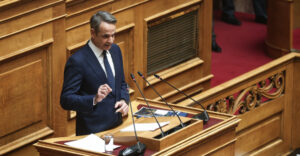
In his rebuttal, Prime Minister Kyriakos Mitsotakis said, “We all have an institutional responsibility to speak—despite the climate you are creating—and New Democracy will take the initiative to move forward,” launching an attack on Nikos Androulakis and stressing that the PASOK leader actually hopes for ND to win an outright majority to get him out of a difficult position.
“I had the impression that when you called for elections, you did so half-heartedly, in case I accepted it. Don’t worry—elections will be held on time, at the end of the four-year term. And while you speak about aiming for first place—which is legitimate, and I don’t say this ironically—your real goal is different,” the prime minister told Androulakis.
“In your dreams, what you really want is for ND to win a majority so it spares you the difficult question of what you’ll do after the elections. By aligning yourself with the most extreme voices, you’ve ended up projecting only your anxiety about securing second place,” he added.
He then also targeted SYRIZA with an indirect reference to Alexis Tsipras: “Is it you, or the one who is coming—whose name isn’t often mentioned in SYRIZA? The one who dismantled his party in order to return. You see the leader who brought you to these numbers now tearing you apart, and you hope he forms another party so he might take some of you along and you can retain your parliamentary seats.”
Prime Minister Kyriakos Mitsotakis launched a fierce attack on those fostering a toxic climate through personal attacks and rhetoric that “can turn into bullets” and create a “jungle of vileness,” during a parliamentary debate on the rule of law, prompted by the serious health ordeal of Giorgos Mylonakis.
Visibly emotional, he said that political opponents and their families are being smeared, adding that “this man has now reached the point of fighting for his life,” while recalling attacks he and his own family faced in previous years. He added that “it is the same Documento that targeted my wife with the aim of destroying my family for political gain. That’s who you are—attacking me and my family, our party, our children, our MPs—everything thrown into the mill of political confrontation.
He also announced that the government will introduce legislation to speed up and conclude procedures involving political figures as quickly as possible, while warning that he will not allow the work of the National Intelligence Service to be undermined by irresponsible public discourse.
The pre-agenda parliamentary debate, initiated by PASOK on the rule of law and the condition of institutions, began with the introductory speech of Prime Minister Kyriakos Mitsotakis.
According to information from protothema.gr, Mr. Mitsotakis is expected to announce the launch of the Constitutional Revision process in May, as the proposal of New Democracy is already largely structured. As reported by “THEMA,” around 50 proposals from MPs and ministers have already been evaluated in the preceding months, while the rapporteur for the majority will be Evripidis Stylianidis, in coordination with Giorgos Gerapetritis and the Prime Minister’s Secretary General, Stelios Koutnazis.
Mr. Mitsotakis is expected to announce interventions in a series of constitutional articles, most notably Article 86, aiming at reducing the procedural safeguards involved in the judicial assessment of cases concerning political figures. In addition, New Democracy has already signaled its intention to intervene in other key constitutional provisions, while revisions to the electoral system are also being reconsidered.
Mr. Mitsotakis referred to an initial idea regarding the incompatibility between the roles of Member of Parliament and minister, while another proposal under discussion is the reduction of MPs from 300 to 250. Two additional options being considered concern the size of electoral districts, based on demographic data, as well as potential term limits for MPs and local government officials. According to information, he is expected to be particularly specific regarding around 20 articles.
In the shadow of the controversy surrounding George Mylonakis, Deputy Minister to the Prime Minister and a close aide to him, Parliament is set to debate today the rule of law and the state of institutions—a discussion initiated by PASOK.
The agenda is expected to be dominated by the OPEKEPE case, the Lazaridis case, and the wiretapping affair. Prime Minister Kyriakos Mitsotakis is preparing what has been described as an “institutional counteroffensive,” as reported by THEMA since Holy Saturday, aiming to avoid being drawn into a debate framed on the opposition’s terms.
According to protothema.gr, PASOK leader Nikos Androulakis contacted the Prime Minister’s office yesterday through Parliament Speaker Nikitas Kaklamanis, proposing that the debate be postponed. Mitsotakis considered the request but ultimately decided the session should proceed as scheduled, telling associates this was the appropriate course of action. He is also expected to address the increasingly toxic tone of political discourse at the outset.
Mitsotakis is bracing for strong criticism from the opposition and plans to respond, but without limiting himself to reactive arguments. Instead, he aims to outline a broader institutional path forward. Close aides suggest his speech could amount to an “institutional push forward,” presenting concrete reforms designed to address systemic weaknesses. His goal is to prevent the debate from being narrowly defined by opposition parties.
Reform proposals and constitutional revision
Mitsotakis is expected to announce the launch of the constitutional revision process in May, with New Democracy’s proposal already largely finalized. According to THEMA, around 50 proposals from MPs and ministers have been reviewed in recent months. Euripides Stylianidis is expected to serve as the majority rapporteur, working alongside Giorgos Gerapetritis and the Prime Minister’s Secretary General, Stelios Koutnatzis.
Key proposed changes include revisions to several constitutional articles—most notably Article 86—aimed at reducing procedural barriers in the judicial handling of cases involving political figures. The government is also considering interventions in other core provisions, as well as possible changes to the electoral system.
Among the ideas already floated are stricter rules on the incompatibility between serving as both MP and minister, and a reduction in the number of MPs from 300 to 250. Other proposals under discussion include redrawing electoral districts based on demographic data and introducing term limits for MPs and local government officials. Reports suggest Mitsotakis may present proposals affecting around 20 constitutional articles.
Government sources say the Prime Minister’s decision to “open up the discussion” and challenge opposition parties to take clear positions is a substantive initiative. In their view, many of the system’s dysfunctions stem from a state that has failed to adapt to modern needs. Mitsotakis is expected to argue that these issues can be addressed through digital modernization—reducing bureaucratic friction and human intervention—as well as through deep institutional reforms tied to constitutional revision.
The wiretapping issue
Mitsotakis is also expected to respond to Nikos Androulakis regarding the wiretapping scandal. He will argue that the government has already assumed political responsibility, pointing to changes in personnel and structures, as well as reforms within the National Intelligence Service.
He is likely to emphasize that the case is now in the hands of the judiciary and that a Supreme Court investigation found no involvement by state officials, apart from the actions of four private individuals. At the same time, he is expected to caution opposition parties to be careful in their public statements about the intelligence service, given its role in safeguarding national security.
Gauging the mood within New Democracy
For Mitsotakis, today’s return to the parliamentary chamber is also an opportunity to gauge sentiment within New Democracy’s parliamentary group. Tensions have reportedly grown between MPs and the Prime Minister’s office, particularly in the wake of the OPEKEPE case. Some MPs are also said to be frustrated at having to defend decisions related to Makarios Lazaridis.
In any case, the planned launch of the constitutional revision process in May will require a preparatory meeting of the party’s parliamentary group, where discussions are expected to be broader and potentially challenging.
Ask me anything
Explore related questions




