





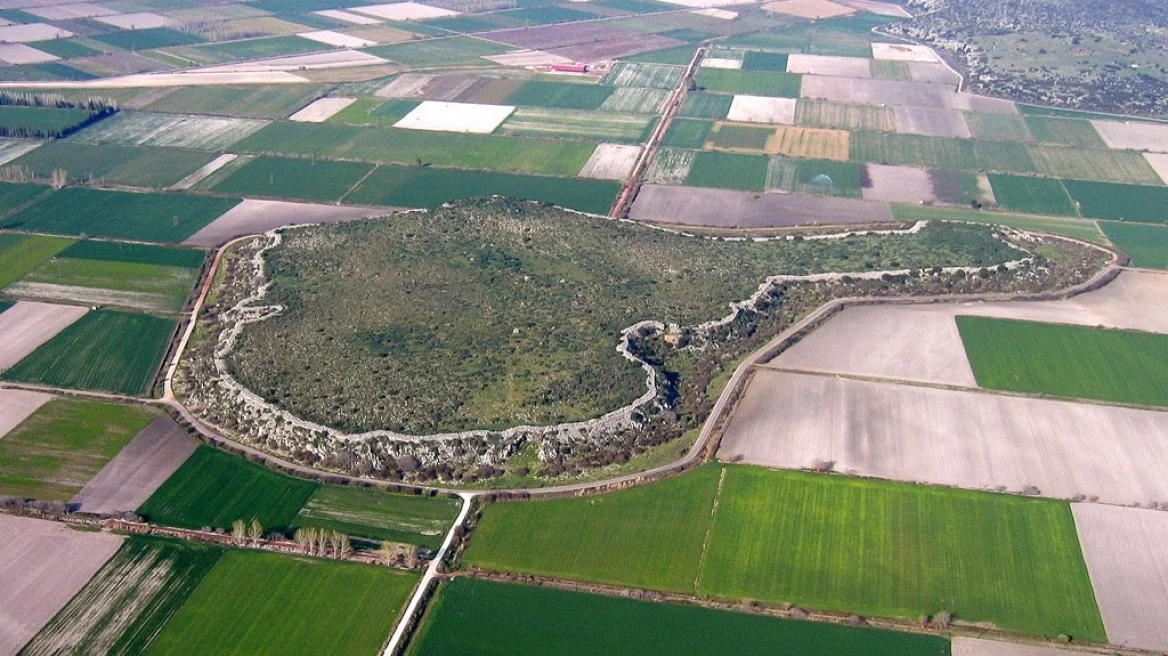
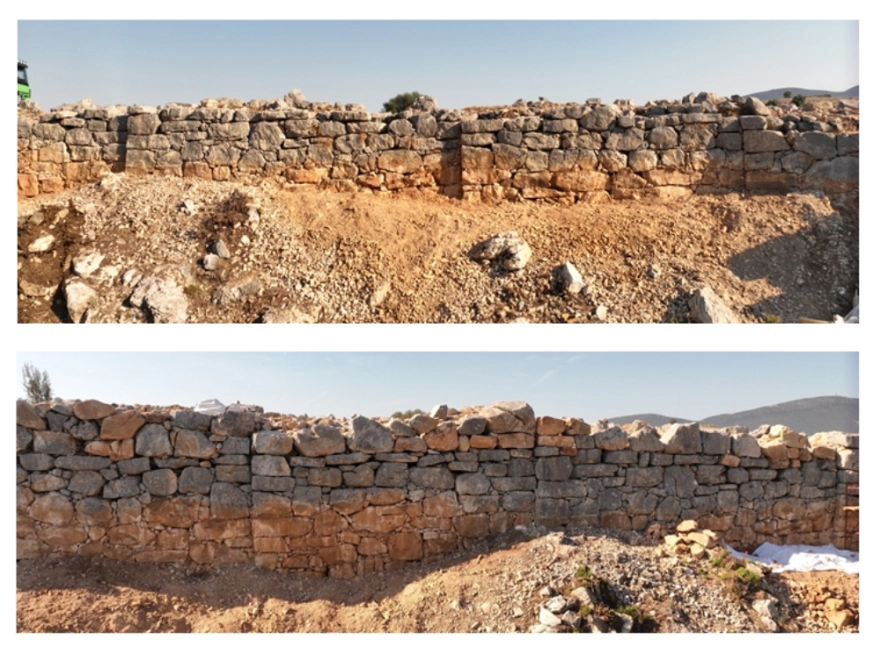
The Ministry of Culture has completed a particularly important project for the protection and enhancement of the Mycenaean acropolis in Boeotia. According to an announcement by the ministry, the project, implemented by the competent Directorate of Prehistoric and Classical Antiquities, concerns the restoration of the Southern Gate and part of the cyclopean wall of the acropolis, within the framework of the overall plan for the promotion of the monument.
The Mycenaean acropolis of Glas, dominating the northeastern edge of the Kopais basin, is one of the most significant and extensive fortified complexes of the Late Bronze Age. Its strategic location, with wide visibility over the plain and proximity to the northern Euboean Gulf, contributed to its development during the 13th century BC as a powerful administrative and economic-technical center, connected to large-scale drainage works in the area.
The Minister of Culture, Lina Mendoni, stated:
“The projects implemented by the Ministry of Culture at the Mycenaean acropolis began in 2022, funded with €2.5 million from the Recovery Fund. They are part of a broader plan to reconnect the Mycenaean acropolis with the natural and cultural landscape of Kopais and to highlight the monument as a unified, functional, and visitable archaeological site, reconstructing its historical identity. The completion of the restoration of the Southern Gate and part of the cyclopean wall is a project of high scientific and technical value. The monument, unique in scale and character, is now gaining greater legibility and safety, while at the same time, the potential for further research and presentation is being strengthened. The experience and expertise gained from this project constitute a valuable legacy for the broader management and restoration of Mycenaean heritage. Our goal is the gradual and systematic enhancement of the Glas acropolis so that it becomes accessible and understandable to the public, as it is a monument comparable to the great Mycenaean centers of the Peloponnese.”
According to the Ministry, the project was based on a comprehensive framework of specialized studies approved by the Central Archaeological Council. The works included systematic documentation and management of scattered building material, structural assessment and stabilization of the construction, as well as the reconstruction of the gate and adjacent wall sections using compatible and documented materials. Special emphasis was placed on the detailed investigation of cyclopean masonry and the archaeological study of the foundations and core of the wall, elements that significantly contributed both to the understanding of the monument and the successful implementation of the interventions. At the same time, extensive clearing works restored the monument’s readability and the surrounding landscape, allowing the geomorphology of the islet to be revealed and improving the visitor experience.
Ask me anything
Explore related questions




