





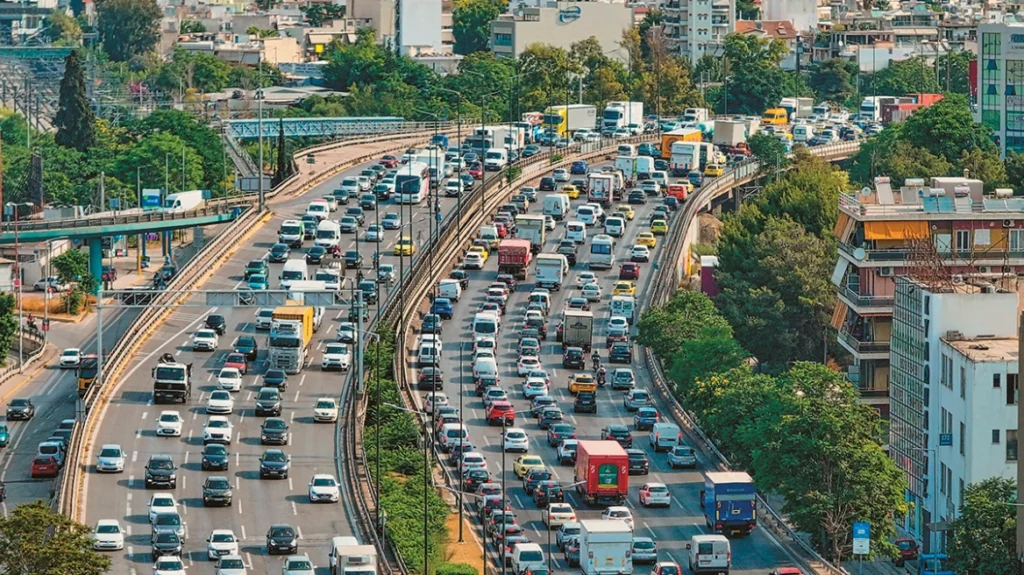
A series of projects, initially focused on easing the burden on the so-called “river of torment,” Kifisos, by diverting truck traffic, promise to reduce the capital’s massive congestion. The starting point is the triple interchange at Skaramagas, which has been prioritized after the tender for the logistics center in Fyli was declared unsuccessful.
The new project offers hope of ending Athens’ traffic nightmare in the same way it is caused—through a system of interconnected routes. Decongesting Kifisos Avenue will first ease Attiki Odos and then reduce traffic even in central Athens and other major roads. How?
Like a clogged artery
After the collapse of the tender for the large logistics park in Fyli (declared void), which aimed to relocate transport company depots from Elaionas, it became clear that relieving Kifisos from truck traffic would be delayed. As an alternative (already considered in parallel), the Skaramagas triple interchange is now being prioritized.
Once contracts are signed, work will begin to connect the Western Aigaleo Ring Road with Schisto Avenue and the wider Skaramagas industrial area. This will significantly ease congestion in western Attica and somewhat relieve Kifisos—though not completely. Still, can it offer breathing room?
The situation is all too familiar for Athens drivers unfortunate enough to use Kifisos, especially in the mornings (and increasingly throughout the day): toward the Corinth exit, everything comes to a standstill.
Traffic queues stretch from the Athens–Corinth highway into Kifisos, creating a bottleneck effect, with at least one lane blocked by stationary vehicles. As time passes, congestion spreads and eventually brings the entire road to a halt.
Like a clogged artery in a body, Kifisos quickly transmits the problem to every road in Attica. Drivers divert to Attiki Odos, causing delays there too, and congestion spreads further.
More than 130,000 vehicles—many of them heavy trucks—pass daily along the Athens–Corinth highway at its junction with Schisto Avenue.
The triple interchange plan
The plan includes constructing three interchanges: Schisto, Shipyards, and Skaramagas, alongside completing the final 1.5 km of the Western Aigaleo Ring Road, linking it with Athens Avenue and Schisto Avenue.
With this project, heavy traffic will be rerouted through Skaramagas, reducing the need for trucks and commuters in western suburbs and the port to use Kifisos. This is expected to significantly relieve congestion, especially in western sections, improving traffic flow across the entire Attica basin.
Project components include:
- Skaramagas interchange: a mini interchange directly linking the Western Aigaleo Ring Road with the Athens–Corinth highway and Schisto Avenue.
- Upgraded Schisto interchange: reconstruction of the existing bridge and addition of a second overpass for traffic from Athens toward Schisto.
- New Shipyards interchange: built from scratch, replacing a problematic traffic-light junction known for kilometer-long queues.
The project, budgeted at €70 million and expected to take about three years, will effectively create a “parallel Kifisos”—an alternative route channeling heavy traffic, especially to and from Piraeus.
It will also eliminate one of western Attica’s most notorious traffic lights (at Skaramagas shipyards) and add lanes to improve flow.
A “parallel Kifisos”
Future plans include another interchange in Aspropyrgos, further strengthening this alternative corridor. The goal is to create a continuous route from Attiki Odos to Piraeus, diverting heavy vehicles away from Kifisos.
Flood-control works are also planned.
Originally, this was to complement the logistics hub in Fyli, a major project dating back to the 1990s—but it has stalled again after the tender failed due to financial disagreements between authorities and the municipality.
The core problem
Transport experts say the key issue is the heavy truck load on Kifisos, which exceeds its capacity.
- Over 260,000 vehicles use Kifisos daily
- Trucks make up about 20% of traffic per lane (vs. ~3% elsewhere)
- Drivers can lose over an hour on trips that should take 20 minutes
Logistics activity alone accounts for more than 20,000 daily truck trips, linked to Piraeus port and industrial zones like Elefsina and Aspropyrgos.
Delays cost the economy an estimated €90 million annually.
From 2024 to today, drivers in Attica are estimated to have lost 14–15 million hours stuck in traffic.
Stress ranking
All this contributes to Athens being ranked the third most stressful city in Europe for driving, according to a study by Compare the Market.
- Score: 58.45/100
- Worse scores: Dublin and Bucharest
- Traffic congestion: 54.7%
- Average speed: 19 km/h
- Time lost: 143 hours per year per driver
Globally, Athens is not far behind cities like Houston, Seattle, and parts of Australia in driving stress levels.
Ask me anything
Explore related questions




