





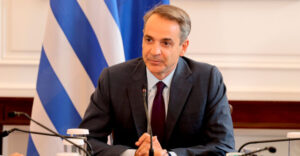
The Prime Minister, Kyriakos Mitsotakis, made extensive reference to the visit of the French President, Emmanuel Macron, to Athens in his Sunday post.
Initially, the Prime Minister referred to the importance of Greek-French cooperation, stressing that the new strategic agreement strengthens the country’s geopolitical role and creates prospects for cooperation in critical sectors such as defense, the economy, and technology.
At the same time, he referred to initiatives being recorded in areas such as healthcare, education, transport, and public safety, as well as interventions to address urgent issues, such as the outbreak of foot-and-mouth disease on Lesbos.
His full post:
“Bonjour! Today I greet you in French, clearly influenced by the visit of the President of France and friend Emmanuel Macron to Athens on Friday and Saturday. It is always good to confirm in practice that you have strong allies, especially when this translates into agreements that safeguard the country.
At a critical geopolitical juncture, we reaffirmed the strategic choice we made in 2021 to strengthen the relationship between Greece and France, turning it into a strong, multifaceted alliance. The Enhanced Comprehensive Strategic Partnership we signed a few hours ago is a broad strategic agreement that further upgrades and deepens Greek-French relations, marking our joint course not only in defense, but also in the economy, civil protection, migration, technology, the environment, education, and culture. This is an agreement that makes Greece safer, strengthens its geopolitical position, and creates new opportunities and prospects for synergies, from artificial intelligence to cybersecurity. At the same time, we are substantially strengthening our deterrent power through the renewal of the 2021 strategic defense and security partnership. Greece and France are member states of the EU and NATO, but at the same time we are becoming a strong axis in the Mediterranean, something we demonstrated with our defense support for Cyprus, showing what European solidarity means in practice. We continue to move forward together on the path toward a strong, competitive, and autonomous Europe—issues we also discussed at the informal European Council in Cyprus. A Europe capable of standing confidently in an uncertain world and defending the interests of its citizens and its values.
Beyond these very important developments, the week we leave behind focused on the economy and supporting disposable income. Our “formula” remains steady: the better the economy performs beyond forecasts, the more the surplus will be returned to citizens, especially the most vulnerable. The momentum of our economy, as reflected in official Eurostat data, allowed us to announce on Wednesday eight new support measures totaling €500 million.
So how do these measures translate:
- 1.86 million pensioners and people with disabilities will see their annual benefit increase from €250 to €300
- More than 1 million tenants will receive a refund of one out of the 12 rents they pay, following the expansion of income criteria we announced
- 3.3 million parents will receive €150 per child
- 1.3 million individuals and 284,000 businesses and self-employed professionals with overdue debts to the state can more easily settle their debts in 72 installments
- 250,000 professional farmers will receive additional support for diesel fuel and fertilizers
- The €0.20 diesel subsidy is extended through May
I am well aware that no single measure is enough to eliminate the pressures of global inflation on its own. However, the fact that Greece is now one of only five EU countries with a surplus allows us to provide solutions without risking what we have built.
Another positive piece of news for our economy came from Europe, as the 7th installment of €1.18 billion from the Recovery and Resilience Facility was disbursed, bringing the total we have received over 4.5 years to €24.6 billion. These resources are being turned into projects the country has needed for decades: from hospital renovations and the digital modernization of the state, to infrastructure that makes Greece a modern country.
However, as no week has only good news, I turn to the issue of foot-and-mouth disease that emerged in livestock units on Lesbos. A major, coordinated battle is underway, mobilizing all available resources and forces to contain and eradicate the disease from the island. I want livestock farmers to know that we stand by them, and we are already preparing and will present a comprehensive support framework, without a financial cap, with four key interventions covering livestock losses, income, feed costs, and impacts on milk production. But this is a battle we must fight together. I urge producers to strictly follow biosecurity measures so we can limit the disease as quickly as possible.
Next topic for today: the “Social Tourism” program, whose applications opened on Tuesday, aiming to begin on May 18, earlier than ever before. It is a program that has been widely embraced—consider that since 2019, more than 1.2 million citizens have taken holidays through it. This year, we are offering 300,000 vouchers, with a focus primarily on those most in need: large families are automatically included, while people with disabilities receive the highest priority scoring.
A very important development concerns accessibility for people with disabilities in the city, as the Free Transportation Service for Persons with Disabilities is being strengthened with 7 additional specially equipped vehicles, bringing the total fleet of OSY to 10. In practical terms, this means available routes more than double. But we are not stopping at vehicles. We are investing in people, training drivers and inspectors to provide the necessary support, and in technology, eliminating bureaucracy. With the Disability Card now directly linked to the electronic ticket, citizens can travel for free without submitting documents or facing the inconvenience of the past.
I continue in the field of public health with the foundation of the new building complex at the “Attikon” University General Hospital, one of the major flagships of the National Health System, originally designed to serve 80,000 people per year and now serving 200,000. This is why the donation of the Stavros Niarchos Foundation is so important, and we warmly thank it. It is a national benefactor of the health system. I will mention only the construction and equipment of three new, state-of-the-art hospitals in Komotini, Thessaloniki, and Sparta, to be delivered within the next 12 months, which will transform the country’s hospital map. As for “Attikon,” the two new buildings will be completed and delivered to the state in 2027. They will meet the hospital’s needs for beds and on-call doctors’ spaces and will host the National Coordination Center for Mobile Medical Units.
The OECD praised the digital transformation of Greek education, noting that our country has moved from lagging in educational innovation to becoming one of the most dynamic examples of adaptation to the modern era. Today, Greece is among the countries that not only follow developments but actively help shape them. Examples include the Digital School, which ensures that a child living on the most remote island or in a mountain village has the same access to knowledge as a student in Athens; the Digital Tutoring platform offering free lessons, especially for students preparing for national exams; tens of thousands of interactive whiteboards in schools; communication apps like e-Parents that strengthen the connection between school and family; and many other initiatives. In short, we have made significant investments in digital infrastructure and educational resources.
The Court of Audit has approved the award of the international tender held in October 2025 for the electronic monitoring of defendants, convicts, and prisoners on leave—the so-called “ankle bracelets”—a significant step in modernizing the country’s criminal policy. I remind you that the pilot program began in 2025, and now, after the green light from the Supreme Fiscal Court, it is being fully implemented nationwide. Judicial authorities will decide on its application where legal conditions are met, but it is clear that electronic monitoring mainly concerns low- and medium-level crime, with particular emphasis on vulnerable groups such as detainees over 70, mothers with minor children, and persons with disabilities. It will under no circumstances be applied to those convicted of serious crimes.
On this occasion, I would also like to once again congratulate the officers of the Organized Crime Unit for dismantling a massive smuggling ring of illegal tobacco products, with damage to the state exceeding €1 billion. The case allegedly involves 38 individuals and 21 companies of various legal forms, as well as 7 shipping companies. The Authority for Combating Money Laundering proceeded with one of the largest asset seizures in Greece—luxury properties, factories, cars, vessels, and three tankers.
I continue with yet another repatriation of Greek antiquities—a restoration of justice in the field of culture. This time, the return αφορά five ancient works of art—vessels, a bronze mirror, a statue, and part of a relief—dating from the 6th century BC to the 2nd century AD, which returned from the United States to the land that created them. They had been acquired by the Grey family, who contacted the Greek authorities and offered to return them. This is a gesture we welcome. Each time one of our treasures returns, a piece of our history is restored.
I close with a very important piece of positive news. In the past week, credible international economic organizations, including the International Monetary Fund, recorded that Greece has achieved in recent years the largest reduction in public debt in Europe and globally. This reduction—by 65 points, or nearly 30% from its pandemic peak—is a conscious choice of fiscal responsibility and intergenerational solidarity toward our children. Quite simply, young Greeks must never again live in an over-indebted country that drives its youth abroad. Our government will not pass the bill to future generations. Our goal is that from next year, Greece will no longer be the EU country with the highest public debt, continuing steadily on the path of convergence with the rest of Europe in this critical area.
This review is clearly longer than last week’s. A return to normality, one might say. See you next Sunday!”
Ask me anything
Explore related questions




