





A group of Greeks who have traveled to the City gaze with awe and emotion at Hagia Sophia. Upon entering, a woman makes the sign of the cross and begins to pray. One member of the group slips away and, discreetly, pulls a Greek flag out of his jacket.
Quickly, another friend photographs him waving it. They are counting on the fact that no one will notice them among the at least 45,000 people who visit Hagia Sophia daily.
Two security personnel approach the group and ask the Greeks to delete the photos with the flag “so that the matter can end here, discreetly.”
They are then arrested, and the two Greeks are taken to prison on charges of insulting a section of the public.
Outside the global symbol of Orthodoxy, another group of Greek tourists plays Greek songs and dances syrtaki. “Greeks provoke,” writes a Turkish website.
“I don’t see them doing anything wrong. And they certainly don’t cause more harm than the trucks and cranes that Erdoğan’s associates have placed inside,” someone comments. In the end, are those who travel to the City to fulfill a vow and raise a flag inside the temple—which became a museum and then a mosque—provoking?
Vows and the “challenge”
For just under 1,000 years—specifically 916—since Justinian declared “Solomon, I have surpassed you” at its inauguration, Hagia Sophia in Constantinople was a Christian church. Then came the Crusades, the decline of the Byzantine Empire, and ultimately Mehmed the Conqueror, with the City falling into Ottoman hands and the building becoming a mosque.
It remained a mosque for 482 years, until November 24, 1934, when Mustafa Kemal Atatürk turned it into a museum. UNESCO declared it a World Heritage Site on December 6, 1985. It remained a museum until July 10, 2020, when Recep Tayyip Erdoğan signed a decree converting Hagia Sophia back into a mosque.
Today, foreign visitors pay an entrance fee to visit it—where they are allowed. On the ground floor, now a mosque, visitors must remove their shoes at the entrance. Women must also wear a headscarf to enter, except during prayer times, when entry is prohibited. Access to the upper gallery is the most common route for visitors.
For Greeks traveling to Constantinople, seeing Hagia Sophia—the symbol of Christian faith, Orthodoxy, Christianity, and Hellenism—is a lifelong dream. For others, it becomes something like a vow: a promise fulfilled through a “symbolic act” against those who repeat that “the City and Hagia Sophia will always be ours.” They open a Greek flag, cross themselves, pray, kneel, and say a few words.
This has become so common that it almost resembles a “challenge” among Greek visitors. That’s why incidents like the arrest of the two Greeks occur nearly every year. According to reports, in this case security intervened—as it always does when a flag is raised, especially a Greek one bearing a cross, which may be considered offensive inside a mosque—due to the slogan written on it.
The phrase “Orthodoxy or death,” although meaning that its bearers would rather die than renounce their faith, can easily be misunderstood as a threat toward others. This appears to have been the case here. When security asked the two Greeks to delete their photos and they refused, the situation escalated beyond control. They were arrested and charged with “inciting public hatred.”
A recurring phenomenon
Such incidents are not new. On March 25, a photo circulated of a Greek who had displayed a Greek flag with Crete on it—an older photo from when Hagia Sophia was still a museum, when security was much more relaxed. Back then, it was common to see groups of Greeks, Armenians, Serbs, Russians, Ukrainians, and others crossing themselves, praying, chanting, or even singing national anthems.
More recently, Turkey debated whether it was provocative that a group of Greeks danced hasapiko in front of Hagia Sophia. The group responded that police present did not intervene and did not object to the Turkish flag visible in the background.
At the end of 2024, an incident occurred when three Greek air force cadets and three Cypriot students unfurled Greek flags outside Hagia Sophia and shouted slogans, prompting police intervention.
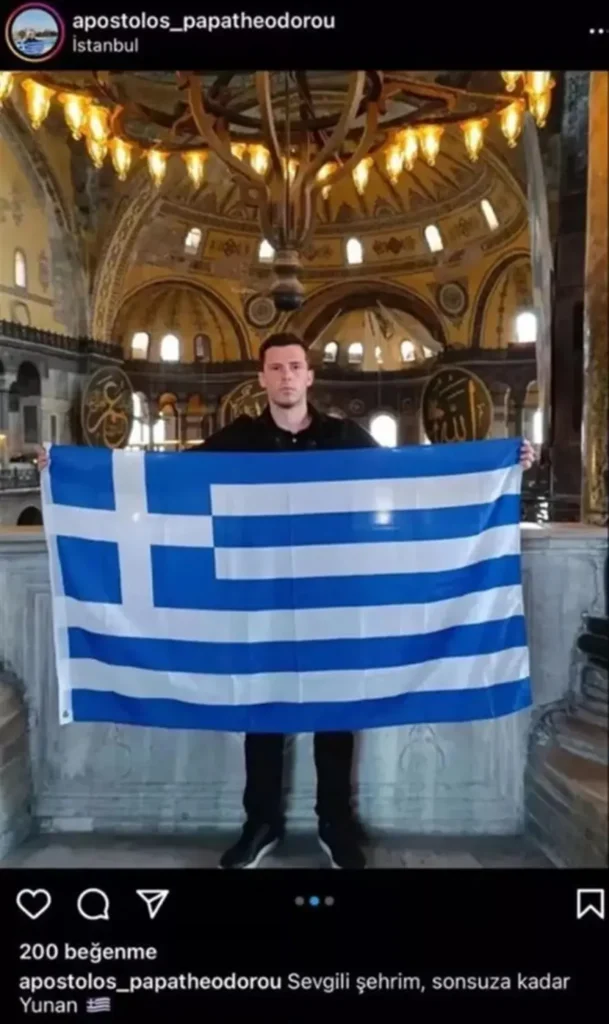
Earlier, a Greek tourist posted a photo of himself holding a Greek flag inside, captioned “My beloved City, forever Greek,” triggering strong reactions in Turkish media.
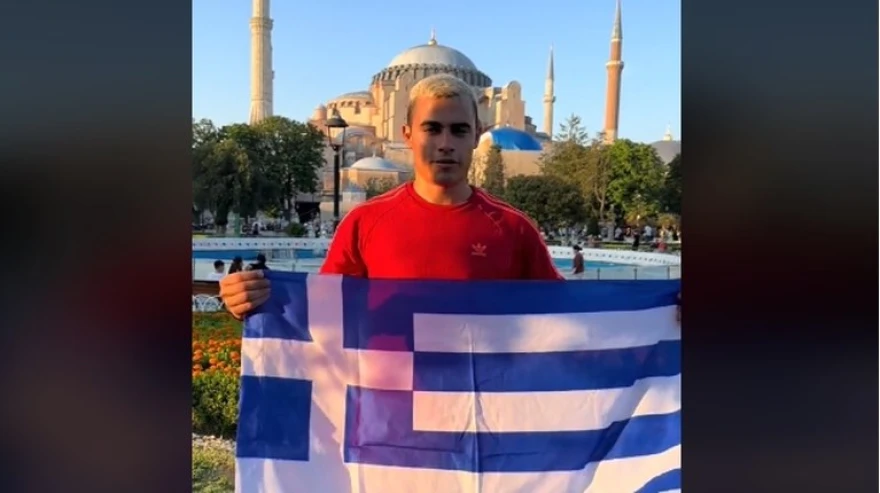
In June 2023, a video by a Greek TikToker declaring that Hagia Sophia “will always be a Greek church” caused major outrage in Turkey and even reached the Turkish parliament. The young man was ultimately banned from entering the country.
The historic secret liturgy
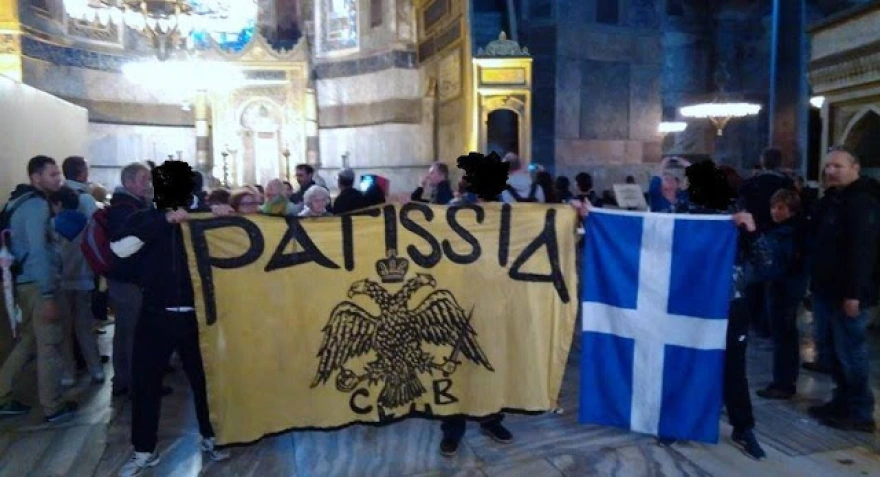
When Greek sports teams visit Constantinople, fans often stop at Hagia Sophia, raising flags, chanting, and sometimes clashing with Turkish ultranationalists or police—creating stories that become legends among fan groups.
However, no story compares to the legendary secret liturgy held at Hagia Sophia on Epiphany in 1919 by Archimandrite Eleftherios Noufrakis and four Greek officers.
They conducted a Divine Liturgy inside the historic temple—the first in 466 years since the Fall of Constantinople—and the last to this day. Greeks watched in deep emotion, while Turks stood astonished.
Armed Turkish forces soon arrived, and a violent clash seemed inevitable. It was avoided when, after the liturgy ended, a Turkish officer restrained his men, aware of the fragile political situation at the time.
The incident was reported to Sultan Mehmed VI, who protested to the Allied powers, who in turn complained to Greek Prime Minister Eleftherios Venizelos. Officially, Venizelos reprimanded Noufrakis; unofficially, he praised him for reviving, even briefly, the nation’s most sacred dreams inside Hagia Sophia.
It was the last time a Christian liturgy was held there—at least up to today.
Ask me anything
Explore related questions




