





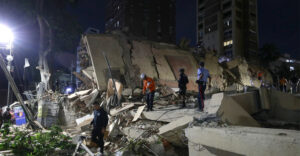
Venezuela has declared a state of emergency after two powerful earthquakes struck the country within seconds of each other on Wednesday evening, bringing down buildings in Caracas, damaging the capital’s main international airport and prompting fears of a large number of casualties.
The US Geological Survey, USGS, said the first earthquake had a magnitude of 7.2 and was followed 39 seconds later by a stronger 7.5-magnitude quake. The tremors struck west of Caracas, along Venezuela’s Caribbean coast, and were followed by around 20 strong aftershocks.
The earthquakes are reported to be the strongest the country has faced in 126 years.
UPDATE
Venezuela is facing a mounting humanitarian crisis after two powerful earthquakes, measuring 7.2 and 7.5 in magnitude, struck the country in rapid succession on Wednesday night, flattening parts of Caracas, forcing the closure of the capital’s airport and leaving thousands of families searching for relatives and friends.
The 7.5-magnitude quake is believed to be the strongest to hit Venezuela in 126 years. The first official toll stands at 32 dead and about 700 injured, although authorities and international monitors fear the number could rise sharply as rescue crews continue searching through collapsed buildings.
Acting President Delcy Rodríguez has declared a state of emergency, while emergency services, volunteers and relatives are still trying to reach people trapped beneath rubble in the capital and nearby areas.
The disaster has also triggered a desperate online search for missing people. With communications badly affected by the earthquakes, a digital platform, desaparecidosterremotovenezuela.com, has been launched to help residents report missing relatives or confirm that loved ones are safe.
The website describes itself as a citizen tool for families who have been unable to make contact.
“After the earthquake, many families still have no news of their loved ones. If you cannot reach someone, report it here. And if you find them, let us know, so that their name brings relief, not anguish,” the message on the platform says.
According to the first figures published by the platform, 9,721 reports have been registered so far. Of these, 9,166 people remain without contact, while 555 have been located and listed as safe.
The figures are not an official missing-person toll, but they reflect the scale of public anxiety in a country where damaged infrastructure, power cuts and interrupted phone networks have made communication difficult in the hours after the disaster.
Images and videos circulating on social media show buildings reduced to rubble, residents fleeing into the streets and scenes of panic at damaged public infrastructure. Witnesses have described apartment blocks collapsing “like cardboard”, while emergency workers have warned people not to return to unstable buildings because of the risk of further collapses and aftershocks.
Caracas airport has been closed after sustaining serious damage, complicating the arrival of international assistance and the movement of emergency teams.
The USGS issued a red alert through its earthquake impact system, warning that the disaster could cause widespread destruction and a high number of casualties.
UPDATE
International support offers
United States mobilises emergency assistance
The United States said it was mobilising assistance for Venezuela after the devastating earthquakes. US Deputy Secretary of State Christopher Landau wrote on X that Washington was in contact with Venezuelan authorities and was “mobilising assistance”. State Department official Jeremy Lewin also said on X that the department had activated a disaster assistance team and task force to coordinate urgent support, including search-and-rescue teams, medical aid, humanitarian supplies and other resources.
Latin American countries and other governments express support
A series of governments expressed condolences and offered support as the scale of the disaster became clearer. Spain’s Prime Minister Pedro Sánchez said his country stood with the people of Venezuela, while Pakistan’s Prime Minister Shehbaz Sharif also expressed condolences to the victims’ families. Offers of help were also reported from Argentina, Bolivia, Brazil, Chile, Ecuador, El Salvador, Mexico, Panama and Uruguay.
Venezuela thanks Washington after Rubio call
Venezuela’s acting president, Delcy Rodríguez, said on X that she had spoken by phone with US Secretary of State Marco Rubio. She said Rubio had expressed “solidarity and support” for the Venezuelan people, and thanked Washington for its message at what she described as an extremely difficult moment for the country.
China says it is ready to help
China said it was ready to provide assistance, depending on Venezuela’s needs. Foreign ministry spokesperson Guo Jiakun said Beijing was willing to offer help “in an appropriate manner”, adding that there had so far been no reports of Chinese citizens killed or injured.
Italy prepares humanitarian channels
Italy’s Prime Minister Giorgia Meloni wrote on X that she was following the situation with “deep concern” and expressed sympathy and solidarity with the Venezuelan authorities and people. She added that Italy was working to activate humanitarian assistance channels and support for Italian citizens in the country.
Germany offers military transport aircraft
Germany said it was ready to provide six Airbus A400M transport aircraft to support relief efforts. German Defence Minister Boris Pistorius said the aircraft could be made available at short notice, once a request for assistance was received. The aircraft can be used to transport emergency supplies and can also be configured for medical evacuations.
UPDATE
According to USGS data, the first tremor, which the agency described as a foreshock, had a magnitude of 7.2 and was recorded at 6:04pm local time, or 1:04am in Greece, at a depth of 21.9 kilometres, about 200 kilometres west of Caracas.
The second quake, measuring 7.5, struck 39 seconds later at a shallow depth of 10 kilometres, around 45 kilometres from the first epicentre. It was followed by about 20 strong aftershocks.
International and local reports described panic across the capital as residents ran into the streets, glass fell from buildings and power cuts were reported in several areas.
Footage and images circulated on X, the social media platform formerly known as Twitter, appeared to show the scale of the damage. Visegrád 24 posted on X: “The first quake had a magnitude of 7.1 and was swiftly followed by a 7.5-magnitude earthquake.” In a second post on X, the same account said: “Horrific images coming out of Venezuela tonight.”
Breaking911 wrote on X that “multiple structures have reportedly collapsed in Caracas, Venezuela, following a powerful earthquake that struck the region.”
Agence France-Presse photographers in Caracas saw search-and-rescue operations being organised around collapsed buildings, with rescuers carrying injured people on stretchers and moving them towards ambulances.
In Altamira, one of the capital’s better-known neighbourhoods, an AFP correspondent saw a 22-storey apartment building that had collapsed and been completely destroyed. Outside, residents shouted the names of relatives, while volunteers climbed through the debris as night fell. “We need flashlights,” one person was heard shouting.
Interior Minister Diosdado Cabello confirmed that buildings had collapsed in the capital and said he had ordered the natural gas supply to be cut off in order to prevent further accidents.
“Some structures have been damaged, and we want to prevent any gas-related accidents,” he said. He confirmed there were injuries, but gave no casualty count.
The situation remained unclear in Puerto Cabello and San Felipe, cities closer to the epicentre, where more than 400,000 people live.
The OSINTdefender account posted that “utter devastation” had been seen across the northern coastal city of La Guaira, following what it described as “tonight’s pair of major earthquakes, measuring 7.2 and 7.5 on the Richter scale, with an epicentre just west of Caracas.”
Another account, Volcaholic, posted on X: “Whole streets just gone after the earthquake in Venezuela. The damage is catastrophic and the casualty count is going to be horrific.”
In Caracas, many residents spent the night outdoors, afraid to return to their homes as aftershocks continued.
“It was unbelievable; I don’t even know how long it lasted. I was on the top floor, and things started falling,” said Heidi Romero, a 42-year-old shop manager who works in a shopping centre in Altamira.
“The whole wall was covered in cracks, things were falling from the ceiling. It was horrible,” said Odalis Escalona, a 54-year-old bank employee.
Carmen Gedes, 69, said she was in the bedroom of her bedridden sister when the shaking began.
“The intensity just kept increasing,” said Gedes, who lives in a middle-class neighbourhood in the hills of Caracas. “I started to see the windows shaking, then everything started shaking. My sister, a neighbour and I were clinging to each other. We couldn’t get out.”
Rodríguez said school and rail services had been suspended. She also announced that Simón Bolívar International Airport, in Maquetía, La Guaira, about 40 kilometres from Caracas, had been closed because of serious damage.
Images shared by Venezuelan congressman Wilmer Asuaje appeared to show sections of roofing collapsed inside an airport terminal, with people running in panic.
The tremors were also felt strongly in neighbouring Colombia, including in Bogotá, around 1,000 kilometres from Caracas. Colombia’s risk and disaster management unit said there was no tsunami risk on the country’s Caribbean coast.
The US tsunami early-warning system initially warned of a possible threat from dangerous waves affecting Puerto Rico, the US and British Virgin Islands, and the Dutch Caribbean islands of Aruba, Curaçao and Bonaire. The warning was withdrawn about an hour later.
Authorities in Venezuela have urged residents to remain alert as rescue operations continue and aftershocks are expected.
Ask me anything
Explore related questions




