





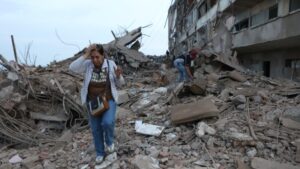
A national tragedy is unfolding in Venezuela after two powerful earthquakes struck the country in rapid succession, leaving entire neighbourhoods in ruins and triggering a desperate race to find survivors beneath collapsed buildings.
The death toll is now reported to have risen to 235, with authorities warning that the number could increase sharply as rescue crews reach the worst-hit areas. Images from northern Venezuela show flattened buildings, damaged hospitals, fires, power cuts and residents searching through debris for relatives and neighbours.
A race against time beneath the rubble
The two earthquakes, measured by the U.S. Geological Survey at magnitudes 7.2 and 7.5, struck on Wednesday afternoon, local time, within less than a minute of each other. The second, stronger tremor was shallow, making its impact far more destructive in densely populated areas.
La Guaira, the coastal state adjoining Caracas and home to the capital’s main international airport, is among the worst-hit areas. Catia La Mar, Morón and parts of Caracas have suffered extensive damage, with apartment blocks, public buildings and roads reduced to rubble.
On X, journalist Sandro Pozzi wrote that buildings were continuing to collapse along Venezuela’s coast, adding that more than 250 structures had been reduced to rubble, according to authorities.
Residents and volunteers have joined rescue efforts, often using only basic tools. In some areas, eyewitnesses described people digging with their hands as they searched for trapped relatives and neighbours, while the lack of heavy machinery slowed the operation.
Several videos circulating online showed dramatic rescues from collapsed buildings. In one post on X, Amar Singh Chouhan described the rescue of a child from the rubble in Catia La Mar as a “heartbreaking miracle”. In another post, user Surajit shared footage of a woman being pulled alive from debris after the quake.
Hospitals overwhelmed, residents appeal for help
The disaster has placed enormous pressure on Venezuela’s already fragile health system. Hospitals in the affected areas have been overwhelmed by the injured, while some medical care is being provided outdoors because of damage to buildings or lack of space.
Doctors and volunteers have reported shortages of basic medical supplies, including gauze, gloves, medicines and painkillers. Power cuts, blocked roads and continuing aftershocks are complicating efforts to evacuate the injured and bring aid into affected districts.
Residents have issued urgent appeals for help, calling for more rescue teams, heavy equipment, food, water and medical supplies. Thousands of people have spent the night outdoors or in their cars, afraid to return to buildings weakened by the tremors.
USGS warning raises fears of a much higher toll
The U.S. Geological Survey has warned that the final toll could be far higher, with its impact models indicating the possibility of very high casualties depending on the number of people trapped, the scale of building collapse and the ability of rescue teams to reach damaged areas.
Authorities say many people remain missing, while aftershocks continue to disrupt search operations. In several locations, streets are covered with concrete, glass and twisted metal, while fires broke out overnight after the quakes.
The earthquakes also damaged Maiquetía International Airport, Venezuela’s main gateway near Caracas, forcing its closure. The La Carlota military airport is being used for humanitarian operations.
Interior Minister Diosdado Cabello said the natural gas supply had been cut in some areas “to prevent any accidents”, while transport services were disrupted and many shops remained closed.
International aid begins to arrive
International support has begun to mobilise as the scale of the disaster becomes clearer. The Venezuelan government has said aid is being sent by the United States, Spain, Mexico and Qatar, while it has also requested assistance from private companies to bring in heavy machinery for rescue work.
On X, El Salvador’s President Nayib Bukele wrote that the first of three planes carrying personnel, equipment and supplies to help Venezuela was already on its way.
Medical students from the Central University of Venezuela have also joined emergency and rescue efforts, according to posts shared online.
The United States has announced humanitarian assistance, with Secretary of State Marco Rubio saying Washington was ready to support rescue and relief operations.
A disaster felt across the region
The earthquakes were felt far beyond Venezuela, including in Bogotá, Colombia, around 1,000 kilometres away, and in parts of northern Brazil.
According to USGS data, the first quake struck at 6:04 p.m. local time on Wednesday, at a depth of 21.9 kilometres, with its epicentre around 200 kilometres west of Caracas. The second, stronger earthquake followed 39 seconds later, at a shallower depth of around 10 kilometres.
More than 20 aftershocks have since been recorded.
Venezuela has suffered deadly earthquakes before. In 1967, a quake in Caracas killed 236 people, while in 1997, an earthquake in Cariaco, in the north-east of the country, killed 73.
This latest disaster, however, is already being described as one of the most devastating natural catastrophes in Venezuela’s modern history. With rescue efforts expected to last for days, and possibly weeks, officials warn that the true scale of the tragedy is still unknown.
Ask me anything
Explore related questions




