






From 1 July, the European Union will abolish the customs duty exemption for low-value parcels worth up to €150. In its place, a temporary flat €3 charge will be introduced, fundamentally changing how purchases from non-European online platforms reach consumers.
Online orders from China, the United States and the United Kingdom will no longer be as straightforward as they have been until now. In practical terms, this means that even for very low-cost parcels, the additional cost can no longer be regarded as negligible.
The key question now—and one that only time will answer—is whether the extra charge will prove significant enough to discourage consumers from placing future orders. Another issue is how the additional cost will be applied in practice to purchases that have already been made but are due to arrive after 1 July.
What changes for shoppers buying from non-EU platforms
According to guidance issued by the European Commission, which will apply across customs authorities throughout the EU for low-value parcels ordered directly by consumers anywhere in Europe, the crucial factor is not when the order was placed, but when the parcel is cleared through customs upon entering EU territory.
As a result, the new €3 charge on low-value online parcels comes with a hidden catch: even orders placed some time ago may still incur the fee if they pass through customs after 1 July.
International online platforms have already begun applying the €3 charge per item at checkout.
However, regardless of whether the charge has already been prepaid, any parcel cleared through customs after 1 July will fall under the new regime, even if the order itself was placed earlier. In other words, what matters is not the date of checkout, but the moment the parcel is processed by customs.
This means that consumers who rushed to place orders before the end of June are not guaranteed to have secured the old rules. If a shipment remains in transit and is cleared only after the new measures take effect, it will be subject to the new regulations.
Who actually pays?
This is another area where the EU is seeking to eliminate confusion. The €3 fee is not presented as a tax on consumers, but as a customs duty that, in most cases, is payable by the platform, the seller, or another commercial entity responsible for declaring the goods to customs.
The European Commission states that online shoppers are not legally responsible for paying this customs duty in most cases, with liability resting primarily with platforms and sellers.
That does not, however, mean consumers will avoid the cost. Rather, the charge is typically passed on earlier or in another way—through the final sale price, customs clearance charges, or the delivery company.
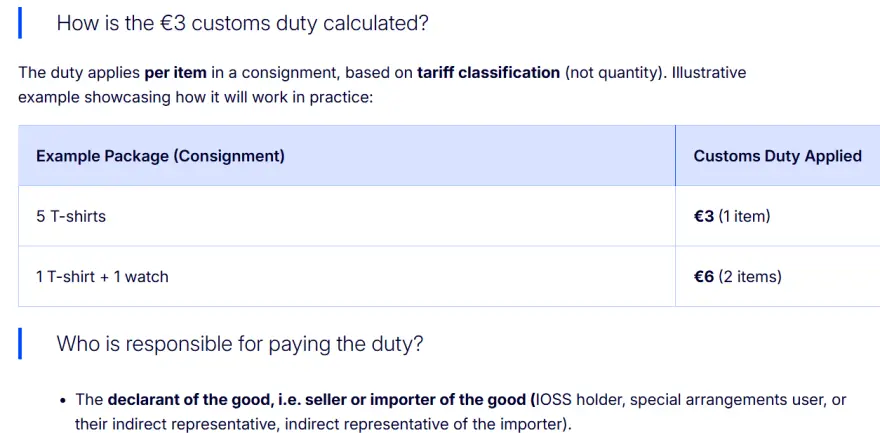
The charge is not per parcel, but per item
Another important change is that the fee does not operate in the way many consumers assume. The EU explains that the temporary charge applies to each type of item declared, rather than to every individual unit or to the parcel as a whole.
In other words, one T-shirt, one umbrella and one pair of shoes are treated as three separate items.
As a result, purchasing multiple inexpensive products from non-EU platforms becomes more expensive and less straightforward than before. For consumers accustomed to filling their baskets with low-cost items, this change may prove more significant than the size of the fee itself. The additional cost does not apply simply to the parcel overall—it follows its contents.
What applies to Amazon, ASOS and similar purchases?
For platforms such as Amazon, when goods are shipped from the United States or another non-EU country, the new system can generally be incorporated at checkout through existing mechanisms that calculate import charges in advance. As a result, customers may see the additional cost before completing their purchase, rather than discovering it when the parcel arrives.
In the case of retailers such as ASOS, the decisive factor is not the brand, but where the product is dispatched from. A parcel shipped from a warehouse within the EU is treated very differently from one dispatched from the United Kingdom or another non-EU country.
In short, consumers will now need to pay attention not only to the price and retailer, but also to the actual shipping origin. The label “Ships from EU” will become more important than ever.
Why has the new measure been introduced?
The EU argues that the previous system had become unsustainable.
In 2025, 5.9 billion low-value items from non-EU countries entered the European market without customs duties, while customs authorities processed more than 16 million parcels every day. These shipments accounted for around 97% of imports by volume, but only 2% of their total value, placing a significant administrative burden on customs services for relatively little economic return.
The European Commission also links the reform to consumer safety and regulatory compliance. According to the figures presented, in 2025, more than 60% of online products inspected in categories including cosmetics, electronics, toys and food supplements failed to meet EU standards.
What else changes from autumn?
The new regime does not end with the €3 charge.
From 1 July 2026, the declaration of Product Identifiers (PIDs) will begin on a voluntary basis, while from November 2026 these identifiers will become mandatory.
The aim is to give products a clearer digital identity, making it easier for authorities to identify unsafe or non-compliant goods.
Ask me anything
Explore related questions




