





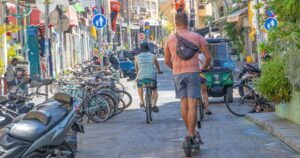
Deputy Transport Minister George Kotsiras has confirmed a stricter framework for the use of electric scooters in Greece, including a ban on their sale, rental or transfer to people under the age of 17, mandatory insurance and tougher fines for violations.
Speaking to ERTnews, Kotsiras said road safety remains a “major challenge” for the government and Prime Minister Kyriakos Mitsotakis, adding that recent changes to the Highway Code, combined with stricter Traffic Police checks, have helped reduce fatal road accidents.
On electric scooters, he said the government had identified “loopholes” in the current system that could put citizens, and especially minors, at risk. The new provisions, which are included in a bill currently under public consultation, are expected to be passed soon.
Under the proposed rules, anyone who sells, rents or lends an electric scooter to a minor will face a fine of €1,000. Users will also face penalties if they violate the new rules.
Kotsiras said helmets will be mandatory, while the use of mobile phones and headphones will be banned. Riders will also be required to wear high-visibility vests during evening hours, and insurance will become compulsory. He added that electric scooters will not be allowed on roads where the speed limit exceeds 50 kilometres per hour.
“These provisions and regulations are being introduced to reduce accidents, protect human life and, above all, protect our young citizens,” he said.
He also said rules will cover illegal parking of scooters, including cases where they block ramps, traffic lights or points that disrupt the movement of pedestrians and vehicles.
Traffic in Attica and Thessaloniki
Referring to traffic congestion, Kotsiras described it as “a major everyday issue” for citizens, particularly in Attica and Thessaloniki.
“It is a multifaceted issue,” he said. “It is a relay race, a multi-level challenge involving many different areas, and that is why we are investing in each of them separately in order to bring improvement.”
He announced that the contract for the Skaramanga interchange will be signed on July 13, describing it as an important project for Attica. According to Kotsiras, it is expected to ease congestion in Western Attica, Skaramanga and along the Athens–Corinth route, particularly for trucks.
He also referred to works at the Metamorphosis interchange, while stressing that improving public transport is central to easing daily congestion.
Kotsiras said 125 new electric buses have already been delivered to Athens, with another 50 delivered to Thessaloniki, and that they will enter service soon. He added that the ministry is also speeding up the hiring of bus drivers in order to improve service frequency and reliability.
Metro upgrades and new funding
On the Athens metro, Kotsiras said the modernisation of a significant number of trains on Lines 2 and 3 has recently been included in the National Strategic Reference Framework.
Funding of around €149.5 million has been approved for the upgrade of 14 metro trains, including modern technology and improved air conditioning.
“It is true that a significant part of the first-generation trains needs upgrading,” he said. “We need to invest in the existing rolling stock, which is why inclusion in the NSRF is so important.”
He added that the first refurbished train could enter service in the final ten days of July, while work is also under way on Line 1. At the same time, he said, the ministry is proceeding with infrastructure work on the tracks of Metro Lines 2 and 3 as a preventive measure to improve the safety, reliability and lifespan of the network.
New trains for the Athens–Thessaloniki route
Kotsiras also referred to the first new train received by Greece in around two decades, describing it as part of the strategic partnership between Greece and Italy, agreed by Prime Minister Kyriakos Mitsotakis and Italian Prime Minister Giorgia Meloni.
The train is expected to enter service on the Athens–Thessaloniki route. A second train is due to arrive in July, while a total of 25 new trains are expected by 2027.
The Deputy Transport Minister said the government’s goal is to create “a modern, reliable and safe railway system” with infrastructure that meets current needs.
He also said work is progressing on the railway section damaged by Storm Daniel, with the aim of completing infrastructure and superstructure works by the end of the summer, together with ECTS installations, so that the section can return to operation.
Airport delays
Asked about delays at Greek airports, Kotsiras said the meeting held on Monday, July 6, was not an emergency meeting but part of regular coordination between the Civil Aviation Authority, the Hellenic Civil Aviation Authority and airport operators.
He said delays remain a concern, especially during the summer tourism season, but noted that, according to the Civil Aviation Authority, delays at Athens International Airport are shorter this year.
Kotsiras added that the situation has been further complicated by unrest in the Middle East, which has forced airlines to adjust routes in order to avoid affected areas. He said the government is working with all relevant agencies to reduce delays, while also strengthening infrastructure and staffing in air navigation.
Elections in 2027
Asked about the next national elections, Kotsiras said they will be held in 2027, as the prime minister has stated, and argued that a majority government for New Democracy remains an achievable goal.
He described New Democracy as the dominant force in Greek politics and said the government’s priority is to address citizens’ problems, support incomes, strengthen the armed forces and maintain credibility in foreign policy.
Referring to criticism from former prime minister and former New Democracy leader Antonis Samaras, Kotsiras called it “unfair,” arguing that the Mitsotakis government has changed the country’s image in foreign policy, national defence and everyday governance.
He said voters will judge the broader picture in 2027, including the government’s economic record, tax policy and efforts to increase disposable income.
“The country’s economy has improved and has shown remarkable resilience in difficult conditions,” he said. “Our goal is to increase citizens’ disposable income, reduce taxes wherever possible and return the benefits of the economy’s positive performance to Greek citizens.”
Ask me anything
Explore related questions




