





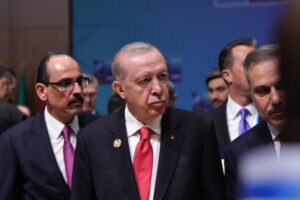
Turkish President Recep Tayyip Erdoğan used his address at the NATO Summit in Ankara to press for Turkey’s inclusion in European defence initiatives, warning that excluding NATO allies that are not members of the European Union would undermine the Alliance at a critical moment for European security.
In remarks that appeared to refer directly to the EU’s Security Action for Europe, or SAFE, programme, Erdoğan said that defence cooperation in Europe should be based on “logic and prudence” rather than institutional divisions.
“Excluding allies that are not EU members will lead to a waste of limited resources and an artificial division in Europe, which we do not want,” he said.
SAFE is the European Union’s new defence-financing instrument, designed to support joint procurement and strengthen Europe’s defence industrial base. Turkey, a NATO member with one of the Alliance’s largest armies and a rapidly expanding defence industry, has repeatedly argued that it should not be left outside Europe’s emerging security architecture.
Erdoğan also said Turkey was increasing its own defence commitments. “As Turkey, we have taken steps to raise our defence spending to 3.5% by 2030,” he said, adding that expenditure linked to security and resilience had already reached 1.5% of the budget.
According to the Turkish president, Ankara aims to reach NATO’s 5% defence-related spending target five years ahead of the 2035 deadline agreed at The Hague.
“Our country’s real success lies in the leap it has made in the defence industry,” Erdoğan said, stressing that Turkey had entered the world’s top ten countries in terms of defence production and export capacity.
He added that Turkey was on track to fulfil almost all 361 targets assigned to it within NATO within three years, ahead of schedule. He also said Ankara had allocated an additional $24 billion to air and missile defence capabilities through its “Iron Dome” project, an area he described as one of the Alliance’s greatest shortfalls.
“As the country with the largest ground forces in Europe, we are striving to put our capabilities at the service of the Alliance wherever needed,” he said.
Erdoğan pointed to Turkey’s role in NATO missions and exercises in Kosovo, the Black Sea, the Baltic region and elsewhere. He also underlined Turkey’s experience with unmanned aerial vehicles and combat drones, saying Ankara wants a planned Centre of Excellence for Countering Unmanned Systems to be certified by NATO.
“I believe this centre will significantly enhance our ability to counter threats from aerial and maritime drones,” he said.
The Turkish president said NATO’s future strength depended on two main issues: the removal of restrictions on defence cooperation between allies, particularly in the defence industry, and the avoidance of steps that could weaken Alliance unity or transatlantic ties.
He addressed EU member states directly, saying the bloc’s security efforts would be most effective only if they avoided unnecessary duplication with NATO.
Erdoğan also used his speech to reaffirm support for Ukraine, while saying Turkey would continue using its channels of communication with Russia to encourage a path towards peace.
“We share Mr Trump’s vision of peace in the war in Ukraine,” he said, adding that Turkey would continue contributing to Ukraine’s defence needs.
On Iran and the wider Middle East, Erdoğan said he welcomed efforts to resolve the crisis and added that Turkey was ready to assist with the demining of the Strait of Hormuz if needed.
“Beyond our diplomatic efforts, we stand ready to make the necessary contribution to the demining of the Strait of Hormuz,” he said.
He also thanked the United States, Spain, Germany and Italy for deploying additional air defence batteries to protect Turkey from missile threats.
Turning to Gaza and Lebanon, Erdoğan said lasting peace in the Middle East depended on a two-state solution and called on NATO partners to contribute to calm in the region.
“We all have a duty to contribute to achieving calm, particularly in Gaza and Lebanon,” he said.
He concluded by calling for full solidarity among allies in the fight against terrorism “in all its forms and manifestations.”
Ask me anything
Explore related questions




