





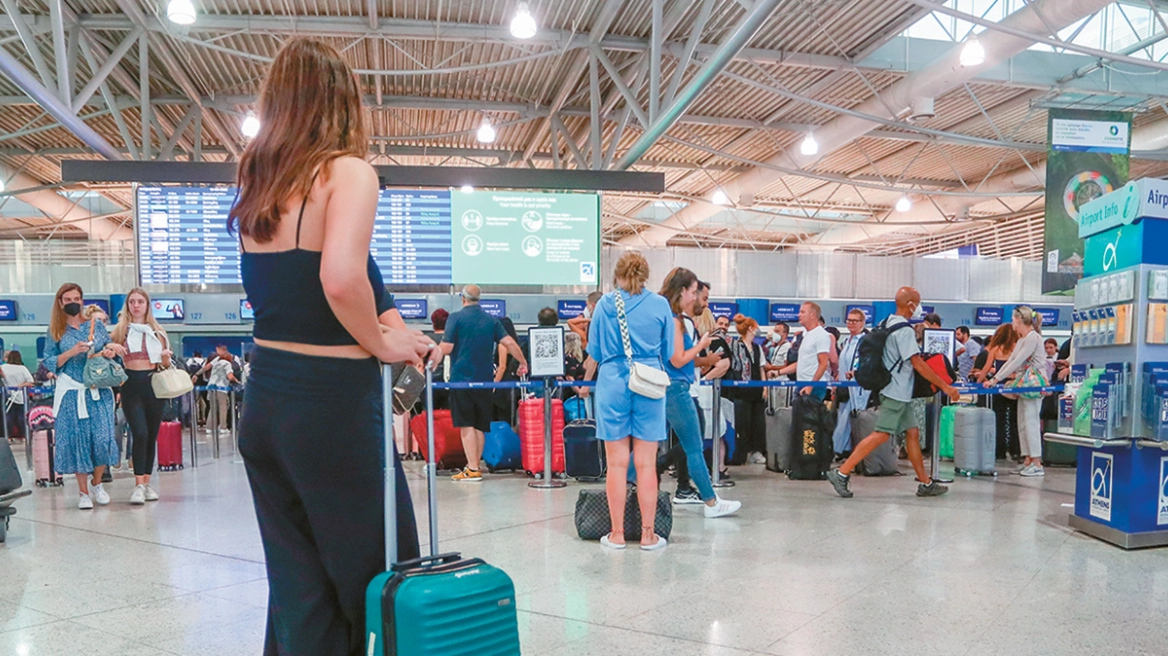
On one hand, Greek airspace keeps setting new traffic records, having reached a historic high of 83.5 million passengers across the country’s airports in 2025, with growth continuing this year: traffic in the first half of 2026 is running at plus 5%, despite the geopolitical crisis in the Middle East.
On the other hand, managing that success is proving increasingly difficult, year after year. The result is that flight delays have become a fixture of every summer season for the past five years, with all the inconvenience this brings for passengers and for the tourist experience in a country like Greece, where tourism contributes directly 13% of GDP.
The crisis
This year’s summer season began with the same pattern of delays, but with an additional factor this time: Greece’s air traffic control system is having to manage even greater daily demand as a result of the Middle East crisis.
Airlines flying to destinations outside Greece have adjusted their routes because of the geopolitical turmoil, opting for safer flight paths, with volumes rising further at the height of summer.
According to figures given by Olga Toki, deputy head of the Air Traffic Controllers’ Union, the Athens and Macedonia Area Control Centre, which oversees Greek airspace, handled a maximum of 4,500 flights a day last year. Last weekend that figure reached 5,000 flights a day, with projections of 5,500 flights a day as the summer season progresses.
The rerouting of air traffic due to the Middle East crisis has increased volume not only over Greece, but also over Cyprus, Albania, Croatia, North Macedonia, Montenegro, Serbia and Slovenia.
“Recruitment has taken place, but training takes time,” Toki explained. In 2025, 92 air traffic controllers were appointed, while 51 more are now due to be sworn in, out of a total of 77 expected to be hired this year.
2,700 flights a day
According to data from the European Organisation for the Safety of Air Navigation, known as Eurocontrol, July got off to a strong start, with traffic increasing for Greece and for the country’s largest airport, Athens International Airport “Eleftherios Venizelos”.
Greece ranks among the 10 countries with the highest traffic for the week of 29 June to 5 July, averaging 2,700 flights a day between arrivals and departures, an increase of 3% on the already elevated figures from the same period last year. Greece placed 7th in the ranking, with the United Kingdom first on 6,482 arrivals and departures daily (up 2%) and Spain second on 6,446 flights daily (up 7%).
For the same week, among Europe’s 10 busiest airports, Athens International Airport ranked last, averaging 1,007 arrivals and departures a day, a rise of 2% on the 2025 record. Istanbul topped the list with 1,603 arrivals and departures daily for the first week of July.
A further sign of rising traffic in Greece is that, for the same period, the country’s two domestic carriers, Aegean and Sky Express, were among nine airlines, alongside Air Serbia, easyJet, Jet2, Pegasus, Ryanair, Turkish Airlines and Wizz Air, that recorded their highest-ever daily flight numbers.
For the same period, Eurocontrol attributes 45% of delays across European airspace to capacity constraints and staff shortages in air traffic control services in three countries: France, Spain and Greece, while weather conditions and unforeseen events can also be contributing factors.
France, with a 29% share of total delays, Spain with 19% and Greece with 13% continue to record, according to Eurocontrol, the heaviest burdens for the period in question.
For Greece specifically, delays across national airspace, which have risen by 70% compared with last year, are attributed mainly to capacity constraints and staffing problems, with additional pressure caused by the increased and more complex flow of air traffic resulting from the Middle East crisis.
What the Civil Aviation Authority says
The Civil Aviation Authority, Greece’s national aviation regulator known as YPA, has pushed back against the recent criticism, pointing out that Eurocontrol’s figures relate mainly to flow management delays at the European network level. While these are important for monitoring airspace operations, the authority argues they should not be equated with passengers’ overall airport experience, nor interpreted as the average delay experienced by each flight.
The Civil Aviation Authority maintains that, in June, the average delay at the Athens and Macedonia Area Control Centre stood at 2.26 minutes per flight, compared with 1.62 minutes in 2025. Excluding weather and other external causes, the average delay comes to 0.97 minutes per flight, against 0.85 minutes in June last year.
At Athens International Airport specifically, the average delay per flight attributed to air traffic reached 4.43 minutes in June, compared with 6.50 minutes in the same period last year, with total delays down 31.77%.
These figures may be open to more than one interpretation and are, as the Civil Aviation Authority itself suggests, more technical in nature, pointing to a reduction and softening the scale of the problem.
Yet whether the delays occur en route, that is, across Greek airspace generally rather than at Greek airports, as the Civil Aviation Authority argues regarding the much-discussed Eurocontrol reports, or on board the aircraft, with airlines boarding passengers only to keep them waiting for up to 45 minutes or more on a route of half an hour, as happened last week on the Athens to Thessaloniki route, or through delays of an hour or more at the gate as passengers wait for the aircraft to arrive, as happened in numerous cases in recent days, the outcome is the same: passenger inconvenience which, according to official figures from the International Air Transport Association (IATA), has become a decade-long problem in Greece.
According to a study titled “Air traffic control delays in Europe: an overview of the economic impact” covering the decade 2015 to 2025, Greece ranks among the four European countries with the largest share of air traffic-related delays.
Out of a total of 7.3 million delayed flights over the decade, France ranks first with a 29% share, Germany second with 24%, Spain third with 10% and Greece fourth with 6%. According to IATA, in 2025 more than a third (35.9%) of annual flow management delays occurred during July and August, compared with 31.6% in 2015, underlining the seasonal nature of the problem facing the country.
Talks and contacts
The issue of delays was first raised at a meeting involving the Civil Aviation Authority, the Civil Aviation Authority Board known as APA, air traffic controllers, Athens International Airport and the two domestic carriers, Aegean and Sky Express, last Monday, followed by further discussions during the week that produced specific proposals on technical issues and better coordination.
A key point is compliance with what has been agreed, based on a recent Joint Ministerial Decision which sets capacity at the country’s largest airport, given that “Eleftherios Venizelos” also sees the highest summer traffic volume, at 35 departures and 31 arrivals per hour during peak times and 35 departures and 28 arrivals per hour outside peak times, with 22 departures and 22 arrivals per hour overnight between 00:01 and 05:59 local time.
In practice, however, controllers say that during the peak hours of 8 to 9am, flights pile up and create congestion, with scheduling sometimes equating to 39 or 40 departures an hour, and delays that roll over into later hours, creating what is known as a “domino effect”.
It was also observed in recent days that on early-morning routes, where 24 departures had been scheduled, only 50% actually departed on time, pushing delays later in the day and adding to the volume of flights in subsequent hours.
The checks issue
The icing on the cake for European air travel this year has been the significant malfunctions recorded across Europe in the rollout of the new EU Entry/Exit System, known as EES, particularly for visitors from non-EU countries.
Although member states are making extensive use of temporary flexibility, with Greece leading the way for British travellers, allowing competent border authorities to suspend the collection of biometric data until early September, travellers are facing lengthy queues for border checks outside terminal buildings and in open aircraft parking areas. Some airlines, including the largest low-cost carrier Ryanair, have not hesitated to depart with a half-empty aircraft in order to keep to schedule, even as some of their passengers remained stuck in passport control queues.
Industry bodies including IATA, the Airports Council International Europe (ACI Europe) and Airlines for Europe (A4E) have warned the European Commission that the problem will worsen during the high summer period of July and August, when European airports are expected to serve around 40 million more passengers than in the previous two months, calling for the system to be suspended and improved.
Alexander Zinell, chief executive of Fraport Greece, which manages the country’s 14 regional airports and will soon add Kalamata as its 15th, told the Financial Times last Thursday that substantive changes are needed to how the system operates, warning that in its current form it cannot cope with the increased demands of the tourist season.
According to Zinell, the temporary exemption of British travellers from full biometric checks, in place until the end of summer, has prevented the situation from worsening at the 14 regional airports managed by Fraport Greece, which include Rhodes, Corfu, Kos, Mykonos, Santorini and Chania. He warned, however, that this is a temporary fix and does not address the underlying problem.
Ask me anything
Explore related questions




