





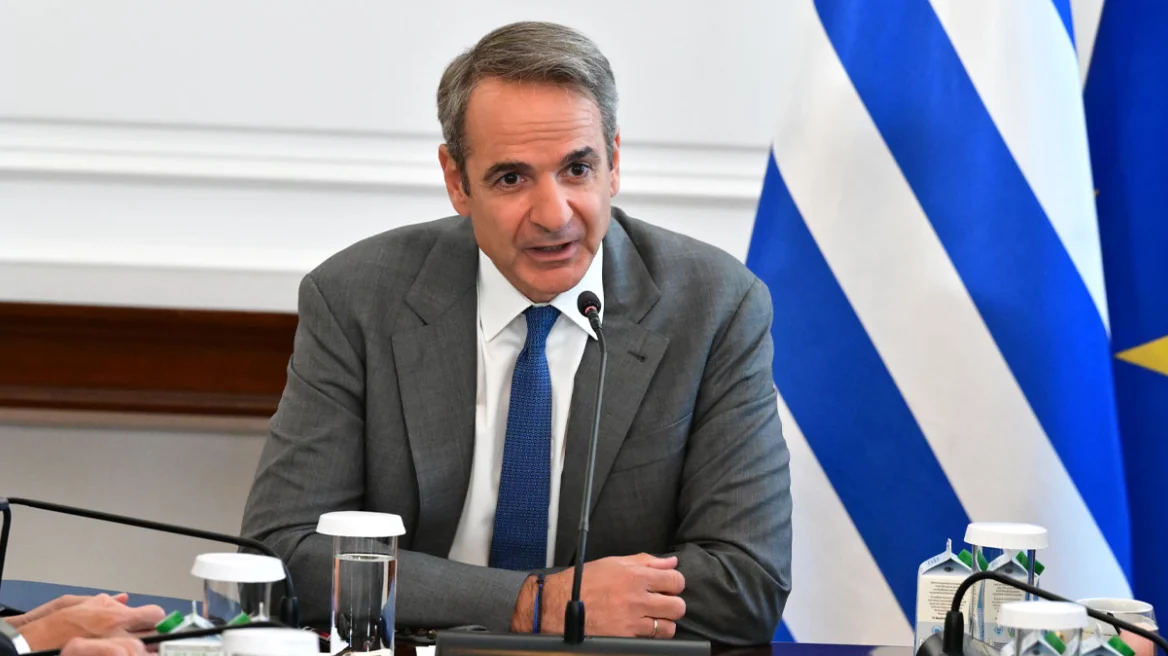
Focusing on major infrastructure projects and government interventions in the economy and society, Kyriakos Mitsotakis presented his weekly review, referring to the Thessaloniki Metro, the transition of Western Macedonia, the completion of the Recovery Fund, and new support measures.
The prime minister also highlighted initiatives in social policy, education, the energy transition, and the new round of European funding, stressing that the changes being set in motion aim to improve citizens’ everyday lives and create a more modern productive model for the country.
In his post, he also referred to the implementation of the new spatial planning frameworks for investment, measures to lower prices on basic goods, changes in education, and the “Personal Assistant” program for people with disabilities.
His post in full:
“Summer is over! The last Sunday of August. I don’t know if you are among those who ‘are owed an August,’ but I do know that Thessaloniki now has one less ‘outstanding commitment.’ For four decades, the Metro was the city’s major outstanding issue, and the delivery of its core network in 2024 by our government brought an end to a wait that had become synonymous with distrust. And this August, we delivered to the people of Thessaloniki the extension of the Metro to Kalamaria, the next step in this major milestone — and one less outstanding commitment! Five new stations, 4.78 kilometers of new line out of a total of almost 15 kilometers, and a single, fully automated network that will connect Mikra with the New Railway Station in approximately 25 minutes. It will serve an additional approximately 63,000 passenger boardings per day, taking another 12,000 private cars off the roads every day, with a corresponding, of course, benefit for the environment. But Kalamaria is not the end, as extensions toward western Thessaloniki have already entered the preparation phase, with preliminary design work beginning immediately.
Of course, beyond this major project, many other things are happening simultaneously in the city. I have spoken to you about the major redevelopment of the Thessaloniki International Fair (TIF), which has already been put out to tender, as we committed to doing during the summer, and the creation of a 120-acre metropolitan park that will change the appearance of the city center. Beyond that, at the end of the year a tender will be announced for the redevelopment of the Railway Station; we are also providing the Municipality of Thessaloniki with public properties to create 600 new parking spaces; the reuse of the Agios Minas complex is moving forward — also through its transfer to the Municipality; as are the enhancement of the archaeological site on Toumba Hill, the creation of a green and sports area on the Agia Fotini property at the northeastern edge of the TIF grounds, and the new 2,000-seat indoor arena on the premises of Aristotle University of Thessaloniki (AUTH), together with the upgrading of 12 of its building complexes. Finally, we are assigning the National Natural Environment and Climate Change Agency (NECCA) exclusive responsibility for cleaning the Thermaic Gulf.
The major changes in northern Greece, however, concern more than just one city. They also concern Western Macedonia, a region associated with lignite that is being called upon to find its new path. On Friday I was in Florina and Kozani and visited, among other places, PPC’s new combined heat and power (CHP) unit at Kardia. Let us note that PPC is implementing an investment plan of €5.75 billion in Western Macedonia through 2030 and, where lignite fields once existed, large-scale photovoltaic parks are already operating, while energy-storage projects and green-hydrogen projects are progressing, along with plans for a Mega Data Center at Agios Dimitrios. The projects are estimated to create more than 1,800 jobs during construction and approximately 700 permanent positions during operation, while the full development of the Data Center is expected to create even more employment. No change of this magnitude is easy. And there is no reason to sugarcoat it: Western Macedonia is being called upon to leave behind a productive model that shaped its life for decades. At the end of the day, what I believe matters is that the people of the region can plan their lives there with greater security and optimism.
Speaking of the next day, tomorrow, along with August, an important European cycle also comes to an end: the implementation period of the Recovery Fund. On March 31, 2021, we presented ‘Greece 2.0.’ Five years and five months later, I dare say that it was not simply a funding program worth many billions, but a dual opportunity: to finance investments, but also to correct delays that the country had been carrying for years. The initial plan provided for a 7-percentage-point increase in real GDP, 180,000 additional jobs, and a 20% increase in investment. The final results, however, were much higher: GDP increased by 11 percentage points, new jobs reached 550,000, while investment increased by 60%. But the most important legacy is that the program’s 74 reforms resolved outstanding issues dating back decades and brought the country closer to what is considered standard elsewhere in Europe: the digitization of the state, the interconnection of hundreds of thousands of cash registers and POS terminals, reducing the VAT gap, the Digital Work Card, speeding up the administration of justice, completing the Land Registry, the green and energy transition, and upgrading healthcare and education. It was a genuine opportunity, and we made the most of it.
And what comes next? The Social Climate Fund. This week, the European Commission approved Greece’s National Plan, which is among the first national plans to be approved and the largest to date in terms of resources, amounting to €5.3 billion including VAT, for the period through 2032. Its 25 measures concern approximately 1.5 million households and 70,000 micro-enterprises. Starting in 2026, social housing, energy upgrades for small businesses, social leasing of electric cars, and 211 new electric buses in Athens and Thessaloniki will be launched. From 2027, further measures will follow for the energy upgrading of homes, heating, student housing, and accessible transportation for our fellow citizens with disabilities, as well as major investments in accessible and clean public transport. The message is clear: European funding does not end with the Recovery Fund. The funding cycle is changing, not the effort to make growth greener, everyday life easier, and society more cohesive.
Two more topics from the field of the economy. First, this week saw the completion of payments of the new survivors’ pensions, following the legislative regulation we announced in July for the definitive abolition of the cuts introduced by the Katrougalos-Tsipras law. More than 8,500 beneficiaries saw their pensions restored, while approximately 75,000 pensioners will not have to repay a single euro from retroactive amounts. Another 122,000 people receiving two national pensions are also protected, as are children who have lost both of their parents. An issue that had caused hardship for thousands of families is now being definitively resolved. Second, starting tomorrow, our initiative for lower prices on basic consumer goods such as food, household necessities, and school supplies will come into effect, with price reductions ranging from 5% to 7% for a period of two to four months. It is certainly not the answer to everything currently putting pressure on a family budget. But it is tangible relief, especially now that the expenses of the new school year are beginning for many families.
Incidentally, let me say that preparations for the new school year effectively began months ago: we proceeded with 5,259 new permanent teacher appointments, of which 1,421 were in special education, while approximately 36,000 substitute teachers are expected overall, so that schools can open with more people in their classrooms. The ‘Marietta Giannakou’ program is also continuing, with the number of renovated schools now reaching 669 and studies for another 500 beginning in September. At the same time, new Experimental and Special Schools are being created, Innovation Centers are increasing from 13 to 18, and curricula are being updated so that classroom learning is more closely connected to the needs of modern life. We want, however, care for children to be visible in much more everyday things as well. So, starting this year, school cafeterias are changing. They will only offer products included on the approved list and meeting specific nutritional criteria: more fruit, dairy products without added sugar, and better-prepared sandwiches, while soft drinks and processed meats are being removed from their shelves. Habits are built through these everyday choices as well, and schools have a duty to set the best possible example for children.
Let me move on to the ‘Personal Assistant’ program for people with disabilities, applications for which opened on August 26. Let me remind you that about a month ago we legislated to make this program permanent throughout the country. Today there are more than 2,000 Personal Assistants, while special provisions are in place for mountainous and island municipalities. New applications can be submitted until November 27 at prosopikosvoithos.gov.gr.
Picking up the thread of the Special Spatial Planning Frameworks from last week, the third and final one, the one for Industry, has now been completed and is in force, replacing the outdated 2008 framework. In practice, this means that an industrial business, a logistics center, or a data center will now know more clearly where it can be located and under what rules. Organized areas, such as Industrial Areas and Business Parks, are being strengthened, while explicit provision is being made for sites for modern activities, from recycling to high-tech infrastructure. At the same time, the protection of sensitive areas, connections to road, port, and rail networks, as well as risks from floods, fires, and earthquakes, are being taken into account. The country is thus gaining clear rules so that investments can move forward more quickly, but also with less impact on the environment and local communities.
Those were some of the things that happened over the past week. Next week I will be at the TIF, where we will have a lot to discuss. So, that means there will be no weekly review. A very interesting weekend is expected, however. Happy Sunday to everyone!”
Ask me anything
Explore related questions




