





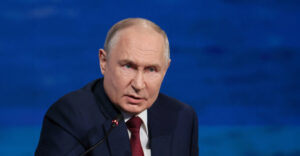
A few days ago, during a meeting with students and staff at a university in Moscow, President Vladimir Putin made an unusual reference to orcas and polar bears. Orcas, the Russian president claimed, feed on polar bears. “That’s the food chain,” he said. “Children must be taught this, so they understand what kind of world we live in and why we are carrying out the special military operation,” as Moscow continues to call the war that began four and a half years ago in Ukraine.
This claim, although according to The Economist there is no recorded case of an orca eating a polar bear, offers a glimpse of how Putin views the world: as an environment in which the strong dominate the weak. And it is precisely the direction in which the Russian president himself may be moving, causing growing concern among NATO countries.
Fears that he will choose escalation again
The Russian army has been mired in a wartime stalemate for years, recording tens of thousands of dead or seriously wounded every month. The war has turned into an extremely costly contest of drones and missiles, causing enormous destruction in Ukraine but now leaving visible marks inside Russia too. Putin, however, shows no sign of backing down.
In the West, there are fears he may try to break out of what Russians call “tupik”, a dead end, in the same way he has done in the past: by escalating the conflict.
Signs of Western concern are already evident. On 25 August, CIA director John Ratcliffe travelled unexpectedly to Moscow. Accounts of his mission differ: according to one version, he went to warn Putin against attacking NATO countries. According to another, he presented a particularly bleak assessment of Russia’s prospects and tried to persuade him to return to negotiations.
Three days later, Finland requested the assistance of Swedish aircraft and warships to monitor its border with Russia against possible violations.
Germany, for its part, is preparing to publicly accuse Russia of a drone attack on Leipzig airport on 4 August and is likely to impose new sanctions.
On 20 August, Romania announced it had destroyed a Russian naval drone that had targeted a drilling platform in its territorial waters, while on 25 August Slovakia thwarted an arson attack on a drone manufacturing plant.
Putin’s warning of “retaliation”
At the same time, Putin broke his long silence over Ukraine’s increasingly effective drone strikes deep inside Russian territory. Targets have included oil refineries and logistics centres, as well as warehouses belonging to Wildberries, Russia’s largest e-commerce company.
In a speech on 22 August, the Russian president accused Ukraine of opening a “Pandora’s box” and warned of “retaliation against the most sensitive sectors of your economy”.
Earlier that day, speaking to United Russia, the Kremlin’s ruling party, he dismissed any talk of ending the war. “The special military operation continues,” he said. “We will only move forward.”
Intelligence from the Kremlin
Sources close to the Kremlin say that after weeks of deliberation over the summer, Putin appears to have opted for escalation. Indeed, one long-time associate believes the Russian president likely interpreted even Ratcliffe’s visit as a sign of American weakness.
According to the same source, Putin drew a similar conclusion from the visit of then-CIA director Bill Burns to Moscow in November 2021. Burns had travelled to the Russian capital to warn him against invading Ukraine. Three months later, Putin ordered the invasion.
The main priority: staying in power
No one can know for certain what Putin is thinking. However, the analysis suggests that his motives for further escalation, like his original decision to invade, are closely tied to Russia’s domestic situation.
His main goal remains holding onto power and, ultimately, his own personal safety.
One problem the Kremlin now appears to face is the gradual erosion of Russian society’s tacit acceptance of the war.
Ukrainian strikes deep inside Russian territory, targeting refineries and logistics facilities, combined with internet restrictions imposed by the security services, have begun to “distort” the image of normal daily life.
According to the independent Levada Centre, 57% of Russians now describe the situation in the country as “tense”. Among the main reasons cited by respondents are the war, human losses, mobilisation, drone strikes and the lack of any clear prospect for the future.
At the same time, trust in television propaganda is declining, young people are posting appeals on social media for the war to end, and Putin’s approval ratings are showing signs of decline.
“There’s a sense that the tsar is naked”
The mood is even more negative within the Russian elite. According to a person inside the system, the biggest problem is not so much the state of the economy or the lack of military success, but the time that has been lost.
Whatever the eventual outcome, almost five years of war are seen by some as a failure. “There is a growing sense that the tsar is naked,” another member of the Russian elite told The Economist.
None of Russia’s economic or political problems is considered, on its own, capable of toppling Putin, since he still has the financial resources and a powerful repressive apparatus to keep going. However, it is perception that matters.
The “underworld logic”: never show weakness
Putin may describe his goals in geopolitical terms, but, according to the analysis, his decisions are shaped largely by a logic reminiscent of organised crime’s unwritten rules: never show weakness.
The Russian system has a high tolerance for violence but a much lower one for failure. Putin likely believes that ending the war without having achieved even his minimum objective, the capture of the entire Donbas region in eastern Ukraine, could endanger him personally.
“They will hang me,” he is reported to have said at some point during the war to people in his inner circle, according to a source cited by The Economist.
On the other hand, continuing the war in its current form is not a solution for the Kremlin either. “Scenarios based simply on inertia are harmful to the Kremlin,” one member of the Russian elite said, since they consume economic resources and deplete political capital without offering a clear way out.
How he might escalate
Against this backdrop, escalation may appear an attractive option for Putin. It is not clear, however, what form it might take.
Russia is considered likely to intensify hybrid warfare and sabotage operations against Ukraine’s allies, as well as to try to disrupt the routes through which European aid reaches Kyiv.
Western intelligence services are also concerned about the possibility that Moscow could target factories in Europe manufacturing military equipment for Ukraine. Their assessment, however, remains that Putin (despite recent threats against London and Paris over their support for Kyiv) does not want a direct military confrontation with NATO.
Another 300,000 to 400,000 men in the war
Inside Ukraine itself, escalation would mainly mean intensifying the operations Russia is already carrying out.
On 30 August, the Russian Defence Ministry announced it was preparing a massive strike on Ukraine’s energy infrastructure.
Kyiv, however, is already preparing for such attacks, viewing them as part of Russia’s effort to break Ukrainian resistance over the winter.
On the ground war front, Russian sources say Putin is determined to throw a further 300,000 to 400,000 men into the fighting. He would not even need to announce a new wave of mobilisation, since the original mobilisation order was never formally rescinded.
The additional men will likely be recruited through pressure exerted by regional governments, so that any social discontent remains local rather than turning into a nationwide political problem.
Authorities are reportedly already testing this new recruitment system in Penza, about 750 kilometres south-east of Moscow.
And more repression at home
Putin could also, according to The Economist, intensify repression against so-called “internal enemies”. Not necessarily because they pose a genuine threat to his power, but because the Kremlin needs to project an image of strength.
None of this, however, solves the fundamental problems Russia faces. On the contrary, a new escalation is likely to further increase the human cost and deepen instability both inside the country and beyond its borders.
Ask me anything
Explore related questions




