





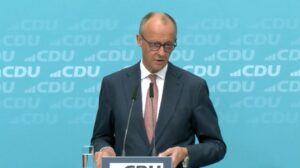
Friedrich Merz described Sunday’s election result, primarily in the state of Mecklenburg-Western Pomerania and secondarily in Berlin, as a “deep rupture” and “dramatic” for the Christian Democratic Party.
The German Chancellor made the remarks on Monday afternoon at a press conference at the CDU headquarters in Berlin, where he appeared alongside the party’s defeated candidate in the capital, Stefan Evers.
Daniel Peters did not attend the press conference because, as reported, he had to proceed with the dissolution of the CDU parliamentary group in the state of Mecklenburg-Western Pomerania, after the party failed to enter the state parliament.
Both leading candidates of the Christian Democratic Party were defeated in the elections: in Mecklenburg-Western Pomerania, the CDU won just 4.9% of the vote and, for the first time in its history, failed to enter the state parliament, while in Berlin the Christian Democrats received 18.8%.
“The result in Mecklenburg-Western Pomerania is also due to the fact that there was a great deal of polarisation between the AfD and SPD,” Merz said. “The reasons go far beyond me.”
The German Chancellor spoke of “deep polarisation” in society. “We are seeing deep polarisation. In Berlin, forces that are destructive were elected with more than 40% of the vote, and they are trying to excite citizens with radical and simple solutions,” he said.
According to him, under these circumstances it is particularly important to maintain stability and ensure that citizens understand its value.
‘Fundamental questions’ for the CDU’s future
Asked what the result means for the CDU’s future, Merz stressed that “the federal government and the states must stand united and find a way to work together”.
“For the CDU, very fundamental and long-term questions arise,” the Chancellor said, adding that these would be discussed in the period ahead. At the same time, he expressed satisfaction that the Social Democrats want the CDU–SPD governing coalition to remain in place at federal level.
Merz insists: I am staying in office
Friedrich Merz was asked at the press conference whether he still felt that he had the necessary support to remain both Chancellor and chairman of the CDU.
He replied in a serious tone: “Neither last night nor this morning did anyone raise any question whatsoever about the discussion concerning me. No one.”
With this statement, Merz sought to put an end to the discussion about a possible change of leadership in the party or the Chancellery.
From election night itself, the German Chancellor had made clear that he intended to remain in office. At the time, however, he had described the result as a “disaster”, although there were still hopes that his party would manage to retain its presence in the Schwerin parliament.
From the early hours of Monday morning, it became clear that the CDU had failed to clear the threshold for entry into the state parliament and was losing its representation in the regional legislature.
Ask me anything
Explore related questions




