





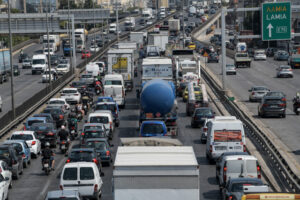
The Kifissos motorway seems to be showing us Athens’ troubled future—that is, what will happen on other major roads if we continue to do nothing, transport expert Stavros Konstantinidis told the Athens-Macedonian News Agency (AMNA) in an interview.
As he explains, the connections between Kifissos, Attiki Odos and the exit towards Lamia are particularly congested. Problems are also evident on Kifissias Avenue, Mesogeion Avenue, Katechaki Avenue, Vasilissis Sofias Avenue, Syngrou Avenue and the main routes towards the southern suburbs. Athens reached the point long ago where demand for travel by private car exceeded the capacity of its road network. Unfortunately, Mr Konstantinidis argues, we are watching the problem grow without introducing serious measures to address it. The issue is therefore not simply a matter of “difficult roads”, but a broader imbalance between the number of cars, available road capacity and inadequate public transport.
Mr Konstantinidis also says that “the traffic ring needs to be redesigned immediately. It should become a green traffic ring, favouring low-emission vehicles and offering incentives for vehicles carrying more passengers. Average car occupancy is very low, meaning that a large proportion of road space is taken up by vehicles transporting just one person. Ultimately, the aim is to make the alternative to the car—namely, public transport—genuinely competitive.”
Below is the full interview with transport expert Stavros Konstantinidis, conducted by G. Psyllias for AMNA.
Which roads and key junctions are currently experiencing traffic problems?
Athens’ traffic problem is no longer confined to isolated locations. It has expanded to take on an almost metropolitan scale. Kifissos is the clearest example of a congested road artery. It seems to be showing us Athens’ troubled future—that is, what will happen on other major roads if we continue to do nothing. The connections with Attiki Odos and the exit towards Lamia are also particularly congested. Problems are also evident on Kifissias Avenue, Mesogeion Avenue, Katechaki Avenue, Vasilissis Sofias Avenue, Syngrou Avenue and the main routes towards the southern suburbs.
Athens reached the point long ago where demand for private-car travel exceeds the capacity of the road network. Unfortunately, we are watching the problem grow without introducing serious measures to address it. We are therefore not simply dealing with “difficult roads”, but with an overall imbalance between the number of cars, available road capacity and inadequate public transport.
Why does Kifissos experience such severe traffic problems every day? Is it because of trucks, the road’s design or the land uses alongside it?
Kifissos is now operating at the limits of its capacity. There is no single culprit. Trucks place a significant burden on traffic, particularly during rush hour, but removing them would not, in itself, solve the problem. Traffic congestion is a “spatiotemporal problem”: what matters is not only how many vehicles are on the road, but also where and when they are travelling.
Huge numbers of daily journeys, heavy vehicles and through-traffic converge on Kifissos, while alternative routes are limited. All the entrances and exits along the road and its connections with other major arteries are problematic. Variations in the road’s width are another major issue that needs to be addressed through structural improvements.
At the same time, the activities located alongside the road—including logistics facilities, intercity bus terminals (KTEL) and freight centres—add to the burden. Around 4,500 buses from KTEL operators across the country, running dozens of successive services every day, need to pass through Kifissos. When a road operates continuously close to its maximum capacity, even a minor incident, an accident or a vehicle breaking down can trigger a chain reaction of congestion.
How could we tackle the problem on Kifissos?
There is no single “magic bullet” for Kifissos. A combination of measures is needed. In the short term, authorities could consider managing truck traffic by time of day, particularly during the morning rush hour, alongside better organisation of freight transport and loading and unloading operations. Rapid infrastructure upgrades are also needed, as is a traffic management system that can clear Kifissos more quickly following minor accidents.
Clearance times are currently long, partly because there has been no public information campaign. A single incident can adversely affect traffic for half the day.
In terms of future infrastructure, projects such as the Skaramangas triple interchange and the Elefsina–Oinofyta road corridor could divert some through-traffic away from Kifissos. However, these projects are relatively long-term solutions and would not be sufficient on their own, even if they are eventually completed.
The substantive solution is to reduce overall demand for private-car travel by strengthening public transport, suburban rail and bus services, improving connections between transport modes and introducing modern traffic management. Building more roads without changing how people travel simply shifts the problem elsewhere.
Is public transport in Athens adequate today?
No, and I want to be clear about that. The inadequate supply of public transport is one of the main reasons Athenians depend on private cars. The crucial test for a major city is whether the majority of its workers can get to their jobs reliably, comfortably and competitively using public transport rather than a car.
Athens needs approximately 3,000 buses, together with an extensive network of dedicated bus lanes and a redesigned bus route network. At the same time, the metro needs to be expanded more quickly, while the tram and suburban railway require upgrades. Until Athens has a much denser metro network, buses remain the main tool for increasing public transport capacity quickly.
What would you recommend doing immediately?
We need a package of interventions immediately, rather than yet another “major project” presented as a cure-all. The first priority is a substantial expansion of bus services, with more vehicles, more frequent routes and genuinely enforced bus lanes.
At the same time, traffic lights need to be managed more effectively, illegal parking must be strictly controlled, loading and unloading operations and freight transport must be better organised, and measures must be introduced to manage trucks during rush hour.
We need to reorganise the government’s response to the problem. We need a deputy minister for sustainable mobility who would be jointly affiliated with both the Ministry of Infrastructure and Transport and the Ministry of Citizen Protection. This is a distinctive and original proposal that I have been putting forward in public debate for some time, but the government appears neither persuaded nor motivated to act on it.
Metropolitan transport planning authorities must be established for the urban areas of Athens and Thessaloniki. We need to redesign the road network, pavements, intersections and junctions. Unfortunately, we cannot address a modern problem that is growing in scale every day while leaving the road network unchanged since the 1980s.
We need to maintain roads and introduce road markings that are currently missing. We should establish minimum requirements for pedestrian crossings in every Greek city, along with minimum standards for road signage. We seem to believe that a well-laid surface of plain asphalt is enough to ensure sustainable mobility. We are 25 years behind European cities.
The traffic ring also needs to be redesigned immediately. It should become a green traffic ring, favouring low-emission vehicles and offering incentives for vehicles carrying more passengers. Average car occupancy is very low, meaning that a large proportion of road space is taken up by vehicles transporting just one person. Ultimately, the aim is to make the alternative to the car—public transport—genuinely competitive.
There is much talk about green development, the climate crisis and sustainable mobility, but in practice we do almost nothing. We allow Athens and other major cities to deteriorate every day, further eroding what remains of the quality of everyday life. Democracy is judged by the quality of that everyday life.
Ask me anything
Explore related questions




