





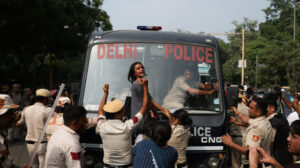
The sight of thousands of police officers and security personnel sealing off central New Delhi, closing metro stations and preventing protesters from reaching designated gathering points hardly evokes a political movement that, five months ago, was little more than an internet joke. And yet the so-called “Cockroach Movement,” which emerged last May as a satirical response to an insulting remark about India’s unemployed young people, has evolved into one of the most unpredictable forces in the country’s political landscape.
Narendra Modi’s government is facing a mobilisation that is not led by any of the major opposition parties and has none of the traditional organisational structures of a political formation. Nevertheless, it has managed to mobilise hundreds of thousands of people online, fill the streets of major cities and contribute to the resignation of a federal minister.
The latest escalation came over the weekend, when Indian authorities attempted to prevent a major gathering at Jantar Mantar, one of the capital’s most historic sites of political protest. More than 2,000 demonstrators were taken in for questioning or temporarily detained, while the movement’s founder, Abhijit Deepke, was arrested alongside two associates upon their arrival in New Delhi.
The three were released in the early hours of Sunday, subject to a court order requiring them not to disturb public order for one year. The police operation also spread to other cities, with more than 600 people detained in Mumbai, including Tushar Gandhi, the great-grandson of Mahatma Gandhi.
Behind the clashes and arrests now lies an issue far bigger than the one that triggered the first demonstrations. A revision of electoral rolls, involving approximately 130 million deletions according to published figures, has sparked accusations of political manipulation of the electorate and the systematic exclusion of citizens from the voting process.
The government and the Election Commission reject these accusations, arguing that the deletions are part of a necessary administrative process to clean up the electoral rolls. For the movement, however, this dispute has now become its central focus.
Six words that became a political movement
The story began on May 16, 2026, when Abhijit Deepke, a 30-year-old political communications consultant from the Dalit community, posted a question on X consisting of just six words in English: “What if all cockroaches come together?”
The post was a response to remarks by Supreme Court Justice Surya Kant, who had compared unemployed young people to cockroaches. He later argued that his comments had been misinterpreted, but the backlash had already gained enormous traction online. Thousands of young people began using the cockroach as a symbol of political protest, turning the word’s derogatory meaning on its head. The insect, associated with dirt and an unwanted presence, was transformed into an image of survival, resilience and collective demands for change.
Within days, the Cockroach Janta Party (CJP) was created, a name that could be translated as the “People’s Cockroach Party.” Despite its name, it did not take shape as a conventional political party. Initially, it was a satirical online platform featuring mock election posters, sarcastic messages and campaigns targeting corruption, unemployment and the growing distance between those in power and the younger generation.
Its success was striking. By June, the Associated Press had reported that the movement had more than 15 million Instagram followers, a figure exceeding that of the ruling BJP’s official account. This popularity does not automatically translate into equivalent organisational strength or electoral support. It does, however, demonstrate that the movement has managed to reach a segment of Indian society that has traditionally viewed party politics with scepticism.
Deepke did not come from the centre of India’s political establishment. His Dalit background—the Dalits are communities historically relegated to the lowest levels of the caste system—gave his presence particular symbolic significance. His personal story connected the question of employment opportunities with India’s deeper social inequalities, without restricting the movement exclusively to the demands of any one community.
The generation that studies but cannot find work
To understand how quickly the movement spread, it is necessary to examine the situation facing young people in India. The country has recorded high rates of economic growth in recent years and has significantly strengthened its position in the global economy, particularly in technology, services and manufacturing. This growth, however, has not been accompanied by the creation of a corresponding number of stable, high-quality jobs for all the young people entering the labour market.
According to an analysis by the British think tank Chatham House, approximately one-third of India’s working-age population belongs to the 15–29 age group. Even more concerning is the fact that nearly four in ten school graduates aged 15 to 25 are unemployed, according to the population category examined in that analysis. These figures do not mean that four in ten young Indians overall are unemployed. They do, however, illustrate the serious difficulties in absorbing young people into the workforce, even when they have completed their education.
The problem is compounded by the way the education system operates. For millions of families, gaining admission to a good university or securing a job in the public sector represents the main route to upward social mobility. National entrance examinations are fiercely competitive and have spawned an entire economy of private tutoring services and preparatory centres. Families devote a significant portion of their income to ensuring their children acquire the knowledge and preparation needed to compete for a limited number of university places or jobs.
When this process is undermined by scandals involving leaked exam papers, cancelled examinations and allegations of opaque procedures, financial pressure turns into political anger. For many young people, the feeling is not simply that opportunities are scarce, but that even the rules of competition are not applied equally to everyone.
This is precisely the discontent on which the Cockroach Janta Party’s first major mobilisation was built. The cockroach was no longer merely an internet symbol. It represented a generation that believes it is being forced to survive in an intensely competitive environment without the protection or opportunities available to previous generations.
From leaked exam papers to a minister’s resignation
The first major battleground with the government was education. In May 2026, allegations that exam papers had been leaked for medical school entrance examinations—in which more than 2.2 million candidates were due to participate—triggered a serious crisis. The cancellation and rescheduling of the examinations provoked fierce backlash, while media reports linked the turmoil to cases of suicide. These reports require a careful distinction between allegations and an established causal relationship.
The movement took its pressure campaign onto the streets of New Delhi, demanding changes to the examination system, accountability for those responsible and compensation for affected families. Gradually, student organisations, social activists and citizens with no previous connection to the CJP joined the demonstrations. Support from well-known public figures brought additional attention to the protests.
The authorities’ response in several cases strengthened the demonstrations rather than containing them. Images of police interventions against young protesters circulated widely on social media. When prominent activist Sonam Wangchuk, who had begun a hunger strike in solidarity with the movement, was removed from a protest site, the backlash intensified further.
Modi’s government initially opted for a hard-line response to the protests, but later acknowledged the need to address the allegations. It held talks with representatives of the movement, announced measures against those implicated in the leaks and pledged to take a tougher stance on similar incidents.
The resignation of Education Minister Dharmendra Pradhan on July 25 was the most significant outcome of that period. For a movement with no parliamentary representation and no traditional party machinery, the departure of a federal minister was a development that substantially strengthened its political standing.
That success, however, had a second consequence. It showed CJP supporters that mobilisation could lead to concrete government decisions. After the education protests ended in late July, the movement did not dissolve. It maintained its networks of supporters and returned with an issue that now touched on the very functioning of Indian democracy.
The 130 Million Names and the Challenge to the Electoral Process
The second phase of the protests is politically far more complex. At its centre is the so-called Special Intensive Revision of Electoral Rolls, known by the acronym SIR, which began in 2025 in the state of Bihar and gradually expanded across much of the country. India has the largest electorate in the world, with at least 960 million registered voters in the 2024 national elections, making any large-scale changes to the electoral rolls a matter of considerable political significance.
The process involves checking voter registrations to remove people who have died, moved away or do not meet the legal requirements for voting. In terms of its stated purpose, this is an administrative practice intended to ensure the proper functioning of an electoral system. The backlash has stemmed from the scale of the deletions, the way the checks have been conducted and allegations that their implementation does not affect all social and religious groups equally.
According to figures from the Election Commission cited by Reuters, approximately 130 million names have been removed from the rolls as part of the verification process. Of these, around 63 million concern people believed to have moved away from the area where they were previously registered, while another 30 million relate to individuals who could not be located. These figures must be interpreted with particular care, since deleted registrations do not automatically mean that an equal number of eligible voters have permanently lost their right to vote.
The key question is how many deletions actually concern citizens who are entitled to vote, and whether adequate opportunities exist to correct errors. This lies at the heart of the allegations made by the Cockroach Janta Party and opposition parties. Critics of the process argue that the checks disproportionately affect Muslim communities, other minorities and sections of the electorate that have traditionally not supported Modi’s ruling Bharatiya Janata Party, or BJP.
The Election Commission and the government reject claims of manipulation, stressing that the revision is intended to remove incorrect and invalid registrations.
The controversy intensified further in late September, when the Indian Express published information suggesting that two deputies to the head of the Election Commission had privately raised concerns about the revision of the rolls, registration procedures and digital systems. The Commission responded that the expression of differing views was a normal part of internal deliberations and reiterated that it favoured no political formation.
For the movement, the disclosure of this information provided the trigger for an escalation of protests. Deepke called for nationwide demonstrations, with the resignation of the head of the Election Commission, Gyanesh Kumar, as their central demand. From that point on, the CJP ceased to focus solely on better education and greater employment opportunities. It shifted the confrontation to the issues of political representation and public trust in institutions, arguing that citizens’ ability to elect their own government was being called into question.
The Capital Under Police Lockdown
Saturday, October 10, marked the most intense confrontation between the movement and the authorities so far. The planned gathering at Jantar Mantar was met with extensive security measures, including roadblocks, metro station closures, restrictions on rail travel and the temporary suspension of mobile internet services in parts of the capital.
Police deployed thousands of officers, while authorities detained or took in for questioning more than 2,000 protesters, including student leaders, opposition politicians and social activists. Some journalists and lawyers were also temporarily detained. The incident provoked a backlash and prompted the Supreme Court to intervene. The court recorded the government’s assurance that journalists and lawyers would not be obstructed in carrying out their professional duties.
Deepke and his associates, Saurabh Das and Ashutosh Ranka, were detained as soon as their aircraft landed in New Delhi. The three were released on Sunday, October 11, but the legal proceedings and restrictions imposed on them raised fresh questions about their ability to continue their public activities.
Efforts to contain the protests did not prevent demonstrations from taking place in other cities. In Mumbai, police made more than 600 detentions around historic August Kranti Maidan, a site deeply embedded in India’s collective memory because it is associated with the launch of the Quit India movement against British colonial rule in 1942. The participation of Tushar Gandhi, Mahatma Gandhi’s great-grandson, added another layer of historical symbolism to the demonstrations.
Tensions continued on Sunday, although gatherings in New Delhi remained limited until midday. Several dozen members of student organisations attempted to continue the protests, while police forces remained deployed across the capital. Metro stations had reopened and mobile internet access had been restored, but the political confrontation remained unresolved.
The authorities’ handling of the demonstrators also provoked international criticism. A United Nations body called on Indian authorities to ensure respect for the right to peaceful assembly. India’s Ministry of External Affairs rejected the intervention, describing it as unjustified interference in the country’s internal affairs.
Why the Crisis Matters So Much for Modi
Narendra Modi’s political dominance rests on a system of strong party organisation, personal popularity and the BJP’s extensive presence across much of India. Since he became prime minister in 2014, the ruling party has substantially reshaped the country’s political landscape, curtailing the influence of the historic Congress Party and consolidating a form of political dominance that extends beyond the traditional boundaries of the Indian right.
The 2024 elections, however, served as a significant warning. Although Modi secured a third consecutive term as prime minister, the BJP lost its outright parliamentary majority and needed the support of its coalition partners to remain in power. Unemployment, social inequality and economic insecurity were important issues in that election.
The emergence of the Cockroach Janta Party is significant precisely because it is connected to these problems without fitting neatly into the contest between the BJP and Congress. The movement did not need to present a comprehensive government programme or secure parliamentary representation to exert pressure. It harnessed the speed of social media and the frustration of large numbers of young people, creating a form of political organisation that operates more as a mobilisation network than as a traditional party machine.
Its influence, however, should not be confused with an ability to bring down the government. The BJP still has a powerful organisational base and significant advantages over a fragmented opposition. Moreover, support for the CJP does not necessarily mean opposition to Modi. A young person who joins a protest over examinations or unemployment will not necessarily vote for Congress or another opposition party.
This distinction is crucial. The movement has demonstrated that it can shape the political agenda and force specific demands into public debate. It has not demonstrated that it can turn protest into a durable electoral force. India’s history includes similar cases of popular mobilisation that attracted enormous publicity but struggled to sustain their initial momentum when called upon to organise politically.
The Fear of a New Generation Z Uprising in South Asia
Developments in India have prompted comparisons with the youth-led protests that have shaken other South Asian countries in recent years. In 2022, Sri Lanka experienced a major popular uprising triggered by economic collapse, which led to the departure of then-President Gotabaya Rajapaksa. In 2024, student protests in Bangladesh evolved into a mass anti-government movement that culminated in the overthrow of Sheikh Hasina’s government. Similarly, in 2025, mass demonstrations involving significant participation by young people triggered major political upheaval in Nepal.
A common thread in these movements was the feeling among a large section of the younger generation that the political system was failing to meet its expectations. Economic insecurity, corruption, a lack of opportunities and the speed at which information spreads through social media created the conditions, in several cases, for protests that grew far beyond their original causes.
Chatham House points out that India exhibits some of the same social contradictions, but its political circumstances are substantially different. Modi’s government has a much stronger political and organisational base than the governments that collapsed in neighbouring countries. The BJP maintains an extensive presence across state governments and local institutions, while the opposition has failed to establish a stable, unified political alternative.
India also has a long history of mass social movements that do not necessarily lead to the downfall of governments. The months-long farmers’ protests of 2020 and 2021 are a characteristic example. Despite the intensity and duration of the demonstrations, their political impact was reflected primarily in the withdrawal of specific government reforms, without changing the overall balance of power.
The Cockroach Janta Party, however, has one important distinguishing feature. The movement does not represent a particular occupational group or a limited geographical area. Its social base is built around age, education, employment and the belief in equal opportunities. This allows it to appeal to young people from different regions and communities, but at the same time makes it more difficult to develop a unified political programme.
Three Possible Paths for the Movement’s Future
The first possibility is that the CJP remains a powerful pressure movement, mobilising around specific issues and seeking to extract concessions from the government. The education minister’s resignation has already established a precedent in this direction. In this scenario, the movement would not need to transform itself into a conventional political party or adopt a unified ideological identity.
The second possibility is that it moves towards more permanent political organisation and develops partnerships with opposition parties, student unions and social organisations. Such an expansion could strengthen its organisational presence, but it would also weaken one of its greatest current advantages: its image as a spontaneous movement operating independently of traditional political machinery. Public expressions of support from opposition figures have already sparked debate over whether the CJP can preserve this independence.
The third possibility is a gradual loss of momentum. The experience of similar movements has shown that online popularity is not always enough to sustain prolonged mobilisation. Organisational difficulties, the absence of a unified political plan, potential internal disagreements and the government’s ability to satisfy selected demands can all limit their longevity and effectiveness.
At this stage, developments in the controversy surrounding the electoral rolls will be decisive. If the allegations lead to judicial intervention, revisions to the procedures or new political confrontations, the CJP will have gained an issue capable of sustaining its mobilisation beyond the narrow sphere of youth politics. Conversely, if the government and the Election Commission succeed in restoring confidence in the process, a significant portion of the current tensions may ease.
For Modi, the real challenge lies not only in managing the demonstrations. It lies in addressing social problems that persist despite the country’s substantial economic growth. Job creation, the credibility of educational examinations and ensuring equal participation in elections cannot be treated exclusively as matters of public order.
India now faces a political test with characteristics that distinguish it from the government’s usual confrontations with the opposition. A movement that began with sarcasm directed at a derogatory remark by a judge has, within a few months, managed to connect anxiety over economic survival with trust in democratic institutions.
Its evolution does not predetermine a change of government or a nationwide uprising. It does, however, reveal that behind India’s high growth rates and rising international standing lies a generation demanding a much greater share of the opportunities and political influence generated by its country.
The government’s greatest challenge is no longer simply to contain the gatherings of the “cockroaches,” but to address the reasons why millions of young people recognised themselves in a symbol that was originally used to marginalise them.
Ask me anything
Explore related questions




