





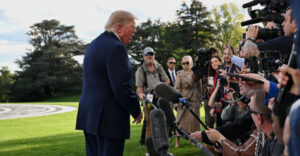
The future of Kimberly Guilfoyle as US ambassador to Greece is increasingly uncertain after US President Donald Trump confirmed that his administration is considering removing her from her post in Athens. “Yes, we’re not happy,” Trump added, speaking just hours after Guilfoyle publicly addressed the allegations against her for the first time.
Trump says they are considering firing Kimberly Guilfoyle: We are not happy. https://t.co/2rg5gUT1O8
— Acyn (@Acyn) October 12, 2026
According to CNN, Trump is weighing whether to dismiss Guilfoyle, with a person familiar with the discussions saying that a decision is expected soon. CNN also reported, citing a source familiar with the investigation, that the US State Department’s Office of Inspector General (OIG) is investigating allegations of misconduct involving the ambassador.
Trump made the remarks at the White House on Monday, 12 October, following a series of Wall Street Journal reports alleging irregularities both before and after Guilfoyle took up her diplomatic post. His latest comments marked a significant shift from his initial response on 10 October, when he was asked about Guilfoyle and said: “I don’t know, she’s an ambassador. I just heard a little bit about it. I don’t know much, but she’s always been very nice.”
Q: Do you know about the reports about Kimberly Guilfoyle, your ambassador to Greece? TRUMP: I just heard about it. It’s too bad. I mean, I don’t know. She’s an ambassador. I just heard a little bit about it. I don’t know too much, but she always very nice. https://t.co/B1BZN0D6nw
— Aaron Rupar (@atrupar) October 9, 2026
Allegations involving $100,000 and access to government officials
According to the Wall Street Journal reports, Guilfoyle allegedly used her political connections to secure financial benefits and advance private interests.
Among the allegations is a claim that she asked Eric Deters, a Trump donor, to pay $100,000 towards an outstanding American Express credit card bill, while allegedly offering him access to US government officials.
Other reports have raised questions about a lobbyist attending private diplomatic meetings and actions allegedly undertaken to benefit private business interests. None of these allegations has been proven, and Guilfoyle’s lawyers deny that the ambassador engaged in any illegal or improper conduct.
Eric Deters: "Kimberly Guilfoyle is a grifter. Kimberly Guilfoyle I have no doubt has done this to more than me. She’s doing it right now in Greece. I know Corey Lewandowski did this stuff. I know Kristi Noem did this stuff." https://t.co/C9ngJnM4q6
— Aaron Rupar (@atrupar) October 8, 2026
Guilfoyle’s response: “Deters owes me $150,000”
Responding to the allegations, Guilfoyle’s lawyers, Jesse Binnall and David M. Schwartz, said in a statement issued on Monday afternoon that Deters was attempting to portray a financial dispute over services provided before her nomination as ambassador as a case of misconduct. They said Deters still owes Guilfoyle approximately $150,000 and that legal action is being considered to recover the money, alongside potential additional claims.
According to her legal representatives, the outstanding payments relate exclusively to speaking engagements and consulting services she provided during 2024 and early 2025.
The lawyers also rejected suggestions that the transactions amounted to a “quid pro quo”, or an exchange of favours, insisting that Guilfoyle was simply seeking payment for work she had already completed. They explained that she had attempted to settle outstanding financial matters as she prepared to move from the private sector into public service.
The $200,000 contract and outstanding payments
In their statement, Guilfoyle’s lawyers said Deters had hired her as a keynote speaker for “Freedom Fest” events in Kentucky. According to her legal team, the former political candidate used the events to raise his public profile ahead of his campaigns for governor and Congress.
On 20 May 2024, Deters signed a contract with the agency responsible for arranging Guilfoyle’s appearances and collecting her fees. The agreement provided for a flat fee of $200,000, payable by 31 May that year.
Her lawyers said additional speaking engagements, strategic communications services and fundraising consultancy work had also been agreed. They cited a third party who, they said, was present when the consulting arrangement was made and had confirmed its terms under oath.
Guilfoyle’s representatives maintained that Deters missed the original payment deadline and subsequently made instalment payments over several months without settling the full amount owed. They also referred to text messages in which Deters allegedly blamed the delays on his business partner and lawyers, describing himself as a “cash-poor millionaire”.
According to the statement, approximately $150,000 remains outstanding for the services provided.
The alleged $1 million offer
Guilfoyle’s lawyers also addressed a proposed $1 million payment which, they claimed, had been offered by Deters himself.
According to their account, the former political candidate offered to pay that sum in return for Guilfoyle helping to publicise and promote a private medical malpractice lawsuit involving him, as well as bringing the case to the attention of US government officials.
The ambassador’s legal team insisted that she rejected the proposal. Her lawyers also cited a statement allegedly made by Deters acknowledging that he had paid more for Guilfoyle’s speaking engagements than he considered justified because he wanted to strengthen his ties with Trump’s circle.
These claims form part of Guilfoyle’s defence. Although the statement refers to contracts, text messages and sworn confirmation from a third party, the supporting documents were not included.
What Guilfoyle says about private jet travel
Guilfoyle’s lawyers also challenged reports concerning her use of private aircraft, describing the coverage as misleading. They maintained that, before undertaking any such journey, the ambassador sought and received guidance from the State Department and followed that advice in accordance with its regulations.
According to her legal representatives, she has fully complied with federal ethics rules, regulations governing the acceptance of gifts and financial disclosure obligations. They added that the US embassy had already confirmed her compliance. However, their statement did not identify specific flights, provide financial figures or explain how the associated travel expenses were covered.
Reference to US-Greece relations
Concluding their response, Guilfoyle’s lawyers highlighted the energy priorities of her tenure and her efforts to strengthen the strategic partnership between Greece and the United States.
They said the ambassador would continue to carry out her duties “with integrity, honour and distinguished service”, while leaving open the possibility of further legal proceedings in her dispute with Deters.
Trump’s public remarks, however, have added a new dimension to the controversy, marking the first time the US president himself has confirmed that Guilfoyle’s removal from her post in Athens is under consideration.
The Wall Street Journal reports at the centre of the controversy
In a series of reports, the Wall Street Journal raised questions about whether Guilfoyle had used her political connections and diplomatic position to further private interests.
In its reporting on Deters, the newspaper alleged that Guilfoyle had asked him for $100,000 to settle an American Express bill while he was seeking her assistance in approaching government officials over tax and legal matters.
Citing text messages, the newspaper claimed that Guilfoyle wanted the payment arranged without leaving an obvious paper trail and sought to avoid written references to their financial dealings. According to the report, the payment was never made.
Another report concerned private jet flights and luxury accommodation allegedly paid for by Greek businesspeople. Guilfoyle has rejected the allegations, maintaining that she was pursuing unpaid professional fees and that her travel arrangements complied with State Department guidance.
Following the reports, the Associated Press said Trump and US Secretary of State Marco Rubio were considering removing Guilfoyle as US ambassador to Greece.
A senior US official, speaking anonymously to the AP, said Trump and Rubio were “extremely angry” about the revelations concerning Guilfoyle and could decide on their next steps within the week.
The official suggested that Rubio was particularly frustrated by the situation. His displeasure was reportedly heightened by the fact that he had visited Athens only the previous week, when Guilfoyle greeted him with a warm embrace on arrival and accompanied him to most, if not all, of his public engagements, despite the allegations against her already being in the spotlight.
Previously, when questioned about the Wall Street Journal reports concerning the US ambassador in Athens, Trump had limited his response to: “I just heard about it. Too bad. I mean, I don’t know, she’s an ambassador. I just heard a little bit about it. I don’t know much, but she’s always been very nice.”
In an earlier report, the Wall Street Journal also claimed that Guilfoyle had made remarks at a dinner attended by Greek and American officials last spring, referring to the government of Romanian Prime Minister Ilie Bolojan. “We can do this in any country we want. We can do it here too,” she allegedly said.
Greek Environment and Energy Minister Stavros Papastavrou was also at the dinner and, according to the newspaper, reportedly responded that the United States could not replace Greece’s democratically elected government.
Speaking in the Greek parliament, however, Papastavrou denied that the exchange had taken place, saying: “There was never any question of pressure or a threat against our country to take any action, nor would such a thing ever be tolerated.”
Government spokesperson Pavlos Marinakis and New Democracy secretary Kostas Kyranakis, who also attended the dinner, issued similar denials.
Ask me anything
Explore related questions




