





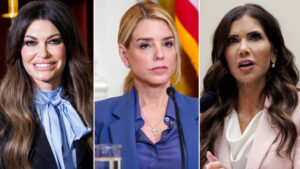
The New York Times has offered a different perspective on developments within the Trump administration following the controversy that led to Kimberly Guilfoyle being removed as US ambassador to Greece, with the decision announced live on air.
In its report, the newspaper identifies what it describes as a broader pattern in US President Donald Trump’s personnel decisions: the overwhelming majority of high-profile figures who have left his administration, whether voluntarily or involuntarily, have been women.
According to the New York Times, even before Guilfoyle’s dismissal, four of the eight women holding Cabinet-level positions in the Trump administration had resigned or been removed within just three months: Attorney General Pam Bondi, Labour Secretary Lori Chavez-DeRemer, Homeland Security Secretary Kristi Noem and Director of National Intelligence Tulsi Gabbard.
All four were replaced by men, noted Erika Green, the newspaper’s White House correspondent and author of the report.
The men who kept their jobs
The newspaper contrasts these departures with the treatment of male members of the administration who have also faced controversies and allegations that have embarrassed the White House.
FBI Director Kash Patel, for example, has faced questions over his conduct, including allegations of excessive alcohol consumption, assigning a SWAT team to protect his girlfriend and using government aircraft for personal travel. Patel has denied the allegations.
Another example cited by the New York Times is Commerce Secretary Howard Lutnick, who appeared in files released by the Justice Department as one of the visitors to the private island owned by Jeffrey Epstein.
A third case involves US Defence Secretary Pete Hegseth, who disclosed classified military operational plans in a conversation on a private messaging app. Jeffrey Goldberg, editor-in-chief of The Atlantic, had accidentally been included in the group chat.
In that instance, Trump dismissed National Security Adviser Mike Waltz, who had added the journalist to the conversation. However, Waltz was subsequently appointed US ambassador to the United Nations, a position Trump had previously promised to his longstanding congressional ally Elise Stefanik.
Stefanik, who describes herself as an “ultra-MAGA warrior”, was ultimately left in political limbo and eventually departed Congress, the New York Times notes.
“I have never seen a situation in which all the initial Cabinet departures were people of the same gender — all women,” said Kathryn Dunn Tenpas, a non-resident scholar at the Brookings Institution who has tracked diversity in presidential administrations since Ronald Reagan’s presidency.
Responding to the New York Times report, White House spokeswoman Taylor Rogers said: “President Trump has assembled the best administration in history, selecting every member of his exceptional team based on one criterion alone: their ability to deliver results for the American people. Unlike Democrats, who are obsessed with identity politics, the president judges people on their merit and qualifications.”
Just four women remain
Speaking at an event marking Women’s History Month in 2025, Trump said he was particularly pleased to announce that his administration had more women serving in the Cabinet than any previous Republican president in US history.
Today, however, only four female Cabinet members remain. According to the New York Times, in many cases the women who departed appear to have failed some form of loyalty test imposed by Trump.
Bondi faced intense criticism over her handling of the release of the Epstein files and for failing to meet Trump’s demands for retaliation against his political opponents. The president was also dissatisfied with her performances at congressional hearings and during television appearances.
Noem’s testimony before Congress also appears to have been a catalyst for her dismissal, particularly her statement that Trump had approved government advertising campaigns worth tens of millions of dollars in which she featured prominently. The US president denied having authorised the campaigns.
Gabbard resigned to care for her ill husband. However, her announcement came amid strained relations with the White House and after she refused to testify before Congress that Iran posed an imminent threat, as Trump had claimed in justifying the war against the country.
Trump had notably described Gabbard as being “more cautious on this issue” than he was.
Chavez-DeRemer resigned amid allegations of a toxic and dysfunctional environment within her department, as well as claims that she had seriously abused her position by maintaining an inappropriate relationship with an employee and using public resources for personal purposes.
May Mailman, director of the Independent Women’s Law Center and a former senior White House official who served in both Trump administrations, nevertheless argued that many powerful women continue to hold influential positions.
She pointed to White House Chief of Staff Susie Wiles, Erika Schwartz, who was recently confirmed by the Senate to lead the Centers for Disease Control and Prevention (CDC), and Harmeet Dhillon, who heads the Justice Department’s Civil Rights Division.
“There is no loneliness for the conservative woman in the Trump administration,” Mailman said. “There is only empowerment. You are an essential member of the team because of who you are, not because of your gender.”
Ask me anything
Explore related questions




