





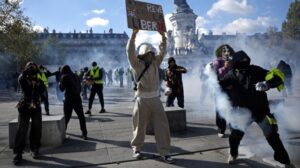
Clashes between rioters and police have broken out in Paris and other French cities during protests against the rising cost of living and falling purchasing power.
Police made extensive use of tear gas and had arrested 166 people by midday, while rioters also stormed the lobby of Marseille’s city hall after smashing their way through the entrance.
Tensions flared around midday in Paris’s central Place de la République, before a major demonstration was scheduled to begin at 2pm local time (3pm in Greece).
According to journalists from Agence France-Presse (AFP), police repeatedly fired tear gas at several hundred rioters, most of whom were wearing masks and dressed in black. Some set off fireworks.
166 arrests and 140 demonstrations by midday
According to sources close to Interior Minister Laurent Nuñez, authorities had recorded 140 demonstrations involving 32,800 people outside the Paris region by midday, while the nationwide arrest total had reached 166.
Dozens of arrests were made in Paris from the early morning, where police maintained a particularly heavy presence, especially around prominent landmarks such as the Champs-Élysées and the Arc de Triomphe.
According to Paris police, around 100 rioters attacked the headquarters of television channel CNews, which is owned by the media group of conservative billionaire Vincent Bolloré, throwing objects at the building’s windows.
Authorities announced 21 arrests in connection with that incident. A further 40 people were detained in the capital, mainly for possessing protective equipment or prohibited weapons.
Demonstrations had been banned across large parts of Paris.
Clashes in Marseille, tear gas in Lyon
Clashes also broke out in Marseille, where rioters threw objects at police, who responded with tear gas. A local police station in the city was also targeted by them.
Earlier, the city’s central Prado Avenue had been temporarily blocked using rubbish bins and scooters before police dispersed those gathered there.
In Marseille’s Old Port area, dozens of rioters stormed the lobby of the city hall, first smashing the entrance and chanting: “Revolution! We’re taking the Bastille!” They remained inside for a short time before police removed them.
In Lyon, police used tear gas to disperse around 300 people gathered outside a university, according to AFP.
Meanwhile, around 40 people attempted to block traffic on a bridge in the city, while other rioters tried to gather near an oil refinery, according to the local prefecture.
In Toulouse, police intervened to prevent blockades affecting railway services and a roundabout.
In Rennes, Brittany, around 20 people erected an improvised barricade using rubbish bins near a large shopping center.
In Rouen, Normandy, a university building was damaged by a fire that broke out early in the morning and was probably caused by arson, according to a source close to the investigation.
However, AFP journalists reported that several blockades announced in advance did not materialise, including at the toll station on the Île de Ré bridge on the Atlantic coast and in Bordeaux.
Yellow Vests return to the streets
The main demand behind Saturday’s demonstrations is action to tackle the rising cost of living, at a time when higher fuel prices and declining purchasing power are fuelling public discontent across France.
The return of supporters of the Yellow Vests movement is also a central feature of the protests. The movement sparked major social unrest in 2018 and 2019, during Emmanuel Macron’s first presidential term.
Initially triggered by increases in fuel taxes, the Yellow Vests staged widespread demonstrations, some of which descended into serious violence, particularly along the Champs-Élysées.
The latest call for protests includes plans to block roundabouts and strategic locations. It also coincides with demonstrations by secondary school and university students, which have been taking place since mid-September to demand better conditions for education.
Around 1,500 actions, demonstrations or blockades had been announced nationwide for Saturday. According to sources within the Interior Ministry, authorities expected around 500 planned actions and more than 90 scheduled demonstrations.
Before the protests began, a police source estimated that around 150,000 people could take part outside the Paris metropolitan area, with a further 40,000 expected in the capital.
However, the actual scale of the demonstrations remained difficult to predict, as the protests coincided with the start of the school holidays.
Macron appeals for calm
French President Emmanuel Macron appealed for calm on Friday while speaking in Brussels, stressing that the right to demonstrate must be exercised with respect and without insults or vandalism.
Saturday’s protests come after weeks of social unrest during which demonstrators and police officers have suffered serious injuries.
Prime Minister Sébastien Lecornu said that more than 900 police officers had been injured during demonstrations in recent weeks.
Political tensions six months before presidential elections
The demonstrations are taking place around six months before France’s presidential election, amid heightened social and political tensions and as the radical-left France Unbowed (LFI) party is fuelling the protests.
Meanwhile, Jérôme Rodrigues, one of the best-known figures associated with the Yellow Vests movement, argued that the demonstrations must continue. Rodrigues lost an eye during a protest in Paris in January 2019.
Trade unions have also called on public- and private-sector workers to take part in a new day of demonstrations and strike action on 5 November.
Ask me anything
Explore related questions




