





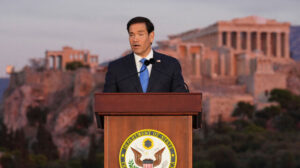
US Secretary of State Marco Rubio has underscored Greece’s strategic importance to the United States, particularly in the energy sector, regional security and NATO, insisting that the change of leadership at the US Embassy in Athens does not signal a downgrading of Greek-American relations.
On the contrary, he stressed that Greece needs an ambassador who has direct access to US President Donald Trump and enjoys his complete confidence.
In an interview with Breitbart News journalist Matthew Boyle, America’s top diplomat spoke at length about the prospects for energy cooperation with Athens, the need to strengthen Europe’s energy independence and the shared historical and cultural heritage of the West.
He also addressed the war in Ukraine, the temporary easing of sanctions on Russian diesel and US military operations against Iran.
“Greece is a very important country and a great ally”
Rubio devoted particular attention to the process of selecting a successor to Kimberly Guilfoyle as US Ambassador to Greece.
He explained that, at the time of the interview, the process was still at an early stage, as identifying a suitable candidate and completing the necessary confirmation procedures would take time.
“Greece is an important country, a very important country. It is a great ally of the United States,” he said, adding that Greece “has helped us in so many ways and is important to our future”.
The US Secretary of State explained that Greece is central to several of Washington’s key priorities, including energy independence, regional stability and the strengthening of NATO. “Greece deserves a strong and good ambassador who has access to the President and his confidence,” he stressed.
Rubio also assured that, until the selection and appointment of a new ambassador had been completed, the US administration would ensure that the embassy had the appropriate team in place to continue its work.
He was particularly keen to dismiss any suggestion that the change of personnel might indicate a weakening of relations between Athens and Washington. “Under no circumstances should any of this be seen as a downgrading of our relationship with Greece. On the contrary, I believe Greece is so important to us that it is essential for the person serving there to have the President’s full support and confidence,” he said.
He explained that the administration’s objective was to appoint an ambassador whose standing would reflect both Greece’s importance and the level of bilateral cooperation.
Greece as an energy hub linking three continents
A significant part of the interview focused on Greece’s prospects in the energy sector, with Rubio highlighting the advantages offered by the country’s geographical location and its political approach to the development of energy resources. “I believe Greece is in a very unique position, both geographically and politically,” he said.
According to Rubio, Greece is open to energy exploration and takes a positive approach to investment in the sector, while he also suggested that such projects enjoy support among the Greek public.
He placed particular emphasis on Greece’s potential to become a hub for energy production and transportation between Europe, Africa and the Middle East.
Rubio explained that developing energy reserves was not enough in itself unless the necessary infrastructure was also available to deliver that energy to markets.
This applies to oil and natural gas as well as electricity, all of which require pipelines, networks and interconnections to reach consumers. “Greece has always been the connecting point between Europe, Africa and the Middle East,” he noted. “Beyond producing energy, it can help move energy northwards into Europe and southwards towards Israel, the Middle East and beyond,” he added.
In Rubio’s assessment, the geographical position that historically enabled Greece to play an important role in trade and economic exchanges now represents a significant competitive advantage in the energy sector.
Criticism of Europe’s energy policies and dependence on Russia
Marco Rubio criticised the energy policies pursued by several European countries in recent years, arguing that the international crisis had exposed their weaknesses.
He pointed out that energy is fundamental to people’s daily lives, industrial activity and countries’ defence capabilities.
In this context, he criticised policies aimed at reducing the use of fossil fuels by making them more expensive, without simultaneously ensuring sufficient development of domestic energy resources.
The US Secretary of State recalled Donald Trump’s warnings during his first presidential term about Germany’s dependence on Russian energy.
He also linked that dependence to Russian President Vladimir Putin’s calculations before Russia’s invasion of Ukraine. “Their dependence on Russian energy is one of the reasons Putin invaded Ukraine, because he thought he could do it, because he believed Europe would do nothing about it,” Rubio argued.
He suggested that European governments were beginning to recognise the consequences of their previous decisions, although reversing policies implemented over approximately two decades would take time.
Rubio also linked the high cost of electricity and transport to the economic stagnation affecting several European economies.
The speech on the Pnyx and the West’s shared cultural heritage
America’s top diplomat also referred to his speech on the Pnyx hill, overlooking the Acropolis, explaining that the message he sought to convey was closely connected to the foreign policy philosophy of the Trump administration.
According to Rubio, the United States and Europe share a common historical trajectory rooted in Greek and Roman civilisation. “We are the heirs. We inherited from Greece and Rome, and ultimately through Europe, many of the values upon which our country is built today,” he said.
He argued that American institutions, political values and social organisation are the product of thousands of years of historical development, and that recognising these origins should not be interpreted as diminishing other civilisations. “Every civilisation should be proud of itself,” Rubio said, expressing the view that the West had adopted an excessively apologetic attitude towards its history and achievements.
He argued that this mindset also influences foreign policy decisions.
Referring to the values and institutions often taken for granted in the United States, from economic prosperity to its system of government, Rubio stressed:
“They come from a shared history that we need to rediscover and embrace. That is what we are doing here in this country under President Trump. We want more Western leaders to do the same.”
The US Secretary of State suggested that this approach was gaining increasing support among foreign leaders, particularly in private conversations.
He acknowledged, however, that publicly embracing such positions and translating them into government policy would take time.
According to Rubio, many politicians remain concerned about reactions from the far left, the media, academia and the established government bureaucracy.
He nevertheless predicted that more political leaders would openly embrace these views in the future, win elections and influence their countries’ approaches to the shared interests of the Western world.
Why Washington eased sanctions on Russian diesel
Turning to the war in Ukraine, Marco Rubio defended the US administration’s decision to temporarily ease sanctions affecting Russian diesel.
He explained that the primary objective was to increase fuel availability on international markets and meet the needs of the American economy.
Rubio acknowledged that the decision could also benefit other countries but made clear that Washington’s overriding consideration was the national interest of the United States.
“If there is a conflict between what is good for them and what is good for us, we must always choose what is good for us,” he stressed.
According to the US Secretary of State, the decision was not intended to benefit Russia or harm Ukraine.
“Not because it is bad for Ukraine or good for Russia, but because it is good and important for America,” he said.
Donetsk, peace negotiations and disagreements between Moscow and Kyiv
Regarding the prospects for a peace agreement, Rubio identified the dispute over control of Donetsk as one of the principal obstacles.
He explained that Moscow is demanding control over the entire region, while Kyiv regards the defensive line maintained by Ukrainian forces there as vital to the country’s future security.
The US Secretary of State reiterated Washington’s willingness to act as a mediator to bring an end to the hostilities, while acknowledging the difficulty of finding a mutually acceptable solution.
“We would like to see the war end, but we also have other priorities around the world that we are focusing on,” he said.
Asked about the possibility of holding elections in Ukraine, Rubio said the issue was important but was not the main reason the conflict continued.
He also referred to Ukrainian attacks on vessels in the Black Sea which, according to him, were carrying oil belonging to American companies.
Rubio expressed Washington’s displeasure over those strikes, although he clarified that he did not believe Ukraine had deliberately intended to target American interests.
At the same time, he emphasised that Donald Trump was also deeply unhappy about Russian missile attacks hitting residential buildings and killing civilians in Kyiv.
Iran: US military operations and the protection of shipping
On Iran, the US Secretary of State argued that American military operations had significantly reduced Tehran’s conventional military capabilities.
In his assessment, the Iranian regime had sought to use those capabilities as a protective shield while developing a nuclear weapon.
Rubio explained that the American military presence in the region was now primarily focused on protecting international shipping through the Strait of Hormuz, while economic sanctions and the blockade against Iran remained in place.
According to figures he presented, an average of between 13 million and 14 million barrels of oil per day had passed through the strait during the ten days preceding the interview.
He said US military forces were escorting commercial vessels and providing protection against possible attacks.
Rubio acknowledged that Iran continued to carry out strikes against ships, but maintained that American operations had enabled a substantial restoration of oil flows to international markets.
He also claimed that, as a result of the blockade, Iran was now the only country unable to transport even a single barrel of oil through the Strait of Hormuz.
“Economic pressure is restricting funding for Hezbollah and Hamas”
America’s top diplomat further argued that economic pressure on Iran was limiting the financial resources available to Tehran, both to fund its armed forces and to support organisations such as Hezbollah and Hamas.
Addressing the wider situation in the Middle East, Rubio described the Iranian regime as a major driver of war and destabilisation across the region.
He acknowledged that the Palestinian issue remained of considerable importance, but argued that confronting Tehran’s influence and activities was a central prerequisite for resolving the broader conflicts affecting the Middle East.
Ask me anything
Explore related questions




